

Cost of Healthy Diet Hits ₦1,513 as Food Affordability Pressure Deepens – NBS

 Nigeria’s healthy-eating bill is rising faster than many household budgets can absorb, with animal-source foods, fruits and vegetables pushing the cost of nutrition beyond the reach of millions.
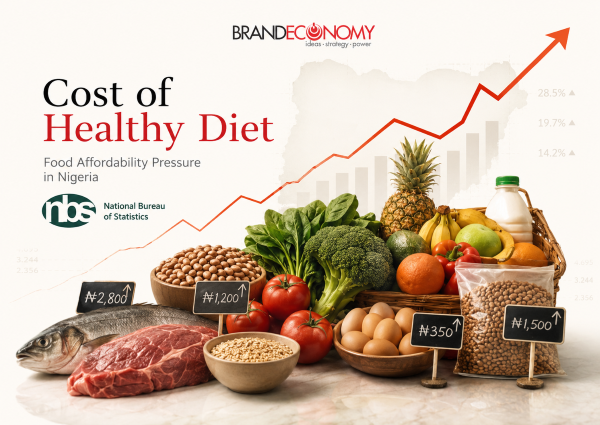 Nigeria’s healthy-eating bill is rising faster than many household budgets can absorb, with animal-source foods, fruits and vegetables pushing the cost of nutrition
 The cost of eating a healthy diet in Nigeria rose to ₦1,513 per adult per day in February 2026, according to the latest Cost of a Healthy Diet report released by the National Bureau of Statistics.
The figure represents a 3.76 percent increase from the ₦1,458 recorded in January 2026, underscoring the stubborn pressure that food prices continue to impose on Nigerian households. More troubling, the February figure was 12.4 percent higher than the ₦1,346 recorded in February 2025, confirming that healthy eating is becoming progressively more expensive even when measured by the least-cost combination of locally available food items.




The NBS defines the Cost of a Healthy Diet as the least expensive mix of foods available locally that meets globally consistent food-based dietary guidelines. It is, in effect, a floor price for nutrition — the minimum daily cost required for an adult to access a healthy diet, excluding transportation and meal preparation.
That qualification is important. The real cost borne by households is often higher once market transport, cooking fuel, storage losses and family size are considered. For many low-income families, therefore, the official cost is not simply a statistic. It is a daily affordability test.
South-East, South-West Record Highest Healthy-Diet Costs
The report showed sharp regional differences in the cost of nutrition.
The South-East recorded the highest average cost at ₦1,889 per adult per day, followed by the South-West at ₦1,786. The North-East recorded the lowest average cost at ₦1,160 per adult per day.
At state level, Ekiti recorded the highest cost at ₦2,075, followed by Imo at ₦2,051 and Abia at ₦1,924. At the other end of the table, Adamawa, Borno and Taraba recorded the lowest costs at ₦979, ₦1,040 and ₦1,102 respectively.
These regional patterns matter because they reveal how food affordability is shaped not only by national inflation, but also by local supply chains, market access, transport costs, food production systems, insecurity, distribution bottlenecks and regional consumption patterns.
A healthy diet may be theoretically available in many markets. The deeper question is whether households can afford it consistently.
Animal-Source Foods Lead the Cost Pressure
The NBS said the food groups driving the year-on-year rise in the cost of a healthy diet were animal-source foods, followed by fruits, oils and fats, and vegetables. By contrast, the cost of starchy staples declined on a year-on-year basis.
Animal-source foods remained the most expensive food group to meet in February. They accounted for 39 per cent of the total cost of a healthy diet while providing only 13 per cent of total calories in the healthy diet basket.
Fruits and vegetables were also expensive when measured by price per calorie. Fruits accounted for 16 per cent of total cost while providing seven per cent of calories. Vegetables accounted for 14 per cent of cost while contributing just five per cent of calories.
By comparison, legumes, nuts and seeds remained the least expensive group on average, accounting for seven per cent of the total cost.
This shows a painful nutrition reality: the foods most important for balanced diets — proteins, fruits and vegetables — are often the least affordable for poorer households. When budgets tighten, families frequently retreat toward cheaper staples that fill the stomach but may not provide adequate nutrition.
Healthy Eating Is Rising Faster Than General Food Pressure
The NBS noted that the Cost of a Healthy Diet has risen faster than general inflation and food inflation, though it cautioned that the CoHD and the food Consumer Price Index are not directly comparable.
The difference is methodological. The CoHD measures the minimum naira cost per adult per day for a healthy diet, using fewer items structured around nutrition requirements. The food CPI, by contrast, is a weighted index that tracks broader food price movements across a larger basket.
Still, the message is clear: nutrition-specific affordability is deteriorating. Nigerians are not merely paying more for food generally; they are paying more for the specific foods required to eat well.
That distinction should matter for policy. Food security is not just about the availability of calories. It is about access to diets that support health, productivity, child development and long-term human capital.
The Household Burden
At ₦1,513 per adult per day, a single adult would require roughly ₦45,390 per month to meet the minimum cost of a healthy diet, excluding transport and cooking costs. For a household with multiple adults and children, the implied monthly food requirement can quickly become unaffordable.
This is where the CoHD becomes a development indicator. It tells policymakers whether the basic economics of nutrition are within reach of ordinary people. If the cost of healthy food rises faster than income, households are forced into difficult compromises: smaller portions, lower dietary diversity, delayed meals, cheaper substitutes or debt.
Over time, those compromises have economic consequences. Poor nutrition weakens learning outcomes, reduces workplace productivity, worsens health risks and increases the burden on households and the public-health system.
A nation cannot build strong human capital on unaffordable nutrition.
Policy Implications: From Food Availability to Diet Affordability
The NBS said the findings should encourage collaboration among policymakers, researchers, civil society actors and food-security stakeholders to design strategies that address access, availability and affordability of healthy diets.
This is the central policy point. Nigeria’s food policy must move beyond the narrow goal of producing more food. It must ask whether the right foods are reaching households at prices they can afford.
That requires action across several fronts:
Agricultural productivity must improve, especially for proteins, fruits and vegetables. Cold-chain systems and storage infrastructure must reduce losses. Transport bottlenecks and insecurity along food corridors must be tackled. Markets must become more efficient. Local food processing must expand. Household incomes must rise. Social protection must be better targeted toward nutrition-sensitive outcomes.
The NBS also noted that future research incorporating income data could help determine the proportion and number of Nigerians unable to afford a healthy diet. That would be a vital next step. Knowing the cost is important; knowing who cannot pay it is essential.
BRANDECONOMY Insight
Nigeria’s Food Crisis Is No Longer Just About Hunger — It Is About the Price of Nutrition
The latest Cost of a Healthy Diet figure should worry policymakers because it shows that the battle for food security is shifting from mere availability to nutritional affordability.
A country may have food in the markets and still have millions of citizens unable to eat properly. That is the danger Nigeria faces. The poor are often not choosing unhealthy diets out of ignorance; they are being priced into them.
The most expensive components of a healthy diet are precisely the foods households need most for balanced nutrition — animal-source proteins, fruits and vegetables. When these become unaffordable, families fall back on cheaper staples. That may reduce hunger in the immediate sense, but it does not solve the deeper nutrition problem.
This is why the CoHD should become a core policy dashboard for government. It connects agriculture, health, inflation, transport, income and human capital in one powerful measure.
The policy challenge is not simply to reduce food inflation in the abstract. It is to make nutritious food affordable for ordinary Nigerians. That means fixing production, logistics, storage, market access, security and incomes together.
If Nigeria wants a productive population, it must first make healthy eating economically possible.