

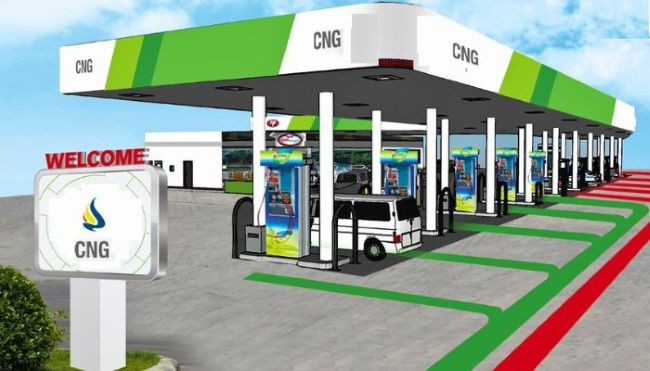
Nearly one year after its celebrated inauguration, the Compressed Natural Gas (CNG) Conversion and Training Centre in Calabar, Cross River State, remains under lock and key — a striking symbol of Nigeria’s slow progress in transitioning from petrol to cleaner, cheaper, and more sustainable fuel alternatives.
The facility, which was commissioned on October 18, 2024, under the Presidential Compressed Natural Gas Initiative (Pi-CNG), was envisioned as a flagship hub for training, retrofitting, and expanding CNG usage across Nigeria’s South-South region. However, a BRANDECONOMY investigation reveals that the centre has yet to commence operations — dashing the hopes of commercial transporters and motorists eager to benefit from the federal government’s post-subsidy energy reform.



A Silent Facility in the Heart of Calabar
Located within Calabar’s bustling city centre, the CNG conversion site remains eerily quiet. Once heralded as a game-changer for energy affordability and clean mobility, it now stands as an emblem of policy inertia and unfulfilled promises.
Commercial driver Mr. Sylvanus Ada, who operates within the Calabar metropolis, expressed deep frustration over the inactivity:
“We were part of the inauguration and were told that vehicle conversion would soon begin. They even mentioned ₦500,000 per vehicle for conversion — expensive but worth it, considering the long-term savings. Yet, since that day, no single car has been converted, and no official has given us updates.”
Similarly, Mr. Jonas Peter, a shuttle driver who plies the Calabar–Ikom–Ogoja route, said he passes by the centre daily, only to find it deserted.
“Every time I drive by, the place looks abandoned. I had my doubts when it was commissioned, and now, it seems I was right,” he lamented.
The frustration among motorists reflects a broader concern — that despite the federal government’s push for a CNG-led mobility transition, implementation has stalled at state level, undermining the programme’s credibility.
CNG: The Promise of a Cheaper, Cleaner Future
The Presidential CNG Initiative (Pi-CNG) was designed to cushion the impact of fuel subsidy removal by providing Nigerians with access to cheaper, locally produced, and environmentally friendly alternatives.
Compressed Natural Gas, derived from Nigeria’s vast natural gas reserves, is 40–60% cheaper than petrol, emits fewer greenhouse gases, and aligns with the country’s Energy Transition Plan and Net Zero 2060 target.
The Calabar CNG Centre facility was intended to:
- Train local technicians in vehicle conversion and CNG maintenance.
- Convert petrol-powered vehicles to dual-fuel systems.
- Serve as a regional hub for research, certification, and safety standards.
Instead, twelve months later, it has yielded none of these outcomes — a costly delay at a time when Nigerians face skyrocketing transport fares and inflation driven by fuel price volatility.
Government Assures Project Is Still on Track
Despite public frustration, the Cross River State Government insists that the CNG initiative has not been abandoned.
Mr. Ekpenyong Cobham, the State Commissioner for Transportation, confirmed that the project’s delay stems from logistical bottlenecks and coordination issues between state authorities and the Presidential CNG Initiative (PCNGI) management.
“Cross River cannot abandon a project as crucial as CNG. Discussions with the Presidential Initiative are ongoing, and we expect a team visit soon to finalise operational rollout,” Cobham assured.
He reaffirmed that the state remains committed to reducing transport costs, leveraging natural gas for economic inclusion, and aligning with the federal roadmap to make Nigeria’s transport sector both affordable and sustainable.
BRANDECONOMY ANALYSIS: A Stalled Transition in the South-South
The Calabar CNG centre’s dormancy offers a cautionary tale about Nigeria’s policy implementation gaps — particularly when ambitious energy reforms fail to translate into functional infrastructure on the ground.
1. Missed Economic and Environmental Gains
Had the Calabar CNG facility been operational, the region could have seen a dramatic reduction in transport costs and emissions. With petrol prices fluctuating above ₦650 per litre, the potential savings from CNG conversion remain a lost opportunity for both consumers and fleet operators.
2. Policy Without Execution
Nigeria’s CNG strategy, though well-intentioned, risks falling into the trap of “inaugurate and abandon.” The lack of follow-through in states like Cross River undermines public confidence and weakens the overall impact of President Bola Tinubu’s Gas-to-Power and Gas-to-Transport agenda.
3. Opportunity for Private Sector Participation
Experts argue that private investors and energy companies should be integrated into the rollout process through public-private partnerships (PPPs), which can fast-track infrastructure delivery, equipment installation, and training programmes.
Countries like India and Pakistan achieved large-scale CNG adoption only after private enterprises were incentivised to participate in conversion and distribution.
4. Regional Equity in Energy Transition
The South-South — home to much of Nigeria’s natural gas — must not be left behind in benefitting from the gas revolution. An inactive CNG centre in a resource-rich region sends mixed signals about policy coherence and governance efficiency.
The Way Forward: From Inauguration to Implementation
To revive public trust and momentum, experts recommend:
- Immediate activation of the Calabar facility with technical staff and equipment.
- Subsidised conversion schemes or soft loans for commercial drivers.
- Awareness campaigns to educate motorists on CNG’s cost and safety benefits.
- Private sector-led expansion of additional conversion centres across southern Nigeria.
A revitalised CNG programme could cut transport costs by up to 50%, boost employment in gas servicing and logistics, and drive Nigeria closer to its clean energy transition goals.
The Bottom Line
The Calabar CNG conversion centre, once a symbol of hope for affordable transport and cleaner energy, now stands as a mirror to Nigeria’s policy paralysis.
As global energy markets shift toward decarbonisation, Nigeria cannot afford to stall on domestic gas utilisation. The blue flame of CNG must not flicker out in bureaucracy — it must be reignited by urgency, coordination, and a renewed political will.
The true measure of the Presidential CNG Initiative will not be in ribbon-cuttings, but in refilled cylinders, converted engines, and reduced transport fares for ordinary Nigerians.