Kano Hosts AfCFTA Pilot as Nigeria Targets $3.4trn African Market

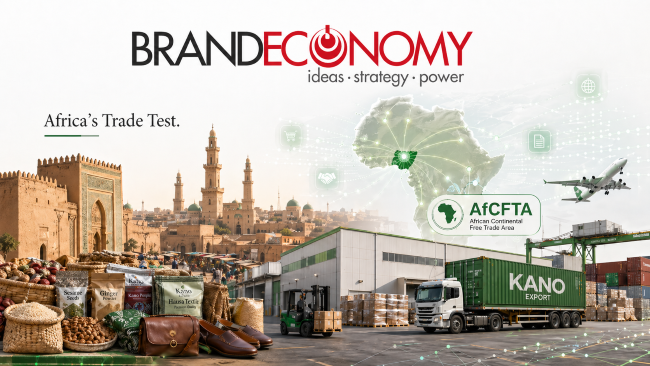 Nigeria is attempting to turn the African Continental Free Trade Area from a high-level policy commitment into a practical export engine. At the AfCFTA P3 Sub-national Engagement for the North-West in Kano, the Federal Government laid out a strategy focused on value-added exports, MSME participation, digital trade, cheaper logistics and subnational implementation—an acknowledgement that continental trade will only work when market women, processors, manufacturers, logistics operators and state governments can use it.
From Agreement to Marketplace
Nigeria’s AfCFTA journey is entering a more practical phase.




At the AfCFTA Public, Private and Press Sub-national Engagement for the North-West geopolitical zone in Kano, the Minister of Industry, Trade and Investment, Dr Jumoke Oduwole, reaffirmed Nigeria’s commitment to using the African Continental Free Trade Area to expand value-added exports, deepen intra-African trade and strengthen the country’s place in regional value chains.
Her message was clear: AfCFTA must no longer remain an elite trade-policy conversation conducted in Abuja, Addis Ababa or Accra. It must become a working commercial instrument for exporters, manufacturers, small businesses, women-led enterprises, informal traders and state-level economic actors.
That is why Kano was symbolically important. Long before modern trade agreements, Kano stood as one of West Africa’s great commercial arteries—linking goods, people, livestock, textiles, leather, grains and enterprise across the Sahel, North Africa and the Gulf of Guinea. To launch a practical AfCFTA engagement in Kano is to remind Nigeria that continental trade is not new. What is new is the need to formalise, scale and modernise it.
Nigeria’s Strategic Bet on AfCFTA
Oduwole described Nigeria’s participation in AfCFTA as both strategic and imperative. Since ratifying the agreement in 2020, Nigeria has recorded several milestones, including the inauguration of the AfCFTA Central Coordination Committee, the gazetting of tariff concessions and the country’s designation as co-champion of Digital Trade.
She also highlighted the launch of an Export Air Cargo Corridor to East and Southern Africa, which she said has reduced logistics costs by up to 75 per cent. In a country where transport and logistics costs often weaken export competitiveness before goods reach the buyer, this is not a minor detail. It goes to the heart of Nigeria’s non-oil export problem.
For years, Nigeria has produced commodities, talent and enterprise, but too often failed to convert them into globally competitive value-added exports. AfCFTA offers an opportunity to correct that weakness—if the country can build the systems required to move goods efficiently, certify products quickly, finance exporters properly and connect suppliers to buyers across the continent.
The Value-Added Imperative
The minister’s central argument was that Nigeria must shift from exporting raw commodities to exporting value-added goods and services.
This is the heart of the AfCFTA opportunity.
Africa’s intra-continental trade remains too low. Oduwole noted that intra-African trade accounts for less than 20 per cent of Africa’s total trade, compared with over 60 per cent in Europe and Asia. That comparison is uncomfortable but instructive. Europe and Asia trade heavily with themselves because they have built integrated production networks, logistics corridors, standards systems, industrial clusters and market access frameworks.
Africa has not yet done this at scale.
Nigeria’s opportunity is therefore twofold. First, it can increase exports into African markets. Second, and more importantly, it can move up the value chain. Instead of exporting sesame seeds, it can export processed food products. Instead of raw hides and skins, finished leather goods. Instead of unprocessed agricultural output, packaged consumer products. Instead of informal services, digitally enabled professional and creative exports.
AfCFTA will not reward countries that merely produce. It will reward countries that organise production.
The Kano Shift: From Awareness to Implementation
The Kano engagement was designed to move AfCFTA from policy awareness to practical implementation. Oduwole said the initiatives include the “One Local Government, One Export Product” scheme, on-site regulatory services for exporters and live simulations of export procedures.
This is a significant shift in approach.
Many Nigerian businesses do not fail because there is no demand. They fail because they do not understand export documentation, product standards, certification, customs processes, packaging requirements, payment systems, logistics options or buyer expectations.
The P3 framework—bringing together the public sector, private sector and press—is designed to simplify AfCFTA processes, localise information and deliver practical support directly to exporters.
The inclusion of the press is particularly important. Trade policy fails when information remains trapped in official documents. If MSMEs, cooperatives, women-led enterprises, manufacturers and informal operators are to benefit, the message must be translated into local languages, local examples and practical step-by-step guidance.
Why Subnational Implementation Matters
The Permanent Secretary of the Ministry of Industry, Trade and Investment, Dr Chris Osa, commended the Kano State Government for hosting the initiative and acknowledged the participation of governors and delegates from Jigawa, Kaduna, Katsina, Kebbi, Sokoto and Zamfara.
That regional participation matters because trade does not happen only at federal ministries. It happens in factories, farms, markets, warehouses, borders, airports, roads, industrial parks and local government areas.
Nigeria’s export future will depend heavily on the states. Each state must understand what it can produce competitively, what markets it can serve, what infrastructure it needs and what standards its producers must meet. Federal policy can open the door, but states must organise the supply base.
For the North-West, the possibilities are wide: leather, textiles, grains, livestock value chains, agro-processing, solid minerals, logistics, creative industries and cross-border commerce. But potential alone is not strategy. The region must now convert commercial heritage into export readiness.
AfCFTA as a $3.4 Trillion Opportunity
The National Coordinator of the AfCFTA Coordination Office, Mrs Patience Okala, reinforced the scale of the opportunity. She noted that AfCFTA gives Nigerian enterprises—from large corporations to small traders—access to a $3.4 trillion market of 1.4 billion people.
Those numbers are often repeated in AfCFTA conversations, but they require context. A large market does not automatically become an accessible market. Businesses must still meet standards, compete on price, navigate rules of origin, understand payment systems, manage logistics and build distribution relationships.
Okala said the Kano engagement was designed to handhold businesses through AfCFTA processes, simplify trade procedures and connect Nigerian suppliers with buyers across Africa. She also announced the unveiling of AfCFTA simplification tools, including “The ABC Series of Doing Business under AfCFTA”, published in English, Hausa and Arabic.
That localisation is vital. AfCFTA will not succeed in Nigeria if it speaks only the language of policy experts. It must speak the language of traders, processors, exporters, truckers, chambers of commerce, cooperatives and SMEs.
Kano as Gateway, Not Just Host
Kano State Governor Abba Kabir-Yusuf, represented by the Secretary to the State Government, Alhaji Umar Farouk-Ibrahim, described Kano as Africa’s historic commercial hub and a natural gateway for continental trade.
His statement that “AfCFTA must work for the trader in our markets, the processor in our industries and the youth in our ICT hubs” captured the real test of the agreement.
For AfCFTA to matter, it must reach three groups.
It must reach the market trader, who needs simplified procedures, trusted logistics and access to cross-border demand.
It must reach the industrial processor, who needs standards, finance, power, packaging, certification and market intelligence.
It must reach the youth in ICT hubs, who can export digital services, build trade platforms, create logistics tools, design payment solutions and help Nigerian businesses access African buyers.
Kano’s role should therefore not be ceremonial. It can become a model for how old commercial cities reinvent themselves as modern trade, logistics and industrial hubs.
BRANDECONOMY Insight
Nigeria’s AfCFTA opportunity is enormous, but it will not be realised by speeches, signatures or continental optimism alone.
The real challenge is execution.
Nigeria must decide whether it wants to remain a large market that imports ambition or become a productive market that exports value. AfCFTA gives the country a framework, but frameworks do not move goods. Roads do. Standards do. Finance does. Ports do. Airports do. Customs efficiency does. Digital platforms do. State-level industrial strategy does.
The Kano engagement is important because it recognises that AfCFTA must be domesticated. It must move from policy rooms into markets, factories, warehouses, farms and local governments. The “One Local Government, One Export Product” scheme is promising because it forces each locality to ask a practical question: what can we produce, process and sell competitively to Africa?
But Nigeria must be honest. The country cannot win under AfCFTA by exporting the same raw commodities in the same old way. It must build processing capacity, improve packaging, certify products, protect brands, reduce logistics costs and ensure exporters understand rules of origin.
The Export Air Cargo Corridor to East and Southern Africa is a step in the right direction because logistics is one of the most punishing hidden taxes on Nigerian exports. If that corridor truly reduces costs by up to 75 per cent, it can improve competitiveness for high-value, time-sensitive goods. But air cargo alone is not enough. Nigeria also needs road corridors, rail links, inland dry ports, efficient seaports and digital trade documentation.
AfCFTA also presents a deeper development opportunity. If properly implemented, it can help Nigeria move from oil dependence to productive diversification. It can create jobs in agro-processing, manufacturing, logistics, packaging, ICT, professional services, fashion, leather, pharmaceuticals, entertainment and creative exports.
For the North-West, the moment is especially significant. Kano, Kaduna, Katsina, Jigawa, Kebbi, Sokoto and Zamfara can become powerful contributors to Nigeria’s export economy if their agricultural, leather, textile, livestock and trade assets are organised into competitive value chains.
The future of African trade will belong not to the countries with the loudest policy declarations, but to those that help businesses cross borders easily, meet standards consistently and deliver value competitively.
Nigeria has the market size. It has entrepreneurial energy. It has strategic geography. What it now needs is disciplined implementation.
AfCFTA is not just an agreement. It is a test of whether Nigeria can finally convert scale into export power.
Strategic Takeaways
For government:
AfCFTA implementation must be decentralised through states, local governments, export desks, simplified procedures and stronger infrastructure.
For exporters:
The future lies in value-added products, proper documentation, standards compliance, packaging, branding and reliable logistics.
For MSMEs:
AfCFTA can open continental markets, but small businesses need handholding, finance, certification support and buyer connections.
For state governments:
Each state must identify export-ready products, build value chains and support businesses with practical trade facilitation.
For investors:
Opportunities exist in logistics, processing, warehousing, certification, packaging, digital trade platforms and cross-border payments.