

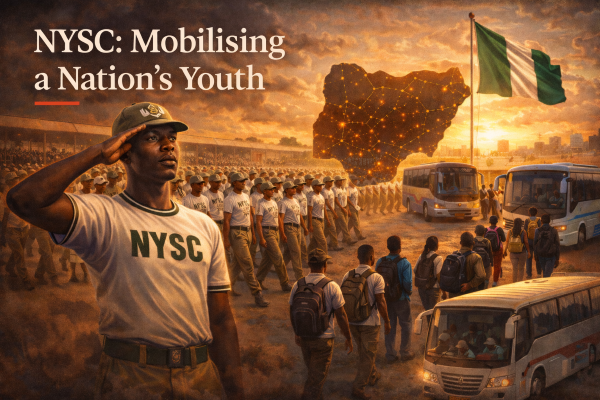
 Nigeria’s annual cycle of youth mobilisation has entered a new phase. The National Youth Service Corps has released the timetable for the 2026 Batch ‘A’ Stream II orientation programme—setting in motion the three-week exercise that remains one of the country’s most enduring instruments of social integration.
According to the scheme’s official communication, registration and reception of prospective corps members will begin on April 22 and conclude on April 24, the same day scheduled for the swearing-in ceremony across all orientation camps nationwide. The programme will run until May 12, after which participants will disperse to their places of primary assignment.



A National Ritual with Economic Undertones
Beyond its ceremonial elements, the NYSC orientation exercise is a logistical undertaking of considerable scale—mobilising thousands of graduates across 36 states and the Federal Capital Territory.
Each year, the programme stimulates short-term economic activity: transport services, hospitality, food supply chains and local commerce within host communities. In this sense, NYSC is not merely a social initiative; it is a seasonal economic catalyst.
More fundamentally, it represents an institutional bridge—connecting education to labour markets, and academic learning to practical engagement.
Safety as Policy Priority
This year’s timetable is accompanied by a renewed emphasis on travel safety—a reflection of broader national concerns around road security.
Participants have been advised to avoid night journeys, with a clear directive to halt travel by 6:00 p.m. and resume the following morning. The guidance, while routine, signals a deeper institutional awareness: that safe mobilisation is as critical as successful deployment.
In a country where inter-state movement remains uneven in terms of infrastructure and security, such advisories are increasingly central to programme execution.
Integration in a Fragmented Landscape
Established in 1973, NYSC was conceived as a unifying mechanism in the aftermath of national conflict—designed to foster cross-cultural understanding by deploying graduates outside their states of origin.
Half a century on, that objective retains relevance. In a nation marked by ethnic, regional and socio-economic diversity, the programme continues to serve as one of the few structured avenues for national integration at scale.
Yet, its evolution is ongoing. Questions around relevance, skill alignment and economic impact persist—particularly as Nigeria’s youth population expands and labour market demands shift.
Preparing for the Next Phase
For prospective corps members, the orientation camp remains an initiation—introducing them to discipline, civic responsibility and national service.
For policymakers, it is an opportunity: to rethink how NYSC can better align with contemporary development priorities—skills acquisition, entrepreneurship and digital economy participation.
BRANDECONOMY Insight
- NYSC as a Development Platform
Beyond unity, the scheme is a potential engine for skills development, workforce readiness and youth productivity—if strategically retooled. - Safety Advisory Reflects Structural Realities
The emphasis on avoiding night travel highlights persistent infrastructure and security gaps that continue to shape mobility in Nigeria. - Economic Ripple Effects Are Underrated
Orientation exercises generate temporary but significant economic activity across host states—supporting SMEs and local supply chains. - Time for Curriculum Evolution
To remain relevant, NYSC must deepen its focus on digital skills, entrepreneurship and sector-specific training aligned with Nigeria’s economic future. - Integration vs Employability Debate
While national unity remains vital, the programme’s long-term value will increasingly be judged by its contribution to employability and economic inclusion.