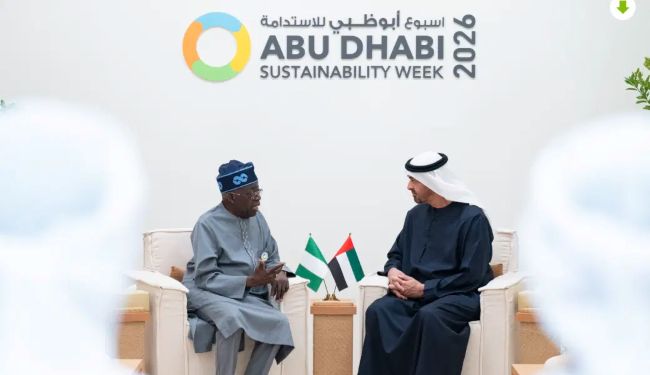
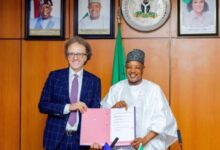
Nigeria and the United Arab Emirates have signed a landmark Comprehensive Economic Partnership Agreement (CEPA) that dramatically resets bilateral trade, unlocks duty-free access for thousands of Nigerian products, and positions Lagos as a new global investment convening hub.
President Bola Tinubu announced that Nigeria will co-host Investopia with the UAE in Lagos in February, a high-level investment forum designed to convert global interest into bankable commitments. The announcement was made on the sidelines of the Abu Dhabi Sustainability Week, immediately after the conclusion of the CEPA with the UAE.
A Strategic Trade Reset, Not a Symbolic Deal
Describing the Nigeria-UAE agreement as historic and strategic, Tinubu said the CEPA deepens cooperation across renewable energy, infrastructure, aviation, logistics, agriculture and digital trade—sectors critical to Nigeria’s diversification drive. He noted that the partnership is calibrated to deliver tangible outcomes: scalable capital inflows, technology transfer and industrial capacity, not headline diplomacy.
“We warmly invite our partners to help build sustainable and shared prosperity for Nigeria, Africa and the world,” said Bola Tinubu.
Nigeria, he added, is targeting up to $30 billion annually in climate and green industrial finance, underpinned by reforms that balance industrialisation with decarbonisation—an increasingly central challenge for Global South economies.
Power, Carbon Markets and Blended Finance
Tinubu underscored electricity as the foundation of every modern economy, pointing to reforms under the Electricity Act 2023 that enable decentralised power for underserved communities. He highlighted a $500 million renewable energy fund backed by the Nigeria Sovereign Investment Authority, alongside a $750 million World Bank-supported programme to expand clean power access to 17.5 million Nigerians.
To attract long-term capital, Nigeria has launched a National Carbon Registry and activated a Carbon Market Policy to enhance transparency and investor confidence, while calling for global finance reforms that shift from rigid sovereign guarantees to blended-finance and first-loss capital mechanisms.
Duty-Free Access for Over 7,000 Nigerian Products
Nigeria’s Minister of Industry, Trade and Investment, Jumoke Oduwole, detailed the commercial substance of the CEPA, describing it as a deal negotiated squarely for Nigerian businesses.
“Today marks a historic milestone in Nigeria’s trade relations,” said Jumoke Oduwole. “This agreement will transform economic ties and deliver tangible benefits for Nigerian businesses, professionals and workers.”
Under the pact, the UAE will immediately eliminate tariffs on more than 7,000 Nigerian products, including fish and seafood, oil seeds, cereals, cotton, pharmaceuticals and chemicals. Tariffs on machinery, vehicles, electrical equipment, apparel and furniture will be phased out within three to five years—opening a competitive pathway into one of the world’s most connected trading hubs.
Business Mobility and Investment Clarity
Beyond goods, the CEPA liberalises services and investment. Nigerian firms can now establish entities, branches and subsidiaries in the UAE, while business visitors gain up to 90 days’ annual stay, and executives and specialists can relocate for renewable three-year periods.
Oduwole said the agreement removes long-standing barriers to foreign direct investment by providing clarity, predictability and legal protection—key factors for institutional capital.
“UAE investors now have clarity and confidence to invest in Nigeria’s productive sectors,” she said.
Nigeria’s Commitments: Inputs, Not Imports
On Nigeria’s side, tariffs will be eliminated on about 6,000 products, with 60 per cent removed immediately and others phased over five years. Crucially, these imports focus on industrial inputs, capital goods and machinery to strengthen local production. Nigeria’s import prohibition list remains intact, preserving policy space for domestic industry.
Services commitments span 99 services across 10 sectors, including finance, transport, construction, health and tourism—aligning the CEPA with Nigeria’s obligations under the World Trade Organization, African Continental Free Trade Area and Economic Community of West African States.
Lagos as a Global Investment Gateway
With Investopia set for Lagos, Nigeria is positioning itself as a gateway for investors seeking access to Africa’s 1.4-billion-person AfCFTA market. Strong UAE participation in infrastructure financing—including the Lagos–Calabar Coastal Road—signals early traction.
Tinubu said reforms have already delivered 21 per cent growth in non-oil exports, with more than $50 billion in investment commitments across key sectors, including lithium and critical minerals—areas where Nigeria is insisting on local value addition.
“We are ready to work with partners across the world to ensure that the next era of development is not only green and inclusive, but just and enduring,” Tinubu said.