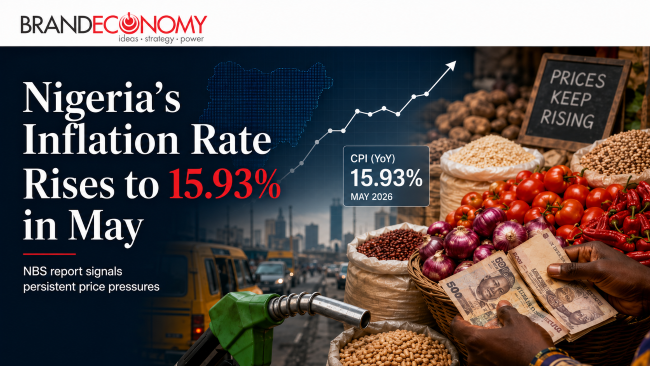
Nigeria’s Inflation Rate Rises to 15.93% in May as Food, Transport and Services Keep Pressure on Households
Food inflation remained heavy at 16.96%

 Nigeria’s inflation story in May is more complicated than the headline number suggests.
The latest Consumer Price Index report from the National Bureau of Statistics puts headline inflation at 15.93% in May 2026, up from 15.69% in April. On the surface, that is a modest acceleration. But month-on-month inflation slowed to 1.75% from 2.13% in April, which means prices were still rising, only at a slower monthly pace than they were a month earlier.




That duality matters. It tells us Nigeria is no longer in the same inflation emergency mood of late 2024 and early 2025, but it also shows clearly that the country is not yet in an affordability recovery. Prices are still moving higher. Households are still under pressure. Businesses are still repricing. And policymakers are still trapped between the need to support growth and the obligation to preserve disinflation credibility.
This is what makes the May print important: it is not just an inflation number. It is a signal about the quality of Nigeria’s recovery.
The May print is warmer than it looks
A closer reading of the May data shows an economy where inflation pressures are becoming more selective, more stubborn, and more urban.
Food inflation remained heavy at 16.96% year-on-year, while core inflation, which strips out volatile farm produce and energy, stood at 16.82%. That combination is important. It means inflation is no longer being driven only by farm-gate volatility or fuel shocks. Broader underlying price pressure is still present.
The details deepen the point.
Food and non-alcoholic beverages remained the single biggest contributor to headline inflation, contributing 6.38 percentage points. But the next major contributors were restaurants and accommodation services at 2.06 percentage points and transport at 1.70 percentage points. In other words, inflation is no longer just a market-stall story. It is increasingly a services, mobility, and urban-living story.
The month-on-month sub-indexes reinforce that interpretation. Energy inflation slowed sharply. Farm-produce inflation also eased. Goods inflation moderated. Imported food inflation softened. But services inflation accelerated month-on-month to 2.48% from 2.1% in April. That is the kind of shift central banks watch closely because services inflation tends to be stickier and harder to reverse.
The urban-rural split also tells a revealing story. Urban inflation on a monthly basis rose to 1.99%, slightly above April’s 1.86%, while rural month-on-month inflation dropped sharply to 1.17% from 2.80%. That suggests that city-based consumers are still absorbing stronger pressure from transport, hospitality, rent-linked services, and other non-tradable costs, even as some rural and farm-related pressures cool.
The state-level picture confirms that inflation is no longer moving as one national wave. On a year-on-year basis, Yobe, Anambra, and Sokoto recorded the highest all-items inflation, while Niger, Plateau, and Edo posted the slowest rises. On a month-on-month basis, Benue, Bayelsa, and Borno saw the sharpest monthly increases, indicating that local logistics, security conditions, climate effects, and market disruptions are still producing highly uneven price outcomes across the federation.
This all matters because inflation in Nigeria is increasingly becoming a multi-speed economic problem: food remains painful, services are sticky, transport is expensive, and geography now matters even more than before.
There is another technical caution here. Nigeria’s inflation series has been going through methodological reform. The NBS rebased the CPI to reflect newer consumption patterns and later shifted to a 12-month reference period for 2024 after warning that a single-month reference would create an artificial distortion in December 2025. That means year-on-year comparisons must be read carefully. The lower-looking annual rates compared with 2025 do not automatically mean households are experiencing proportionate relief.
Why Nigerians still do not feel relief
For ordinary households, inflation is not about year-on-year graphs. It is about whether salary still reaches the third week of the month, whether transport fares are manageable, whether school runs cost more, and whether proteins, grains, pepper, and cooking staples are becoming luxury items.
That is why the May number, despite being dramatically lower than the eye-watering figures recorded a year earlier, is not likely to feel reassuring to most families.
The CPI index itself rose to 140.7 in May from 138.3 in April. That means the aggregate price level continued to climb. Inflation may be lower than it was during the peak shock period, but the cost base of living remains materially elevated.
This is exactly the disconnect global institutions and market observers have been warning about. The World Bank said in 2025 that the cost of a basic food basket in Nigeria had risen fivefold since 2019, with poor households spending as much as 70% of income on food. It made the point bluntly: food inflation is the harshest burden on poor Nigerians.
The humanitarian backdrop is even more sobering. The United Nations warned in January that nearly 35 million Nigerians could face hunger in 2026, including around 3 million children at risk of severe malnutrition. Conflict-affected northeastern states were identified as particularly vulnerable. AP separately reported that the World Food Programme expected northern Nigeria to face its worst hunger conditions in years, driven by violence, displacement, and the inability of farmers to access land safely.
So while annual inflation in May is far below the levels associated with the worst phase of the crisis, the lived economy still feels brutal. In practical terms, this is disinflation without comfort.
What is driving inflation now
The main inflation engine in Nigeria has not disappeared. It has simply evolved.
Food remains the largest driver. The NBS highlighted price movements in everyday essentials such as onions, maize, egusi, yam, cassava flour, crayfish, fresh pepper, tomatoes, ginger, plantain, wheat grain, and cowpea. These are not luxury products. They are the architecture of daily Nigerian consumption. When they move, everything from household food budgets to restaurant menu prices shifts with them.
Transport remains the second major pressure channel because Nigeria’s inflation transmission is still heavily dependent on fuel and logistics. Reuters reported in April that the Middle East conflict had pushed domestic fuel prices sharply higher, with petrol up more than 50% and diesel up more than 70%, adding pressure to transport, manufacturing, and small business costs. That shock helped reverse what had been an improving disinflation trend earlier in the year.
This is why the May report’s combination of softer energy month-on-month inflation and firmer services inflation is so important. It suggests the first-round fuel shock may have eased somewhat, but the second-round pass-through into transport, dining, accommodation, distribution, and urban services is still unfolding.
There is a partial reason for cautious optimism. Reuters reported today that oil prices fell sharply after a peace deal to reopen the Strait of Hormuz, with Brent dropping to around $82.95 a barrel. If that move proves durable, it could help reduce imported energy pressure and provide some relief to later inflation prints. But pass-through is rarely immediate in Nigeria, and markets often lag global price turns.
Another driver is structural: insecurity and weak food-system productivity. The Financial Times recently highlighted how insecurity in rural Nigeria has weakened smallholder output and shifted demand toward large, better-capitalized food companies that can manage imports, refining, and logistics at scale. That is commercially rational, but it also shows how fragile local supply remains.
In short, Nigeria’s inflation problem is now a layered one: food remains dominant, fuel and transport still transmit shocks quickly, services inflation is turning sticky, and insecurity continues to distort supply.
The policy dilemma for Abuja and the CBN
The Central Bank of Nigeria began easing modestly in February, cutting the Monetary Policy Rate by 50 basis points to 26.50% after inflation had been cooling for months. Governor Olayemi Cardoso said the decision reflected a balanced reading of risks, while Reuters noted that the policy stance remained restrictive despite the cut.
The May numbers complicate that easing story.
On one hand, month-on-month headline inflation slowed, and energy and farm-produce indicators improved. On the other hand, headline inflation edged up year-on-year, core inflation momentum strengthened month-on-month, and services inflation became more pronounced. That is not an easy platform for aggressive rate cuts.
The World Bank has already signaled what it thinks Nigeria should do: save windfalls from stronger oil prices, keep monetary policy tight, and avoid broad subsidy reversals that would undermine reform credibility. It also warned that while business activity remained in expansion territory, higher inflation still threatened incomes and poverty reduction.
Fiscal policy is trying a different tool. Reuters reported that the government plans to cut import duties from July 1, 2026 on goods including rice, sugar, palm oil, passenger vehicles, and construction materials, while exempting electric vehicles, mass-transit buses, and manufacturing machinery. The stated goal is to lower household costs and input prices.
That could help at the margin, especially for food processors, import-dependent manufacturers, transport fleets, and construction-linked sectors. But tariff relief alone cannot solve inflation if logistics remain broken, local supply remains insecure, and service-sector costs keep rising.
The true policy challenge is therefore not whether to choose between tightening and relief. It is whether Nigeria can combine monetary discipline, targeted trade relief, food-system repair, and credible social protection without sliding back into blunt subsidy politics.
What this means for markets
For markets, the May inflation print argues against simplistic conclusions.
It is not a return to crisis pricing. But it is also not a clean victory over inflation.
For the fixed-income market, the message is that disinflation is still alive, but not linear. That likely supports continued investor interest in Nigerian local-currency assets, especially if inflation remains well below policy rates and exchange-rate conditions stay more orderly than in the past. Reuters reported that hedge funds have resumed local-currency bond positions in countries including Nigeria, while Standard Chartered said reform credibility, regulatory streamlining, and central-bank reliability were helping African markets recover investor appeal.
For sovereign risk, the broader macro story has become more constructive. S&P upgraded Nigeria’s sovereign rating in May, citing a stronger macroeconomic profile, higher oil production and prices, greater domestic refining capacity, and exchange-rate liberalization. Reuters also reported that the World Bank still expects Nigeria to grow by about 4.2% in 2026, even with inflation risks.
But investors are not looking at inflation in isolation. They are also watching policy transparency. The IMF warned this month about the risks around Nigeria’s proposed $5 billion derivative-based borrowing arrangement, describing such structures as opaque and complex. That matters because markets reward reform, but they discount opacity.
For equities and operating businesses, the implications are mixed.
Banks may continue to benefit from a high-rate environment and strong nominal activity.
Consumer goods companies will still face margin pressure from weak purchasing power, high distribution costs, and customer resistance to full price pass-through.
Restaurant, hospitality, and transport brands are likely to remain under pressure because these are exactly the categories now showing heavier inflation relevance.
Construction and vehicle-linked businesses may see some marginal benefit if tariff cuts are implemented effectively and passed through.
Agribusiness remains a strategic upside story, but only if Nigeria can improve security, storage, logistics, and rural productivity.
Brand implications in an inflation economy
Inflation is not only a macroeconomic statistic. It is a brand stress test.
In a high-cost environment, consumers stop buying categories and start buying value signals. They compare pack sizes more carefully. They notice hidden price increases. They remember which brands quietly downgraded quantity, which ones protected quality, and which ones offered usable affordability.
That means Nigerian brands now have to operate with greater sophistication.
Fast-moving consumer goods companies need tighter pack-price architecture, clearer value ladders, and credible reasons to stay in the basket.
Retailers need to make affordability visible, not just advertised.
Restaurants and hospitality businesses must rethink menu engineering, occasion-based pricing, and lower-entry bundles without destroying brand equity.
Mobility and logistics players must optimize routes, fuel efficiency, fleet economics, and digital coordination because transport inflation has now become a core consumer pain point.
There is also a government brand lesson here.
Macroeconomic stabilization is not automatically a political or reputational win. A reform program is only believed when the public begins to feel daily life becoming more manageable. If headline inflation moderates but the cost of food, transport, school runs, and city survival remains punishing, the reform narrative will feel abstract.
In other words, a falling inflation rate can still coexist with a failing public mood.
BRANDECONOMY Insight
Nigeria’s May inflation print is best understood as a warning against false comfort.
Yes, inflation is far below the terrifying levels that followed the worst phase of the subsidy, currency, and energy shocks. Yes, some sub-indexes improved in May. Yes, reforms have stabilized parts of the macro picture enough to earn praise from ratings agencies, multilaterals, and foreign investors.
But none of that changes the essential truth: Nigeria is still an expensive country to live in.
What the May data reveals is not a broken inflation story, but a changing one. Broad goods and energy pressures have cooled somewhat. Meanwhile, services, transport, and urban consumption are becoming the new zone of stickiness. That is why inflation feels stubborn even when the annual headline looks better.
For policymakers, the message is that the next phase of inflation control cannot be fought by rates alone. Nigeria needs a deeper anti-inflation architecture: safer farming corridors, better logistics, more efficient food distribution, credible FX management, lower transport friction, and targeted protection for households that are still visibly exposed.
For business leaders, the message is equally clear: this is an era of pricing intelligence, not pricing power. The winning brands will be the ones that understand affordability as strategy, not charity.
For investors, Nigeria remains a market of paradox: improving macro credibility, stronger reform signaling, renewed capital interest, but still-fragile household demand and still-elevated social risk.
The most honest reading of May is therefore this:
Nigeria is stabilizing, but it is not yet comfortable. Inflation is moderating, but life is not yet cheaper. And until that gap closes, the economy will remain statistically stronger than it feels.