Nigeria Customs Launches SCADS to Cut Airport Delays, Improve Passenger Clearance

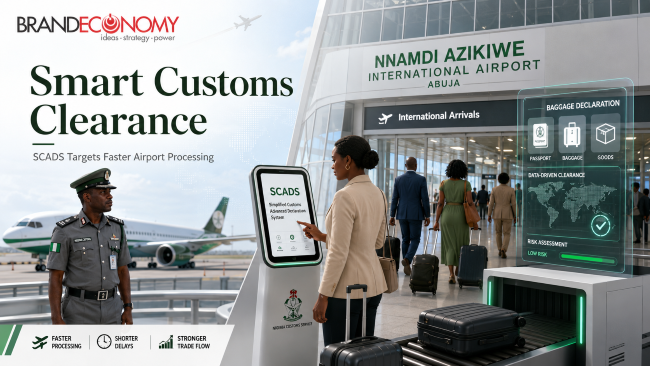 The Nigeria Customs Service has launched the Simplified Customs Advanced Declaration System, SCADS, at the international wing of the Nnamdi Azikiwe International Airport, Abuja, in a move aimed at reducing passenger clearance delays, strengthening compliance and modernising Customs operations at Nigeria’s airports.
The new digital platform is designed to simplify baggage declaration for inbound international passengers by allowing travellers to declare dutiable items before arrival. Customs says the system will reduce manual bottlenecks, improve transparency in revenue assessment and create a faster, more predictable clearance process.



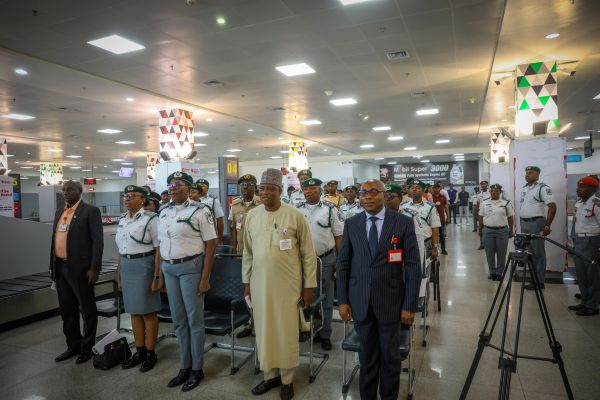
Speaking at the inauguration, Oluyomi Adebakin, Deputy Comptroller-General of Customs in charge of ICT and Modernisation, said the deployment of SCADS marked another important step in the Service’s wider digital transformation agenda.
She explained that the platform was developed after operational challenges affected an earlier passenger declaration system introduced this year, adding that Customs chose to treat the setback as an opportunity to build a stronger and more efficient alternative.
“When the earlier platform experienced operational challenges, we chose not to see it as a setback. We saw it as an opportunity to build something better, stronger and more efficient,” she said.
According to Adebakin, SCADS will make airport movement smoother for passengers by enabling advance declarations ahead of arrival, while also improving the accuracy and integrity of Customs processes.
“For passengers, this system creates the opportunity for advance declaration before arrival. It means faster clearance, easier compliance and smoother movement through our airports,” she added.
Adebakin said the platform would also curb subjective revenue assessment by automatically calculating duties based on declared items, quantities and actual values.
“When we talk about revenue collection, it is not about collecting more or less. It is about collecting the right revenue. With this system, assessment will now be more objective, accurate and driven by data,” she said.
The development reflects a broader shift in border management: from paper-heavy, officer-dependent processing to digitally enabled risk management and data-led compliance. For international passengers, that could mean shorter queues and clearer obligations. For Customs, it offers a better audit trail, more consistent duty computation and reduced room for discretionary practices.
Pilot Phase Begins in Abuja
Victoria Alibo, Customs Area Controller of the FCT Area Command, described the selection of Abuja for the pilot phase as a vote of confidence in the command’s operational capacity.
She said SCADS brings passenger baggage declarations and e-commerce declarations into a single digital framework, aligning Nigeria’s airport Customs processes more closely with global best practice.
“SCADS is designed to simplify declarations, reduce clearance time, eliminate manual bottlenecks and align our operations with international standards,” Alibo said.
The pilot phase is scheduled to run for five days, from May 18 to May 22, during which Customs officers and technical teams will evaluate the platform in a live operating environment ahead of possible nationwide deployment.
The inauguration was attended by senior Customs officials, representatives of the Federal Airports Authority of Nigeria, partner government agencies, technical teams and other stakeholders within Nigeria’s aviation and border-management ecosystem.
Why SCADS Matters for Trade, Travel and Revenue Integrity
Although the system is passenger-facing, its significance extends beyond airport convenience. Efficient customs clearance at international gateways is closely tied to a country’s broader trade reputation, investment climate and public-service credibility.
Airport delays, inconsistent assessment practices and opaque baggage-declaration procedures often create frustration for travellers while also weakening confidence in border institutions. By moving toward pre-arrival digital declaration and automated assessment, Customs is signalling a preference for predictability over improvisation and systems over discretion.
The move also complements wider efforts to digitalise Nigeria’s trade and border processes. A more automated airport declaration regime can support:
- faster passenger processing;
- clearer compliance obligations;
- improved duty collection accuracy;
- reduced opportunities for informal negotiation;
- and better data for Customs risk management.
If implementation is smooth, SCADS could become an important element in Nigeria’s attempt to make its ports of entry more efficient, transparent and traveller-friendly.
BRANDECONOMY Insight
SCADS Is More Than an Airport Tool — It Is a Test of Customs’ Digital Reform Discipline
The launch of SCADS is significant because it addresses a practical pain point in Nigeria’s border-management system: the often cumbersome experience of passenger declaration and airport clearance.
For Customs, the promise of the platform lies in three areas — speed, consistency and trust. Allowing passengers to declare items before arrival should reduce avoidable airport delays. Automating duty assessment should improve objectivity. Integrating passenger and e-commerce declarations into a single framework should strengthen institutional data and process control.
But digital reform is only as credible as its execution. Nigeria has seen ambitious public-sector platforms struggle when user education, infrastructure readiness and backend integration fail to keep pace with launch announcements. Customs will therefore need to ensure that SCADS is stable, intuitive, well-supported and properly explained to travellers and officers alike.
If the pilot succeeds, the system could help build a more modern airport clearance regime and reinforce the Service’s larger transformation agenda. If it falters, it may deepen scepticism about digital reform in critical public-facing institutions.
The opportunity is clear: Customs can make compliance easier, revenue fairer and airport movement faster — all at once.