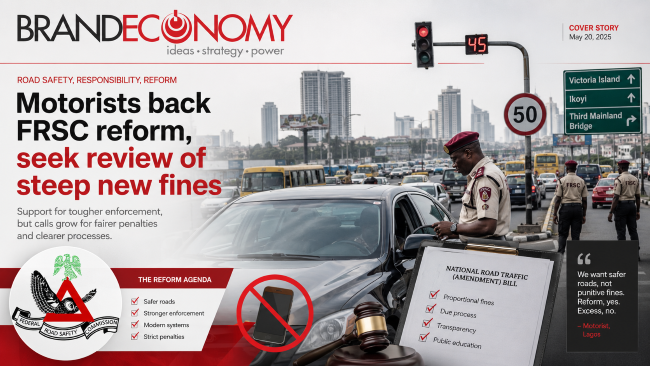
 Motorists in the Federal Capital Territory have expressed qualified support for proposed reforms to strengthen the Federal Road Safety Corps and improve discipline on Nigerian roads, but warned that increasing some traffic fines from ₦5,000 to ₦100,000 could punish low-income drivers more harshly than it deters dangerous behaviour.
The reactions followed the Senate’s passage of the Federal Road Safety Corps Amendment Bill, which proposes substantially higher penalties for reckless driving, speeding, traffic-light violations, driving under the influence of alcohol or drugs, and using a mobile phone while behind the wheel.


Although the FRSC Reform bill is still awaiting presidential assent, its proposed penalties have already triggered a wider debate about road safety, affordability, enforcement fairness and the risk that extremely high fines could encourage corruption rather than compliance.
Private and commercial motorists who spoke in Abuja generally agreed that stronger laws were necessary to curb indiscipline and reduce crashes. Their concern was that the proposed financial sanctions appeared disconnected from the economic realities facing most Nigerians.
Under the bill, penalties for speeding, reckless driving, failure to obey traffic lights, road signs or markings would rise from ₦5,000 to ₦100,000. Offenders could also face up to two years’ imprisonment, or both fine and imprisonment, upon conviction.
Similar penalties are proposed for driving under the influence of alcohol or drugs and using a mobile phone while driving.
Drivers who refuse an FRSC roadside breath test based on reasonable suspicion could face a ₦50,000 fine, six months’ imprisonment, or both. Corporate offenders may be fined up to ₦5 million, while offences involving drivers’ licences and vehicle particulars could attract penalties of ₦50,000.
The FRSC Reform bill also proposes a ₦50,000 fine for hawking or preaching in commercial vehicles, a provision that has drawn objections from some Christian groups, which argue that it could restrict religious expression and criminalise peaceful preaching.
Safety reform wins support—but not at any price
Mr Anthony Mangwe, a ride-hailing driver, said the proposed law could make motorists more cautious, particularly those who use mobile phones while driving.
“If that bill becomes law, it will benefit some of us. Many people will be more careful on the road, especially by avoiding phone calls while driving,” Mangwe said.
He nevertheless warned that traffic laws often impose their greatest burden on people at the lower end of the income ladder.
For a commercial driver, being detained, fined or having a vehicle impounded can destroy an entire day’s earnings. A ₦100,000 penalty could represent several weeks of income for some drivers and may place severe pressure on their households.
“When you are caught, your business for the day will be ruined,” Mangwe said.
His position captures the central tension in the proposed reform: penalties must be strong enough to deter dangerous conduct, but not so financially extreme that they become economically destructive or practically unenforceable.
A law that most offenders cannot realistically comply with may create incentives for roadside bargaining, informal settlements and selective enforcement.
Enforcement must apply to officials and privileged motorists
The motorists also argued that stronger laws would command greater public respect only when they were applied uniformly.
Mangwe criticised the conduct of some government officials and drivers of politically connected or security vehicles, noting that reckless movement by those in authority often weakens public respect for traffic regulations.
He said compliance would improve if political leaders, public officials and security personnel obeyed the same rules imposed on ordinary citizens.
Mr Rasheed Adebayo, a taxi driver, similarly said the intention behind the amendment was commendable, but its effectiveness would depend on consistent enforcement.
Where penalties are selectively applied, road-safety legislation can quickly lose legitimacy. Ordinary motorists become less willing to comply when convoys, official vehicles and influential individuals appear to operate above the law.
The demand for uniform enforcement is therefore not merely a matter of fairness. It is essential to the credibility of the FRSC and the wider traffic-management system.
Commercial drivers call for gradual increase
The Chairman of Jabi Town Service, Mr Ismaila Ibrahim, welcomed the effort to reduce road crashes but criticised the scale of the proposed financial penalties.
Mr Abdul Mumini, the first Chairman of Jabi Town Service, also described the reform as necessary because of widespread recklessness on Nigerian roads.
“This is a Federal Government decision. It’s good because of our indiscipline on the roads and for safety,” Mumini said.
He observed that some motorists ignore traffic lights and other road rules without fear of consequences, and argued that stronger punishment could make drivers more mindful.
But Mumini said moving directly from ₦5,000 to ₦100,000 was excessive.
“If they had increased it gradually, say from ₦5,000 to ₦10,000, it would make more sense,” he said.
His proposal reflects a broader principle of regulatory design: punishment should be proportionate, predictable and enforceable.
Gradual increases could strengthen deterrence while allowing authorities to evaluate whether higher fines actually reduce violations. A staggered system could also differentiate between first-time offenders, repeat offenders and conduct that causes injury or death.
The case for differentiated penalties
Not all traffic violations carry the same risk.
Using a phone while driving, running a red light and driving under the influence can directly endanger lives. Documentation offences, by contrast, may involve administrative failures that do not always create immediate physical danger.
A more balanced reform could therefore distinguish between high-risk behaviour and lower-level compliance failures.
The law could also apply escalating sanctions. A first offence might attract a moderate fine and compulsory safety education. Repeat offences could lead to higher fines, licence suspension, vehicle impoundment or prosecution.
Such an approach would preserve deterrence while reducing the likelihood that one traffic mistake destroys a household’s finances.
Fines could also be calibrated according to the seriousness of the offence and whether it resulted in damage, injury or death.
Economic and social implications
Nigeria’s road-safety crisis carries enormous economic costs.
Crashes destroy lives, reduce household income, increase medical expenses and damage vehicles and public infrastructure. They also disrupt logistics, workplace productivity and commercial activity.
Dangerous driving is therefore not merely a personal choice. It creates costs for families, employers, insurers, hospitals and the wider economy.
Stronger enforcement could reduce those losses, but excessively high penalties may create new problems.
Commercial drivers already operate under pressure from fuel prices, vehicle maintenance, levies and unstable daily earnings. A ₦100,000 fine could push some into debt or cause vehicles to remain off the road for prolonged periods.
The government must therefore balance public safety with economic proportionality.
Market and investor implications
Safer roads would benefit logistics companies, insurers, manufacturers, transport operators and investors dependent on predictable movement.
Reduced crash rates could lower fleet-repair costs, insurance claims, delivery disruptions and employee downtime.
Technology companies may also find opportunities in speed monitoring, digital ticketing, automatic-number-plate recognition, telematics, breath-testing equipment and fleet-safety management.
But the FRSC Reform enforcement system must be transparent. Digital payment channels, electronic evidence and documented appeal processes would reduce roadside discretion and protect motorists from extortion.
Investors and businesses want safety—but they also want predictable rules and credible institutions.
Brand implications
For the FRSC, the amendment represents an opportunity to strengthen its brand as a professional road-safety institution.
However, public trust will not be built by severe penalties alone. It will depend on courteous enforcement, accurate evidence, transparent procedures and equal treatment.
For transport companies and ride-hailing platforms, stronger laws should encourage greater investment in driver training, vehicle maintenance and safety monitoring.
Government itself must also lead by example. Official convoys and state-owned vehicles cannot violate traffic rules while ordinary motorists are subjected to heavy sanctions.
BRANDECONOMY Insight
Nigeria unquestionably needs tougher action against dangerous driving. Speeding, drunk driving, mobile-phone use and traffic-light violations kill people and impose heavy costs on the economy. This makes the FRSC Reform bill timely and necessary.
But deterrence is not measured by how dramatic a fine appears on paper. It is measured by whether the law is respected, consistently enforced and capable of changing behaviour.
A jump from ₦5,000 to ₦100,000 may sound tough, but could prove counterproductive if it encourages bribery, selective enforcement or widespread inability to pay.
The better approach is a graduated penalty system supported by digital enforcement, compulsory safety education, licence points and escalating sanctions for repeat offenders.
Road safety must be firm. It must also be fair.
The real objective should not be to collect more fines, but to prevent more accidents and avoidable deaths.