
Nigeria Customs Launches MIS File Tracker to Speed Administration and Trade

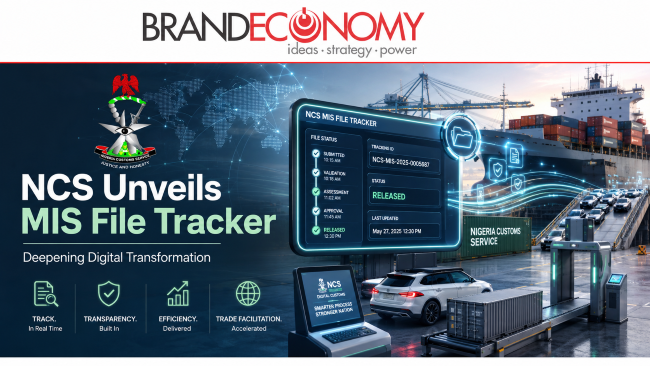 The Nigeria Customs Service has unveiled a Management Information System File Tracker at the Ports and Terminal Multi-Services Limited Area Command in Lagos, marking another step in its drive to replace fragmented manual processes with faster, more transparent and data-led administration.
The Comptroller-General of Customs, Bashir Adeniyi, said the initiative aligned with the Service’s broader modernisation agenda, which seeks to deploy digital solutions across operational and administrative functions, improve institutional transparency and facilitate smoother trade.




Adeniyi was represented at the unveiling by the Deputy Comptroller-General in charge of ICT and Modernisation, Mrs Oluyomi Adebakin.
He reaffirmed the Customs Service’s commitment to using technology to improve efficiency, strengthen accountability and deliver better services across its commands nationwide.
The new tracker builds on previous digital initiatives, including the Nigeria Trade Portal, Customs Verification Management System and the Unified Customs Management System, popularly known as B’Odogwu.
While those platforms focus substantially on trade processing, cargo documentation and Customs verification, the MIS File Tracker addresses the internal administrative machinery that supports frontline operations.
That distinction matters. A Customs administration cannot deliver truly seamless trade when its external platforms are digital but its internal approvals, staff files, duty rosters and administrative workflows remain slow, duplicated or dependent on physical documents.
One platform for multiple administrative functions
Adeniyi described the MIS as an enterprise platform equipped with a Single Sign-On feature, giving authorised officers access to a unified data environment across departments.
The system is designed to reduce duplication, streamline workflows and improve the speed with which administrative requests are processed.
Officers will use the platform for leave and pass applications, file tracking, duty rosters, internal staff orders, nominal rolls and other personnel-related functions.
The File Tracker is also expected to improve visibility over the movement and status of official documents. Instead of files disappearing between offices or approvals becoming difficult to trace, authorised users should be able to determine where a document is, who has acted on it and what remains outstanding.
That creates a stronger audit trail and reduces opportunities for delay, administrative manipulation or loss of institutional records.
Adeniyi said the platform incorporated feedback channels that would allow users to recommend modifications and improvements as implementation progresses.
This is a practical feature because enterprise technology rarely succeeds through deployment alone. It requires sustained user engagement, regular upgrades and adaptation to the realities of different commands.
PTML strengthens reputation as innovation hub
The PTML Area Command was selected for the unveiling because of its growing reputation as one of the most technologically advanced Customs commands in Nigeria.
The command has previously piloted major digital projects, including B’Odogwu, and is increasingly being positioned as a testing ground for technology-led Customs administration.
The Acting Controller of the PTML Area Command, Deputy Comptroller Nura Miko, expressed confidence that the command would implement the system successfully and provide a model that could be replicated across the Service.
Miko said the command was already applying technology-driven trade-facilitation initiatives introduced by Customs management to improve cargo processing and service delivery.
He disclosed that efforts were underway to reduce the clearance time for compliant Roll-on/Roll-off cargo from two hours to one hour.
RoRo operations are particularly important to Nigeria’s automotive, machinery and logistics sectors because they involve vehicles and wheeled cargo driven directly on and off vessels.
Reducing clearance time for compliant cargo could lower storage costs, improve terminal throughput and give importers greater predictability.
Why internal efficiency matters to trade
Although the MIS File Tracker is primarily an internal administrative tool, its successful implementation could influence the wider trade environment.
Customs officers require timely duty postings, approvals, personnel records and operational instructions to perform effectively. When internal processes are slow, the consequences can filter outward through delayed decisions, weak coordination and inconsistent service.
A modern Customs organisation must therefore digitise both the trader-facing and employee-facing sides of its operations.
The wider objective should be an integrated institution in which cargo declarations, risk assessments, payments, inspections, personnel deployment and management decisions are supported by reliable data.
That would allow the Service to identify bottlenecks, allocate resources more intelligently and measure performance across commands.
Market implications
For importers, exporters, freight forwarders and terminal operators, more efficient Customs administration could reduce uncertainty and improve the predictability of cargo clearance.
Faster processing also lowers the hidden costs of trade. Delays translate into demurrage, storage expenses, disrupted delivery schedules and additional working-capital pressure.
If the PTML Command achieves its target of clearing compliant RoRo cargo within one hour, it could strengthen the terminal’s competitiveness and encourage more operators to meet documentation and compliance requirements.
The initiative also expands opportunities for Nigerian technology companies specialising in enterprise software, data integration, cybersecurity, document management and public-sector digital transformation.
Investor relevance
Investors assess ports not only by physical infrastructure but also by the efficiency of the institutions operating within them.
A modern Customs platform can strengthen confidence that approvals, documentation and cargo processing will be handled transparently and consistently.
However, investors will expect reliability. System downtime, incomplete integration or the continued use of parallel manual processes could dilute the benefits.
Cybersecurity and data protection must also remain priorities. A unified administrative platform will contain sensitive personnel and operational information that must be protected from breaches, unauthorised access and manipulation.
Brand implications
For the Nigeria Customs Service, the MIS File Tracker supports an evolving institutional identity built around modernisation, trade facilitation and accountability.
The Service’s brand will, however, be judged less by the number of platforms launched than by the improvements users experience.
Technology should translate into faster decisions, fewer lost files, transparent approvals and better treatment of legitimate businesses.
For PTML, successful implementation could further position the command as a reference point for efficient and technology-driven port administration in Africa.
BRANDECONOMY Insight
The digitisation of Nigeria’s ports cannot end at electronic cargo declarations. The institutions managing trade must also digitise their internal thinking, workflows and accountability systems.
The MIS File Tracker is therefore more significant than its administrative label suggests.
It can help build a Customs Service in which decisions are traceable, information is accessible and officers are deployed more efficiently.
But software alone does not create transformation. Officers must use the platform consistently, managers must abandon unnecessary paper processes and system performance must be measured against clear service-delivery targets.
If properly implemented and scaled, the initiative could help the Nigeria Customs Service move closer to a modern administration where technology does not merely automate old habits—but fundamentally improves how trade is governed.