Eleven Poets Enter $100,000 Race as Nigeria Prize for Literature Unveils 2026 Longlist

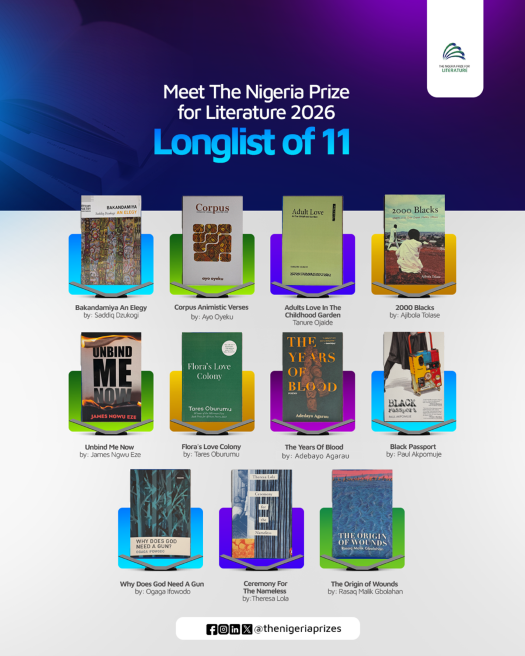 Eleven poetry collections have advanced to the longlist of the 2026 Nigeria Prize for Literature, emerging from 223 submissions in a contest that once again places Nigerian writing, publishing and cultural expression under an international spotlight.
The $100,000 prize, sponsored by Nigeria LNG Limited, is one of Africa’s richest literary honours. Now in its 22nd year, the competition rotates annually among prose fiction, poetry, drama and children’s literature, with the 2026 edition devoted to poetry.


The 11 books still standing
The longlisted collections are: Adult Love by Tanure Ojaide; Bakandimiya by Saddiq Dzukogi; Black Passport by Paul Akpomuje; 2000 Blacks by Ajibola Tolase; Ceremony for the Nameless by Theresa Lola; Corpus: Animistic Verses by Ayo Oyeku; Floral’s Love Colony by Tares Oburumu; The Origin of Wounds by Malik Gbolahan; The Years of Blood by Adebayo Agarau; Unbind Me Now by James Ugwu Eze; and Why Does God Need a Gun by Ogaga Ifowodo.
Announcing the list, Chairman of the Prize Advisory Board, Prof. Akachi Adimora-Ezeigbo, said the selected works reflected the quality, creativity and diversity shaping contemporary Nigerian poetry.
She observed that the collections revisit history while challenging established accounts of the past and examining the forces that shape identity, social relationships and collective memory.
Although the poets approach their subjects differently, the works share an interest in how individuals and communities survive violence, oppression, displacement and social fragmentation.
Poetry as national memory
The longlist suggests that contemporary Nigerian poetry is increasingly functioning as both artistic expression and social documentation.
In a society marked by rapid political, economic and cultural change, poets are becoming custodians of experiences that may be simplified, ignored or erased from conventional public narratives.
Adimora-Ezeigbo noted that the works display a broad range of techniques, including lyrical, allegorical and elegiac forms. Some draw heavily from folklore and oral tradition, while others engage directly with present-day realities, creating a meeting point between inherited memory and contemporary experience.
The judges will now undertake closer readings of the books, focusing on language, structure, originality, artistic discipline and enduring literary value.
A three-title shortlist is expected in August, while the winner may be announced in October.
Beyond prize money
The $100,000 award is significant in an African publishing environment where writers often contend with small print runs, limited distribution, weak library systems and modest financial returns.
For the winning author, the prize could deliver not only substantial financial reward but also international visibility, stronger book sales, translation possibilities and invitations to literary festivals and academic institutions.
The longlist also creates commercial opportunities for publishers, booksellers, libraries and cultural organisations. Each nominated title gains renewed relevance, providing a rare moment when poetry can command national attention beyond literary circles.
Market and investor implications
Nigeria’s literary economy remains underdeveloped relative to the country’s creative talent.
Investment opportunities exist in digital publishing, audiobooks, translations, literary events, educational content, screen adaptations and international rights management.
A strong prize ecosystem can help reduce investor uncertainty by identifying quality works, credible authors and stories with wider market potential.
However, one major award cannot carry the entire publishing industry. Nigeria still needs stronger book distribution, functional libraries, improved copyright protection and more dependable platforms connecting writers with domestic and global readers.
Brand implications
For NLNG, the prize remains one of Nigeria’s most enduring corporate investments in intellectual and cultural development.
The initiative has helped position the company beyond its core energy operations, strengthening its identity as a supporter of education, creativity and national heritage.
Yet the 2026 Nigeria Prize for Literature prize’s greatest brand value rests on credibility. Transparent judging, respected advisory leadership and consistent standards are essential to maintaining public trust.
For the longlisted authors, selection creates a powerful personal-brand moment. How they engage readers, publishers, schools and the international literary community could determine whether the recognition produces lasting influence.
BRANDECONOMY Insight
The Nigeria Prize for Literature is valuable because it places serious writing within the national conversation.
Its impact, however, should extend beyond announcing winners. The longlisted books should enter schools, libraries, book clubs, festivals and digital platforms.
Nigeria’s creative economy will grow stronger when literary excellence is converted into readership, intellectual property, cultural exports and sustainable publishing businesses.
Eleven poets are now running for $100,000. The larger 2026 Nigeria Prize for Literature prize is the opportunity to ensure that Nigerian poetry—and the truths it carries—travels further, lasts longer and earns greater value.