MAN Warns Against NESREA-Proposed Single-Use Plastics Ban
Calls for Evidence-Based Environmental Reform

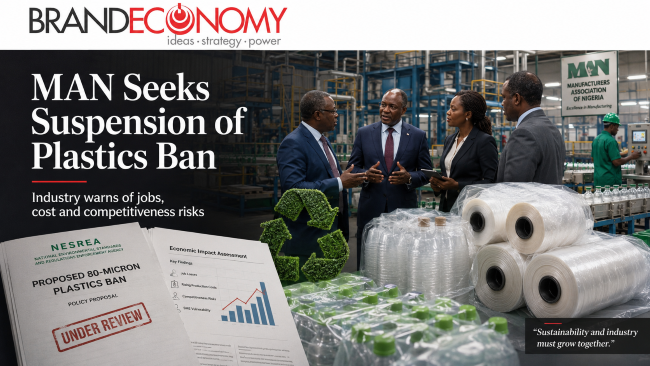 The Manufacturers Association of Nigeria (MAN) has urged the Federal Government and the National Environmental Standards and Regulations Enforcement Agency (NESREA) to suspend the planned implementation of new restrictions on certain plastic products, warning that the plastics ban move could trigger significant economic, industrial and employment consequences if introduced without a comprehensive impact assessment.
At the centre of the plastics ban debate is the proposed National Environmental (Plastic Waste Control) Regulations 2026, which seeks to prohibit the production and use of single-use plastic materials below 80 microns in thickness while introducing additional measures affecting a broad range of plastic products.




While supporting the broader objective of reducing environmental pollution and promoting sustainability, MAN argues that the proposed regulatory approach risks undermining industrial competitiveness at a time when manufacturers are already contending with high energy costs, elevated borrowing rates, exchange-rate pressures and weak consumer purchasing power.
According to MAN Director-General, Segun Ajayi-Kadir, environmental sustainability and industrial development should not be treated as competing priorities. Rather, they should be pursued through carefully calibrated policies that achieve ecological objectives without imposing avoidable costs on businesses, workers and consumers.
The Bigger Question: Is Plastic the Problem or Waste Management?
The debate surrounding plastics often centres on production and consumption. However, manufacturers insist that the more fundamental challenge lies in the country’s weak waste management architecture.
Nigeria’s urban centres continue to struggle with inadequate waste collection systems, poor sorting infrastructure, limited recycling capacity and weak enforcement of environmental regulations. As a result, a substantial proportion of waste ends up in drainage channels, waterways and open dumpsites.
Industry stakeholders argue that a plastics ban policy banning thinner plastic products without addressing these structural deficiencies may simply shift the problem rather than solve it.
The association notes that the Federal Government had already established a framework through the National Plastic Action Partnership (NPAP), which developed a Plastic Circularity Roadmap in 2024. The roadmap emphasised recycling, waste recovery, Extended Producer Responsibility (EPR), circular economy models and stronger collection systems as the primary pathway to addressing plastic pollution.
For many operators, the key question is whether existing initiatives have been sufficiently implemented and evaluated before introducing a more restrictive regulatory regime.
Potential Impact on Manufacturing
The plastics value chain remains one of the most important segments of Nigeria’s manufacturing ecosystem.
Its influence extends beyond packaging to food processing, pharmaceuticals, agriculture, retail distribution, logistics, healthcare and consumer goods production.
A mandatory shift to thicker plastic specifications would require significant adjustments in production processes, machinery configurations and raw material inputs. Manufacturers warn that such changes could render portions of existing investments economically inefficient while raising operating costs across multiple sectors.
The likely consequence is that higher production expenses would eventually be transferred to consumers through increased prices of packaged goods, food products, pharmaceutical items and everyday household essentials.
For small businesses, market traders and informal sector operators who depend heavily on affordable packaging materials, the financial burden could be particularly severe.
Global Lessons: What Works and What Doesn’t
The international experience offers important lessons.
Several countries that adopted outright bans on certain plastic categories achieved mixed results. While some environmental gains were recorded, enforcement challenges, substitution costs and unintended economic consequences often limited overall effectiveness.
By contrast, countries that invested heavily in recycling systems, collection networks, producer responsibility frameworks and public awareness campaigns have generally achieved stronger and more sustainable outcomes.
The implication for Nigeria is clear: environmental policy works best when it is supported by infrastructure, incentives and behavioural change mechanisms rather than relying exclusively on prohibition.
Why Investors Are Watching
Beyond environmental concerns, the proposed regulation carries important implications for investors.
Regulatory predictability remains one of the most important factors influencing investment decisions. Investors seek assurance that policy changes will be supported by adequate consultation, credible impact assessments and realistic implementation timelines.
Any perception of abrupt regulatory shifts can increase investment uncertainty, discourage capital expenditure and weaken confidence in long-term industrial planning.
This is particularly relevant for manufacturers that have invested heavily in packaging facilities, plastics production plants and downstream processing operations.
The concern is not necessarily the environmental objective itself, but whether implementation is supported by sufficient evidence and stakeholder engagement.
Market Implications
The proposed regulation could reshape multiple markets simultaneously:
- Packaging costs may rise across consumer goods industries.
- Food and beverage manufacturers could face higher operating expenses.
- Pharmaceutical packaging costs may increase.
- Informal retail operators may experience reduced access to affordable packaging.
- Demand for alternative packaging materials could accelerate.
- Recycling and waste management companies may gain new opportunities.
In the medium term, the policy could stimulate innovation in biodegradable materials, recycled-content packaging and sustainable alternatives. However, stakeholders insist that the transition must be carefully managed to avoid unnecessary economic disruption.
Brand Implications
The plastics ban issue also presents an important reputational challenge.
Manufacturers increasingly face pressure from consumers, regulators and investors to demonstrate environmental responsibility.
Companies that proactively embrace circular economy practices, invest in recycling partnerships and adopt sustainable packaging strategies are likely to strengthen their brand equity and social licence to operate.
At the same time, regulators must ensure that environmental objectives are pursued in ways that preserve competitiveness, employment and industrial growth.
The most successful sustainability policies globally are those that bring industry along rather than positioning environmental protection and economic development as opposing goals.
BRANDECONOMY Insight
The debate over plastics is no longer merely an environmental conversation; it is now an economic competitiveness conversation.
Nigeria stands at a critical crossroads. The country can either pursue a restrictive policy path that prioritises bans before infrastructure readiness, or adopt a circular economy model that combines recycling, producer responsibility, waste collection, innovation and consumer education.
The strongest outcome lies in balancing environmental sustainability with industrial resilience.
MAN’s call for a Regulatory Impact Assessment deserves serious consideration because evidence-based policymaking remains the foundation of effective regulation.
The ultimate goal should not simply be reducing plastic consumption. It should be building a cleaner environment while preserving jobs, attracting investment and strengthening Nigeria’s manufacturing base.
Environmental progress and economic growth must advance together.