CPPE Backs Smarter Tariffs to Deepen Refining, Ease Mobility and Expand Clean Energy

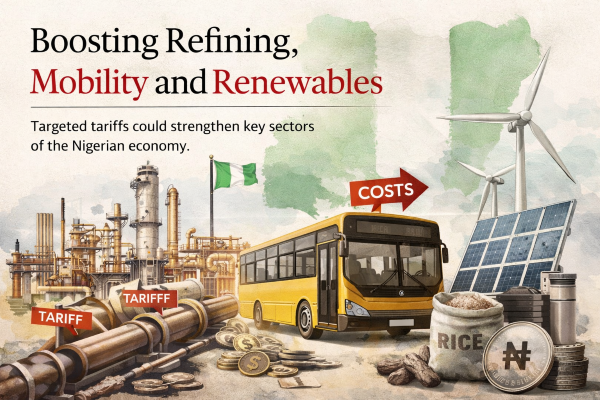 Nigeria’s latest fiscal policy recalibration is being welcomed—cautiously—by the private sector, with the Centre for the Promotion of Private Enterprise (CPPE) arguing that tariff policy must now move beyond broad protectionism and become more strategically targeted. In its view, the real test of the 2026 Fiscal Policy Measures and Tariff Amendments will lie not in how many tariff lines were revised, but in whether the changes meaningfully strengthen domestic refining, improve mobility and make renewable energy more affordable.
That was the thrust of a statement by Dr Muda Yusuf, Chief Executive Officer of CPPE, who described the new framework as a potentially important pivot toward local production, industrialisation and reduced import dependence—but one that still leaves critical gaps in sectors central to growth and household welfare.




A Tariff Reset with Winners and Losers
At first glance, the direction of travel is clear. The revised framework introduces adjustments across 192 tariff lines, combining higher levies on selected finished imports with lower duties on certain productive inputs, selective import restrictions, excise revisions and green taxes on imported vehicles.
For domestic manufacturers, this could be a turning point.
Yusuf noted that imported finished goods—including food products, plastics, textiles and metals—now face combined tariff and levy burdens ranging from 20 to 70 per cent. That shift, he argued, will raise the cost of imports and improve the competitive position of local producers, particularly in agro-processing, packaging, light manufacturing and metals.
In theory, CPPE believes that such protection should improve local capacity utilisation and encourage investment in domestic industry. In practice, however, much will depend on whether local producers can respond quickly enough in scale, price and quality.
For import-dependent firms, the picture is less benign. Higher landed costs are likely to squeeze margins, weaken volumes and force business model adjustments in sectors still heavily reliant on foreign inputs or finished goods.
The Refining Blind Spot
Yusuf’s sharpest criticism was reserved for the treatment of petroleum products.
At a time when Nigeria is trying to consolidate gains in domestic refining, he argued, the tariff framework remains unexpectedly soft on imported refined petroleum products. This, in his view, creates an asymmetry: sectors such as food and light manufacturing are receiving stronger tariff support, while refining—arguably one of the country’s most strategic industrial priorities—is left comparatively exposed.
That matters because refining is not just another industry. It sits at the centre of energy security, foreign exchange conservation, industrial competitiveness and macroeconomic resilience. Protective tariffs for locally refined products, Yusuf argued, would provide the investment security needed to deepen capacity, stabilise supply and reduce dependence on imports.
In effect, the CPPE is making a broader industrial policy point: if Nigeria truly wants to build a post-import fuel economy, refining must be protected with the same seriousness as other priority sectors.
Mobility Costs and the Used Vehicle Question
The transport dimension is equally significant.
Yusuf expressed concern over the 40 per cent tariff on used vehicles below 2000cc engine capacity, warning that once additional charges are added, the effective burden exceeds 50 per cent. In a country where road transport remains the dominant mode of mobility for households and businesses, that level of taxation, he suggested, is economically counterproductive.
The consequences are wider than private car ownership. Expensive vehicles mean higher entry barriers for e-hailing drivers, car hire operators and small-scale logistics providers—all of which feed directly into employment and transport costs.
His proposal is a more moderate ceiling: a maximum tariff burden of 25 per cent inclusive of all charges for lower-engine used vehicles. The logic is developmental rather than populist. If mobility becomes too expensive, the wider economy becomes less efficient.
A Case for Supporting Vehicle Assembly and Mass Transit
CPPE’s argument extends beyond used imports to the broader automotive value chain.
Yusuf called for a more supportive tariff regime for local assembly, proposing duties of no more than five per cent on Semi Knocked Down parts and zero duty on Completely Knocked Down parts. That would align tariff policy more closely with industrial policy—lowering the cost of assembly inputs while encouraging local production.
On public transport, he urged tariffs on mass transit buses to be cut to five per cent, alongside a full VAT waiver. Such a move, he argued, would stimulate private investment in staff buses, fleet operations and urban mobility infrastructure, while also easing the transport burden on households.
In a period when transport inflation is feeding directly into the broader cost-of-living crisis, the case for cheaper mass transit inputs is compelling.
Renewables as Economic Relief
Perhaps the most forward-looking part of the CPPE’s position is its emphasis on renewable energy equipment.
Batteries and inverters, Yusuf noted, remain prohibitively expensive for most households and small businesses. Yet in an economy still constrained by unreliable grid power, they are no longer luxury items. They are productivity tools.
To improve affordability, CPPE proposed a five per cent import duty and a full VAT waiver on such equipment. The developmental logic is straightforward: cheaper renewable energy systems would reduce dependence on diesel and petrol generators, lower operating costs for businesses and offer households a more resilient alternative to unstable electricity supply.
In that sense, tariff relief on clean energy equipment is not just an environmental measure. It is a competitiveness policy.
Industrialisation Needs Precision
The larger message from CPPE is that Nigeria’s new tariff architecture is directionally promising, but still incomplete.
Higher tariffs on finished imports may support local producers, but without equal attention to refining, mobility and energy access, the gains could be uneven. Investors may see opportunities in manufacturing and green industries, but consumer-facing sectors and import-dependent businesses will also face serious adjustment risks.
The challenge for policymakers, then, is not only to protect. It is to protect strategically.
BRANDECONOMY Insight
- Tariffs Are Now Industrial Policy by Another Name
Nigeria’s 2026 tariff measures confirm that fiscal policy is becoming a more active tool of structural transformation. The issue is no longer whether tariffs should be used, but how intelligently. - Refining Deserves Strategic Protection
If local refining is to become a genuine pillar of energy sovereignty, imported refined fuels cannot continue to enjoy relatively softer fiscal treatment than priority manufacturing sectors. - Mobility Is an Economic Variable, Not a Private Luxury
Taxing low-engine used vehicles too aggressively may look fiscally efficient on paper, but it can deepen transport inflation, undermine job creation and reduce economic mobility. - Clean Energy Relief Could Boost Productivity Fast
Lower tariffs and VAT waivers on batteries and inverters would directly support households and SMEs battling unreliable electricity—making renewable energy an immediate economic relief tool. - The Best Tariff Frameworks Balance Protection with Access
A successful tariff regime must protect local production while reducing the cost of strategic inputs—especially for assembly, refining, public transport and distributed energy solutions.