

After the ₦4.65trn Banking Reset: Which Top 10 Nigerian Banks Are Built for the Next Growth Cycle?
The capital race is over. The growth race has begun.

 Nigeria’s banking industry has crossed one of the most consequential regulatory bridges since the 2005 consolidation. After 24 months of rights issues, public offers, private placements, mergers, capital injections, investor roadshows and balance-sheet restructuring, Nigerian banks have raised ₦4.65 trillion in fresh capital under the Yemi Cardoso-led Central Bank of Nigeria’s recapitalisation programme.
That is not small change. It is a system-wide reset.




But the end of recapitalisation is not the end of the story. It is the beginning of the real deal.
For two years, the industry’s dominant question was simple: which banks would meet the new capital requirement? That question has now been answered substantially. The more important question is now sharper, tougher and more revealing:
Which Nigerian banks are genuinely built for the next growth cycle?
Capital is necessary, but capital alone does not build a great bank. A bank may raise billions and still remain strategically weak. Another may raise capital quietly but deploy it with superior discipline. A bank may look strong in a high-interest-rate environment but struggle when margins normalise. Another may appear less glamorous but possess the customer franchise, risk culture and technology architecture required for durable growth.
That is why the ₦4.65trn banking reset must be judged not by who raised money, but by who can convert fresh capital into productive lending, stronger earnings, digital resilience, investor confidence, brand trust and national economic value.
The next phase of Nigerian banking will not reward lazy banking. It will reward banks that are bigger, smarter, better governed and more useful.
Why this reset matters
The CBN’s recapitalisation programme was designed to create stronger banks capable of financing a larger Nigerian economy, withstanding shocks and supporting the ambition of building a trillion-dollar economy.
The capital thresholds were deliberately demanding. International commercial banks were required to reach ₦500 billion in minimum capital. National commercial banks were required to reach ₦200 billion. Regional commercial banks were required to reach ₦50 billion. The eligible capital base focused on paid-up capital and share premium, rather than broad shareholders’ funds swollen by reserves, revaluation gains or retained earnings.
That distinction matters. The regulator wanted fresh equity commitment, not cosmetic strength.
The timing was also significant. Nigeria’s banking sector had been operating through one of the most complex macroeconomic transitions in recent memory: foreign-exchange reforms, elevated interest rates, inflationary pressure, subsidy removal effects, tighter supervision, weaker FX windfalls, rising impairment charges and the gradual exit from regulatory forbearance.
Yet, despite these headwinds, banks raised capital, investors responded, and the capital market proved that it could carry a major national financial reform.
But the deeper test is ahead.
The recapitalisation has given the sector stronger muscles. The next cycle will reveal which banks have the brain, discipline and character to use those muscles well.
BRANDECONOMY’s ranking logic
This is not a popularity list. It is not a simple size table. It is also not investment advice.
BRANDECONOMY’s Top 10 ranking is based on seven strategic filters:
- Capital strength and regulatory buffer
- Earnings quality and profitability resilience
- Asset quality and risk discipline
- Deposit franchise and funding advantage
- Digital capability and operational resilience
- Strategic clarity and growth platform
- Brand trust, governance credibility and economic usefulness
On this basis, the banks best primed for the next growth cycle are not necessarily the loudest. They are the banks with the best combination of scale, capital, customer franchise, execution discipline, technology relevance, governance confidence and growth optionality.
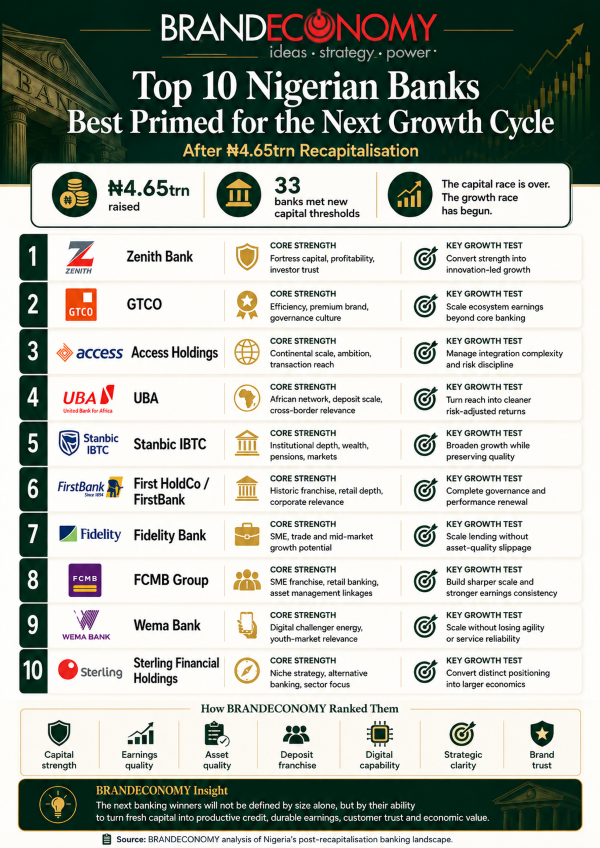
BRANDECONOMY Top 10: Banks Built for the Next Growth Cycle
| Rank | Bank / Banking Group | Core Strength | Key Growth Test |
| 1 | Zenith Bank | Fortress capital, profitability, investor trust | Convert strength into innovation-led growth |
| 2 | GTCO | Efficiency, premium brand, governance culture | Scale ecosystem earnings beyond core banking |
| 3 | Access Holdings | Continental scale, ambition, transaction reach | Manage integration complexity and risk discipline |
| 4 | UBA | African network, deposit scale, cross-border relevance | Turn reach into cleaner risk-adjusted returns |
| 5 | Stanbic IBTC | Institutional depth, wealth, pensions, markets | Broaden growth while preserving quality |
| 6 | First HoldCo / FirstBank | Historic franchise, retail depth, corporate relevance | Complete governance and performance renewal |
| 7 | Fidelity Bank | SME, trade and mid-market growth potential | Scale lending without asset-quality slippage |
| 8 | FCMB Group | SME franchise, retail banking, asset management linkages | Build sharper scale and stronger earnings consistency |
| 9 | Wema Bank | Digital challenger energy, youth-market relevance | Scale without losing agility or service reliability |
| 10 | Sterling Financial Holdings | Niche strategy, alternative banking, sector focus | Convert distinct positioning into larger economics |
 1. Zenith Bank: the fortress with firepower
 1. Zenith Bank: the fortress with firepower
Zenith Bank begins the post-recapitalisation cycle as one of the most formidable institutions in Nigerian banking.
Its advantages are clear: strong capital, deep corporate relationships, a history of profitability, robust investor confidence and a brand identity built around financial solidity. In difficult markets, these attributes matter. Banking customers do not merely buy products; they buy assurance. Investors do not merely buy numbers; they buy confidence in management discipline.
Zenith’s strength is that it has long behaved like a bank that understands the value of institutional steadiness. It is not usually the most flamboyant. It does not need to be. In Nigerian banking, Zenith’s brand has become almost shorthand for balance-sheet confidence.
That gives it a powerful starting point for the next growth cycle.
But Zenith’s opportunity is bigger than defensive strength. With fresh capital and a strong franchise, the bank can deepen structured lending, expand trade finance, finance larger corporate transactions, support energy, infrastructure, manufacturing and export-led businesses, and push harder into retail and SME ecosystems.
The central challenge is reinvention.
Zenith is already strong. The question is whether it can become more imaginative. The next cycle will reward banks that combine fortress banking with platform banking. Customers want digital reliability, faster credit decisions, better advisory depth, and more personalised financial solutions. Corporate customers want capital, but they also want intelligence.
Zenith is built for the next cycle. To dominate it, it must prove that safety and innovation can live in the same institution.
2. GTCO: the efficiency king with ecosystem potential
Guaranty Trust Holding Company remains one of Nigeria’s most valuable banking brands.
GTCO’s enduring advantage is not simply capital. It is culture. The group has built a reputation around efficiency, service design, premium positioning, disciplined risk appetite and governance credibility. In a market where many banks compete on noise, GTCO has historically competed on clarity.
Its holding-company structure gives it a major opening. The future of financial services will not be defined by banking alone. It will be defined by ecosystems: banking, payments, wealth management, pensions, asset management, insurance distribution, consumer finance, SME platforms, lifestyle products and embedded financial services.
GTCO has the brand permission to play in this wider space.
The key question is execution. Can GTCO convert its premium banking identity into a broader financial-services machine without weakening the quality of the core brand? Can it use its customer base more intelligently? Can it create fee-rich, capital-light, technology-enabled earnings streams that reduce reliance on traditional banking margins?
Its efficiency culture is a serious advantage. As interest-rate conditions normalise and regulatory costs rise, banks with tight cost discipline and strong profit conversion will stand out.
GTCO is built for the next cycle because it combines trust, efficiency and brand strength. But the next level of growth will require a more aggressive ecosystem play. The group must not merely remain admired. It must become more economically expansive.
3. Access Holdings: the continental engine
Access Holdings is Nigeria’s boldest banking growth story.
It has scale, ambition, geographic spread, acquisition experience and a pan-African vision that few peers can match. While some banks are essentially Nigerian champions with external branches, Access is building a continental financial services architecture.
This matters because Africa’s next banking growth cycle will not be confined to domestic lending. It will be shaped by intra-African trade, payments, remittances, regional corporates, supply-chain finance, energy flows, diaspora capital, correspondent banking and cross-border advisory.
Access has positioned itself to benefit from that future.
Its network can support businesses moving across African markets. Its scale can attract large corporate and institutional relationships. Its transaction banking opportunity is significant. If the African Continental Free Trade Area gradually gains commercial traction, banks with broad regional presence may become indispensable.
But Access also carries one of the biggest execution risks in the sector.
Scale is powerful only when it is well integrated. Acquisitions must be digested. Cultures must be aligned. Technology systems must be harmonised. Risk frameworks must be consistent. Governance must travel across borders. Operating complexity must not erode shareholder value.
Access is built for the next growth cycle because it has ambition, reach and capital. But its success will depend on whether it can convert continental presence into disciplined, risk-adjusted profitability.
If it gets integration right, Access could become one of Africa’s defining financial institutions.
4. UBA: the African network bank
United Bank for Africa has one of the most compelling strategic assets in Nigerian banking: a true African network.
In an economy where Nigerian corporates are increasingly thinking beyond national borders, UBA’s footprint gives it natural relevance. It can serve trade corridors, regional businesses, remittance flows, sovereign relationships, cross-border payments and multinational clients seeking African reach.
UBA’s brand story is also powerful. It is not merely a Nigerian bank with branches abroad. It is an African bank with Nigerian roots. That distinction carries strategic value.
However, the next cycle will demand more than presence. It will demand performance quality.
UBA must convert geographic spread into cleaner, more consistent risk-adjusted returns. The bank must improve operational efficiency, deepen digital reliability, manage impairment pressure and ensure that its African network produces profitable diversification rather than uneven earnings.
Its opportunity is large. Its brand is visible. Its franchise is significant. Its challenge is conversion.
UBA is built for the next cycle if it can make its network work harder. The bank already owns a continental narrative. The next task is to translate that narrative into stronger, more predictable value for customers and investors.
5. Stanbic IBTC: the quiet compounder
Stanbic IBTC is not always the loudest name in mass-market banking conversations, but it remains one of the most strategically important financial institutions in Nigeria.
Its strength lies in institutional banking, investment banking, wealth management, pensions, custody, markets, asset management and the broader Standard Bank connection. That makes Stanbic IBTC different from banks whose strength depends largely on branch spread or retail visibility.
This is a high-quality franchise.
In the next growth cycle, Nigeria will need more sophisticated financial intermediation. The economy will need long-term savings products, deeper capital-market instruments, pension-linked investment vehicles, structured finance, custody services, corporate advisory, infrastructure financing and market access. These are natural Stanbic IBTC territories.
The bank’s opportunity is to deepen its position as the financial institution of choice for corporates, institutions, affluent individuals and long-term investors.
Its challenge is broader relevance. Institutional depth is valuable, but the next phase of growth may also require wider digital penetration, SME engagement and scalable retail propositions. Stanbic IBTC must keep extending its reach without losing the discipline that gives it its quality premium.
It is built for the next cycle because it understands high-value finance. In a market that must gradually move from short-term liquidity to long-term capital formation, that is a major advantage.
6. First HoldCo / FirstBank: the heritage giant seeking full renewal
FirstBank remains one of Nigeria’s most important banking franchises.
Its history is unmatched. Its retail footprint is deep. Its corporate relationships are extensive. Its brand remains embedded in the economic memory of the country. For millions of Nigerians, FirstBank is not just a bank; it is part of the institutional furniture of commerce.
That heritage is both a blessing and a burden.
The blessing is scale, familiarity and trust accumulated over generations. The burden is that old institutions must constantly prove that they are not trapped by their own past.
First HoldCo’s next growth-cycle opportunity is substantial. With renewed capital strength, a large deposit base, broad customer relationships and long-standing corporate relevance, the group can reclaim stronger competitive momentum if it deepens governance stability, improves operational agility, strengthens risk controls and accelerates digital renewal.
The bank’s future depends on transformation credibility.
FirstBank does not need to introduce itself to the market. It needs to reassure the market that its next chapter will be cleaner, sharper and more performance-driven than some parts of its recent past.
If it gets that right, First HoldCo can remain one of the most powerful institutions in Nigerian banking. Its franchise is too large to ignore. But the next cycle will not reward history by itself. It will reward heritage that has been modernised.
7. Fidelity Bank: the ambitious climber
Fidelity Bank has become one of the more interesting growth stories in Nigerian banking.
For years, it was seen as a strong mid-tier player. Today, it is pushing harder into national relevance, supported by recapitalisation, stronger earnings ambition and a clearer focus on SMEs, trade, retail and emerging corporates.
That positioning matters.
Nigeria’s next growth cycle will not be driven only by mega corporates. It will also be driven by mid-market companies, exporters, importers, distributors, manufacturers, healthcare businesses, logistics operators, schools, consumer businesses and ambitious entrepreneurs trying to scale.
Fidelity has an opportunity to become the bank of choice for this productive middle.
Its challenge is risk discipline. SME and mid-market lending can be rewarding, but it is not a charity. It requires data, cash-flow intelligence, collateral creativity, sector knowledge, monitoring discipline and strong recovery systems. Banks that lend emotionally to SMEs will suffer. Banks that lend intelligently will build durable value.
Fidelity is built for the next growth cycle as an ambitious challenger with real upside. If it can convert capital into disciplined credit growth, it could move from challenger status to major national force.
8. FCMB Group: the SME and financial-services platform
FCMB Group has long occupied an important space in Nigeria’s financial ecosystem.
Its strength lies in SME banking, retail relationships, consumer finance, investment banking linkages, asset management connections and a historically entrepreneurial identity. It is not always discussed with the same intensity as the biggest tier-one banks, but its platform has strategic usefulness.
The next growth cycle could favour FCMB if Nigeria’s economy begins to demand more mid-market financing, household finance, wealth products and SME-focused solutions.
Its group structure provides room for diversified earnings. Its SME orientation is relevant. Its capital raise and international banking ambition give it a stronger runway.
But FCMB must sharpen execution. The bank needs greater scale visibility, stronger earnings consistency, deeper technology performance and a more assertive brand narrative. It has the ingredients for a more powerful cycle, but the market will need to see stronger proof of momentum.
FCMB is built for the next cycle as a specialist-growth platform. Its task is to turn strategic relevance into market leadership in chosen segments.
9. Wema Bank: the digital challenger with momentum
Wema Bank deserves serious attention.
For a long time, Wema’s story was framed around survival, turnaround and reinvention. That story has changed. The bank has used digital positioning, particularly through ALAT and a younger customer connection, to build a fresh identity in a market where legacy banks often struggle to feel modern.
Wema’s advantage is not sheer size. It is agility.
The bank has carved out a space as a digital-era challenger with youth-market relevance, improving profitability and strong market sentiment. In a financial landscape increasingly shaped by fintechs, mobile-first customers, SME digitisation and social commerce, that agility matters.
However, the challenge of growth is real. Many challenger brands lose their magic when they scale. App reliability must improve continuously. Customer service must deepen. Credit growth must be disciplined. Technology investment must be matched by cybersecurity, fraud management and operational resilience.
Wema is built for the next cycle, but not as a fortress bank. It is built as a momentum bank.
Its opportunity is to prove that digital challenger energy can mature into a stable, profitable and trusted national banking franchise.
10. Sterling Financial Holdings: the focused niche player
Sterling’s value lies in its willingness to pursue differentiation.
In a market where many banks sound alike, Sterling has often tried to build around focused sectors, alternative banking, social-impact themes, health, education, agriculture, renewable energy, transport and lifestyle-driven propositions. Its holding-company structure and link with The Alternative Bank also give it room to create a more differentiated financial-services group.
The next cycle may reward this kind of focus.
Not every bank needs to become a giant. Some banks can win by becoming highly relevant to selected customer groups, sectors or value chains. Sterling’s opportunity is to convert identity into economics. A distinctive story is not enough. It must produce stronger deposits, better lending, loyal customers, fee income and shareholder value.
The bank’s challenge is scale. Differentiation must not become smallness. Niche must not become constraint. Purpose must be tied to performance.
Sterling is built for the next cycle if it can turn its distinct positioning into repeatable commercial advantage.
The banks just outside the Top 10
Several institutions deserve close watching.
Ecobank Nigeria and Ecobank Transnational Incorporated remain relevant because of their pan-African footprint and transaction-banking potential, although their Nigeria positioning and group structure require separate analysis.
Jaiz Bank is a strong non-interest banking story and could become increasingly important as ethical finance, alternative investment structures and faith-aligned banking gain more market attention.
Providus-Unity represents a consolidation play. If the business combination is executed properly, it could create a stronger national competitor. But mergers only create value when integration is disciplined.
PremiumTrust, Globus, Optimus, Citibank Nigeria, Standard Chartered Bank Nigeria and other recapitalised players will also shape the competitive field in specialist areas, corporate banking, affluent banking, trade finance and private-client services.
The next cycle will not be won by size alone. There will be room for specialists. But specialists must be excellent.
Investor relevance: the new question is return on fresh capital
For investors, the recapitalisation era has changed the banking thesis.
The early fear was dilution. That was understandable. Rights issues and public offers increase share count. But once capital is raised, the more important question becomes return on capital.
Investors should now ask five questions.
- Can the bank grow earnings without relying excessively on one-off FX gains?
- Can it increase loans without creating future non-performing assets?
- Can it keep cost of funds under control?
- Can it generate stronger fee income from payments, trade, wealth, custody, cards, digital channels and advisory?
- Can it sustain dividends while preserving regulatory buffers?
Zenith and GTCO remain premium-quality plays because of profitability, governance perception and investor confidence. Access offers scale and continental upside, but with integration risk. UBA offers African reach and deposit scale, but must deliver cleaner returns. Stanbic IBTC offers institutional depth and capital-market relevance. First HoldCo offers franchise recovery potential. Fidelity, FCMB and Wema offer growth upside. Sterling offers differentiated niche potential.
But investors must remain careful. Bigger capital can create overconfidence. Banks under pressure to justify new equity may push loans too aggressively. High interest income can hide weak underlying diversification. Government securities can be comfortable but economically lazy. FX gains can flatter results but cannot be relied upon forever.
The smartest investors will look beyond headline profit. They will examine earnings quality, impairment trends, cost of risk, liquidity, funding mix, governance signals, customer growth, technology resilience and management discipline.
Market implications: the capital market has proved its power
One of the biggest lessons of the recapitalisation exercise is that Nigeria’s capital market is more capable than many assumed.
Raising ₦4.65trn in 24 months is not only a banking story. It is a capital-market story. It shows that with regulatory clarity, investor confidence and credible institutions, the market can mobilise large pools of domestic and international capital.
That matters for the future.
Nigeria will need long-term capital for infrastructure, mortgages, power, transport, technology, healthcare, manufacturing, agriculture, exports and energy transition. Banks alone cannot fund the entire development agenda. But stronger banks, a deeper capital market and large pension assets can form a more powerful financing triangle.
The recapitalisation has shown that such mobilisation is possible.
The danger is that banks may use their strengthened balance sheets mainly to buy government securities rather than support productive sectors. That would be profitable, but insufficient. Nigeria does not need stronger banks merely to finance fiscal deficits. It needs stronger banks to finance growth.
The market implication is clear: the banking reset must become a credit reset.
Brand implications: trust is the new capital
The next banking cycle will redefine brand leadership.
In the old era, bank brands were built around branch networks, billboards, executive prestige, marble banking halls and sponsorship visibility. In the new era, bank brands will be built around reliability, transparency, digital uptime, complaint resolution, fair pricing, data protection, governance and visible support for customers’ growth.
Customers are asking harder questions.
- Will my transfer go through?
- Will the app work when I need it?
- Will my complaint be resolved?
- Will charges be transparent?
- Will this bank protect my money?
- Will it support my business when I need working capital?
- Will it still be standing when markets shake?
- For corporate clients, brand trust means advisory competence, confidentiality, credit reliability, transaction speed and cross-border capability.
For investors, brand trust means disclosure quality, dividend discipline, governance credibility and risk transparency.
For regulators, brand trust means compliance, stress-test seriousness and systemic responsibility.
The banks that understand this will build loyalty that advertising money cannot buy. Banking is not merely a financial business. It is a licensed trust business.
Development economy angle: stronger banks must now build a stronger Nigeria
The recapitalisation exercise will be incomplete if it produces only stronger bank balance sheets.
Nigeria needs banks that can finance production, not just consumption. It needs banks that can support manufacturing, agriculture, logistics, exports, healthcare, education, housing, renewable energy, technology and women-led enterprise.
The country needs more productive credit, better SME risk-sharing, improved credit guarantees, stronger export finance, sector-specific lending models and more patient capital.
The banks have now raised capital. The economy must feel the impact.
If the next cycle produces only higher profits and larger investment securities portfolios, the reform will be remembered as a financial-sector success with limited development impact. But if it produces stronger businesses, more jobs, deeper trade finance, better household credit, more resilient SMEs and stronger industrial capacity, it could become one of Nigeria’s most important economic reforms in a generation.
This is where banking meets nation-building.
The final verdict
The ₦4.65trn recapitalisation has reset Nigerian banking. But it has not abolished the laws of banking gravity:
- Poor lending will still punish capital.
- Weak governance will still destroy trust.
- Bad technology will still frustrate customers.
- Excessive exposure will still create future provisions.
- Scale without discipline will still disappoint investors.
The banks built for the next growth cycle are those that understand that capital is not the destination. It is permission:
- Permission to lend better.
- Permission to innovate faster.
- Permission to support enterprise.
- Permission to compete across Africa.
- Permission to earn deeper trust.
- Permission to become more useful to Nigeria.
Zenith Bank, GTCO and Access Holdings begin as the clearest front-runners. UBA and Stanbic IBTC remain formidable platforms with strong strategic relevance. First HoldCo has the heritage and franchise to reassert itself if renewal is sustained. Fidelity, FCMB and Wema offer compelling growth narratives. Sterling has the chance to prove that differentiated banking can become durable value.
- The capital race is over.
- The growth race has begun.
- The next scorecard will not ask which banks raised the most money.
- It will ask which banks raised Nigeria higher.
BRANDECONOMY Insight
The recapitalisation exercise has produced stronger banks. But the true measure of success will be whether those banks become more useful to the economy.
The next Nigerian banking champion will not be defined merely by size, profit or market capitalisation. It will be defined by the ability to convert capital into productive credit, technology into trust, brand equity into loyalty, governance into confidence and balance-sheet strength into national development.
The winners of the next cycle will be banks that answer one question better than their rivals:
After becoming bigger, did they become better?