Soil Data, Smart Farming and Nigeria’s 10 Million Farmer Target

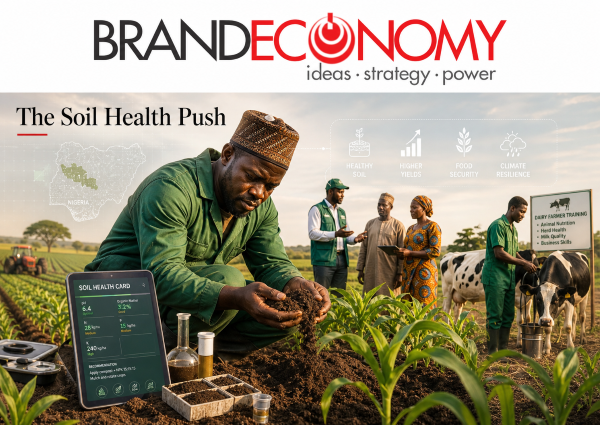 Nigeria wants to provide soil test-based advisory services to at least 10 million farmers by 2027, in a major push to improve productivity, nutrition and rural incomes. The programme, built around digital soil health cards, mobile laboratories, organic fertilisers and improved advisory systems, could become one of the most important agricultural interventions under the food-security agenda. But its success will depend on execution: laboratories, extension workers, farmer trust, state readiness, financing and the ability to turn soil data into higher yields.
The Land Beneath the Food Crisis
Nigeria’s food-security challenge is often discussed in terms of insecurity, fertiliser prices, transport costs, climate shocks, weak storage, farmer credit and market access. All these matter. But beneath them lies a quieter crisis: the health of the soil itself.




The Federal Government now says no fewer than 10 million farmers will receive soil test-based advisory services by 2027, as part of a national effort to raise productivity, improve nutrition and strengthen farmer incomes. The Minister of State for Agriculture and Food Security, Senator Aliyu Abdullahi, disclosed this in Abuja during the unveiling of the Readiness Assessment of Sub-Nationals for the Nigerian Farmers Soil Health Scheme.
The ambition is substantial. About five million hectares are expected to be managed through improved soil practices, including organic fertilisers, lime application, cover crops and agroforestry systems. Farmers across Nigeria’s 774 local government areas are also expected to receive digital soil health cards using mobile technology.
If well implemented, this could shift Nigerian agriculture from guesswork to evidence-based production.
Why Soil Testing Matters
For decades, many Nigerian farmers have applied fertilisers without precise knowledge of what their soil actually needs. Some soils are acidic. Some are depleted. Some lack specific nutrients. Some require organic matter rather than more chemical fertiliser. Some need lime. Some need cover crops. Some need better water management.
When farmers apply inputs blindly, they waste money, reduce efficiency and often fail to achieve optimal yields.
Soil testing changes that equation. It tells the farmer what the land needs, what crop will perform better, what nutrient gaps exist and how to restore fertility. In practical terms, soil data can determine whether a farmer earns more or loses a season.
That is why the soil health scheme is potentially transformative. It recognises that food security is not achieved merely by distributing inputs. It is achieved by matching the right inputs to the right land, at the right time, under the right advisory system.
This is agribusiness intelligence, not charity.
The Readiness Test for States
The readiness assessment is designed to identify degraded soils, gaps in access to soil testing and capacity constraints in delivering advisory services nationwide. According to Abdullahi, the report draws from fieldwork, laboratory audits, policy analysis, stakeholder consultations and data validation across states.
This is important because agriculture is not executed in Abuja alone. States control much of the ground reality: extension workers, farmer clusters, local laboratories, input distribution systems, agro-dealer networks and implementation partners.
The assessment covers five pillars: policy and governance, institutional capacity, technical readiness, stakeholder engagement, and monitoring and evaluation systems. These are the right pillars because soil health reform is not only scientific. It is institutional.
A state may have fertile land but weak extension services. Another may have laboratories but no data platform. Another may have active farmer groups but poor financing. Another may face severe erosion or flooding but lack climate-smart advisory systems.
The readiness assessment should help Nigeria avoid one of its recurring policy mistakes: designing a national programme as though all states are equally prepared.
They are not.
Digital Soil Health Cards and the Data Future of Farming
One of the most promising aspects of the scheme is the proposed use of digital soil health cards.
These cards could help farmers understand their soil profile, recommended fertiliser mix, organic matter needs, acidity levels and crop suitability. If integrated into mobile platforms, they could also connect farmers to extension advice, input suppliers, credit providers, insurers, off-takers and government support programmes.
That is where the real opportunity lies.
A soil health card should not become another document farmers receive and forget. It should become part of a wider agricultural data system. With proper design, soil intelligence can support precision input use, reduce fertiliser waste, improve yields, guide irrigation planning, support climate resilience and help banks or insurers better assess agricultural risk.
Nigeria’s farming future will be built not only on land and labour, but on data.
Organic Fertilisers, Biochar and the Return of Soil Restoration
The minister also highlighted organic fertilisers, biochar, lime application and improved extension services as part of the scheme.
This is critical. Nigeria’s soil problem cannot be solved with chemical fertiliser alone. Many soils need restoration, not just stimulation. Organic matter improves water retention, microbial activity and long-term fertility. Lime can correct soil acidity. Cover crops can reduce erosion and improve soil structure. Agroforestry can support biodiversity, carbon retention and resilience.
The transition from extractive farming to regenerative soil management will be essential if Nigeria wants to protect yields under climate pressure.
Flooding, erosion, heat stress and changing rainfall patterns are already affecting farmers. Soil health is therefore not just an agricultural issue. It is a climate-resilience issue.
The Dairy Connection: Training Farmers for Value-Chain Transformation
The same policy logic applies to the livestock sector.
At a separate training programme in Ibadan, the Federal Government said the capacity development of grassroots farmers is central to transforming national dairy production. Mr Idris Ajimobi, Senior Special Assistant to the President on Livestock Development, said the training of 100 small-scale dairy farmers was aimed at improving productivity, quality and sustainability in the dairy value chain.
The Oyo State Coordinator of the Federal Ministry of Livestock Development, Dr Florence Kalulu, noted that small-scale dairy farmers remain essential to local milk production, rural income and food security. But she also identified persistent challenges: low productivity, poor animal health management, inadequate hygiene practices and limited access to modern techniques.
This is the same agricultural truth expressed differently: knowledge must reach the farmer.
Policies do not milk cows. Farmers do. Policies do not restore soil. Farmers do. Policies do not raise yields by themselves. Extension, training, tools, finance and market access do.
The call by Mrs Racheal Eyitayo-Ariori, President of the Women in Dairy Production Association, for greater inclusion of women in dairy production is also strategically important. Women are central to food systems, yet are often under-supported in finance, training, land access and technology adoption.
The Agribusiness Case
Nigeria’s agricultural transformation will require moving farmers from subsistence logic to productivity logic.
Soil testing can reduce wasteful input use. Better dairy training can improve milk quality and yields. Digital platforms can connect farmers to advisory services. Farmer data can improve credit access. Better practices can raise incomes. Higher output can reduce food-price pressure.
But none of this is automatic.
The risk is familiar: strong announcements, weak execution. Farmers have seen many schemes come and go. To build trust, the government must ensure that soil cards are accurate, laboratories are functional, extension workers are available, recommendations are practical and inputs are affordable.
A farmer who receives a soil recommendation but cannot access the required fertiliser, lime or organic amendment will not benefit. A dairy farmer trained on hygiene but unable to access cold-chain infrastructure or veterinary services will remain constrained.
Agricultural reform must be end-to-end.
BRANDECONOMY Insight
Nigeria’s plan to reach 10 million farmers with soil advisory services is one of the most consequential agricultural ideas now on the table.
The country cannot defeat food inflation, rural poverty or low productivity without fixing the soil. For too long, Nigerian agriculture has relied on effort without enough intelligence. Farmers plant, fertilise and harvest in conditions where they often lack the most basic data about the land beneath them.
Soil testing changes the conversation. It turns farming into a more scientific enterprise. It allows government support to be targeted. It helps farmers reduce waste. It improves productivity. It strengthens resilience. It can also create a foundation for agricultural finance, insurance and market planning.
But the scheme must not become another bureaucratic dashboard. Its real measure will be simple: did farmers produce more, earn more and waste less?
The dairy training initiative carries the same lesson. Nigeria’s food system will not be transformed from conference halls. It will be transformed when practical knowledge reaches farmers, when women are included, when young people see agriculture as viable enterprise, and when value chains are supported from production to processing and markets.
The future of Nigerian agriculture is not only bigger farms. It is smarter farms.
Soil is the first asset. Data is the new fertiliser. Farmers are the enterprise.
Strategic Takeaways
For government:
Soil testing must be tied to affordable inputs, extension support, financing and measurable yield improvements.
For states:
The readiness assessment should help target investments based on real gaps in laboratories, extension systems and farmer networks.
For farmers:
Soil health cards can improve productivity only when recommendations are understood and implemented.
For investors:
Soil diagnostics, organic fertilisers, digital advisory platforms, dairy training, veterinary services and cold-chain infrastructure present major agribusiness opportunities.
For food security:
Improving soil health is one of the fastest routes to stronger yields, better nutrition and reduced pressure on food prices.