


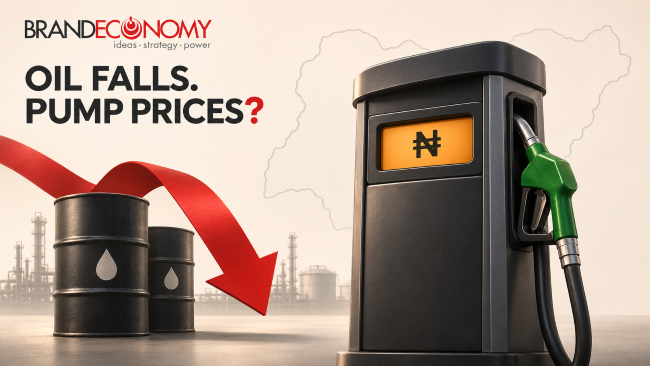
 Nigeria’s competition watchdog (the FCCPC) is pressing refiners and petroleum marketers to pass falling costs through to consumers, putting the fairness of fuel pricing under scrutiny as global crude retreats but domestic petrol prices remain elevated.
The Federal Competition and Consumer Protection Commission said it expected lower wholesale petrol costs to translate into retail savings without unnecessary delay. Executive Vice Chairman Tunji Bello announced the monitoring in Abuja on Tuesday, November 10, following public complaints and enquiries.



The intervention is a test of deregulation: whether prices respond to cheaper inputs as readily as they respond to supply shocks. It is not an announcement of a price ceiling, a compulsory reduction or a concluded finding against any operator.
The gap troubling consumers
Bello cited reports that Brent crude futures had declined from a September peak of $115 a barrel to below $90 this week. Separately, Reuters reported that Brent briefly traded below $90 on Tuesday, underlining the volatility surrounding the latest retreat.
According to the commission, petrol was selling for ₦1,405–₦1,420 per litre in Abuja and ₦1,325–₦1,370 in Lagos. These are its quoted market ranges, not a nationwide station survey.
For comparison, Bello said Brent closed at $72.48 on February 27, immediately before the conflict involving the United States, Israel and Iran began. Petrol around that period sold for ₦839–₦925 across Lagos and Abuja, he said.
Marketers have attributed much of the subsequent increase to international crude volatility associated with the Middle East conflict. Bello’s argument is that sustained improvements in those conditions should benefit buyers, rather than leave the higher prices permanently embedded.
Crude prices are not pump prices
The consumer case is compelling, but the pricing comparison requires discipline.
A barrel of crude is an input, not a finished litre of petrol. Refining margins, international petrol benchmarks, freight, insurance, exchange rates, financing, distribution and retail operating expenses influence what Nigerians ultimately pay.
A weaker naira can offset cheaper dollar-priced supplies. Equally, lower crude prices may not immediately reduce finished-product prices when refinery disruptions constrain petrol availability.
Inventory matters too. Retailers may still be selling fuel purchased at earlier prices. But expensive stock cannot become an indefinite explanation: regulators should compare purchase records, replenishment dates and wholesale adjustments against actual retail behaviour.
Nor does a roughly 22 per cent decline from $115 to below $90 automatically justify an equivalent pump-price reduction. The appropriate calculation must establish the change in the complete supply cost.
Scrutiny must follow the money
Bello said the FCCPC would work with the Nigerian Midstream and Downstream Petroleum Regulatory Authority and other agencies to track wholesale and retail prices.
He warned that evidence of anti-competitive conduct or unfair practices preventing consumers from receiving savings would attract action within the commission’s mandate.
That qualification matters. High prices alone do not establish collusion, and similar prices can reflect shared costs rather than coordination. Investigators must distinguish legitimate commercial decisions from restrictive agreements, deceptive pricing or other prohibited conduct.
The commission has previously clarified that it does not set or approve petroleum prices in the deregulated market. Its task is to protect competition and consumers, not replace market pricing with an administratively preferred figure.
What businesses stand to gain
Sustained reductions would ease operating costs for transporters, delivery businesses, traders and enterprises running petrol generators. Diesel relief would separately benefit haulage, larger generators and other commercial users.
Lower fuel expenditure could release household income for food, healthcare and other purchases, supporting consumer-facing businesses.
However, cheaper petrol does not automatically reverse transport fares or food inflation. Vehicle maintenance, wages, security, borrowing costs and distribution bottlenecks also shape those prices. Any relief should be measured across the supply chain, not declared from a single commodity quotation.
There is a national trade-off, however. Cheaper crude can lower fuel-supply costs while reducing Nigeria’s export receipts and fiscal revenues, other things equal. Policymakers must therefore separate the household benefit from the sovereign exposure, rather than describe falling oil prices as an unqualified economic windfall.
The investor and brand calculation
For refiners and marketers, falling prices can generate inventory losses and pressure cash flows. Investors should examine stock turnover, foreign-exchange exposure, replacement costs and margins rather than assume every delayed reduction represents excessive profit.
Predictable, evidence-led regulation also matters. Enforcement grounded in disclosed methodology can strengthen confidence; arbitrary demands could discourage investment or disrupt supply.
For fuel brands, responsiveness is becoming a trust differentiator. Operators that explain adjustments clearly, maintain accurate pump measurements and compete transparently can build loyalty. Repeatedly invoking global markets only when prices rise invites reputational damage.
BRANDECONOMY Insight
Nigeria’s deregulated fuel market must pass a two-way credibility test: consumers should bear genuine cost increases, but also receive genuine savings.
The FCCPC should publish comparable wholesale and retail trends, explain reasonable adjustment periods and identify the cost components under review. Operators should substantiate claims with transaction evidence, not broad references to market volatility.
This is not a choice between investor returns and consumer protection. Competitive returns attract supply; transparent competition ensures efficiency gains are not trapped within the chain.
The decisive outcome will therefore be neither a threatening statement nor an isolated price cut. It will be a market in which changes are explainable, enforcement is defensible and sustained savings reach consumers visibly, consistently and promptly across Nigeria’s diverse fuel distribution network.