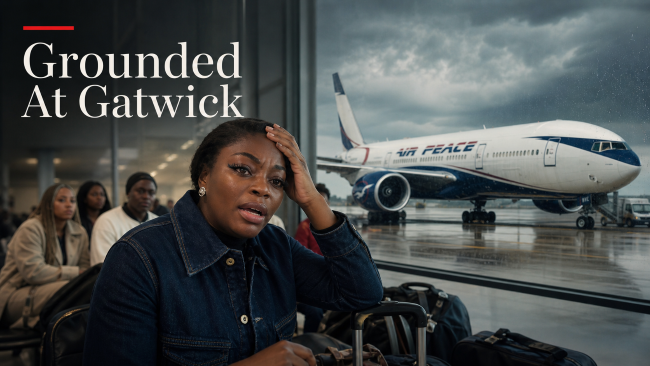
 Air Peace says a bird strike forced the grounding of its London Gatwick–Lagos aircraft for mandatory safety checks. That explanation is credible in aviation: bird strikes are recognised operational hazards and no serious airline should fly an aircraft before engineering clearance. But the anger that followed—amplified by Nollywood star Funke Akindele—was not really about the bird strike. It was about passenger welfare, communication, luggage access and the duty of care when safety disruptions become long, exhausting delays.
When Safety Meets Service Failure
Air Peace has found itself at the centre of a fresh passenger-care controversy after travellers on its London Gatwick–Lagos service were left stranded for hours following a disruption attributed to a bird strike.




The airline, through its spokesperson, Osifo-Whiskey Efe, said the affected aircraft experienced a bird strike and was immediately grounded for comprehensive inspection and engineering checks. The airline stressed that this step was consistent with international aviation safety practice and was taken to protect passengers and crew. Reports from several Nigerian outlets confirmed that Air Peace linked the disruption to the bird strike and said affected passengers were being contacted on the next steps.
On the safety question, Air Peace has a strong defence. Aviation is not a business where operators are allowed to gamble. A bird strike can affect aircraft components, engines, sensors or structures, depending on the point of impact. Even where there is no visible catastrophic damage, the aircraft must be inspected before it is returned to service. No passenger wants an airline to compromise safety in order to preserve a schedule.
But aviation is not judged by safety alone. It is also judged by communication, contingency planning and passenger dignity.
That is where the anger began.
Funke Akindele and the Power of Public Complaint
Nollywood filmmaker Funke Akindele publicly criticised the airline on X, saying passengers—including elderly travellers—had been at Gatwick since early morning without adequate communication, hotel accommodation, access to bags or clear updates. She said passengers had been told a bird strike caused the disruption and that a hotel would be provided, but many remained around the baggage area for hours, tired and hungry.
Her criticism became a pressure point because she gave public visibility to a familiar passenger experience: not merely a delay, but uncertainty.
For airlines, delay management is now reputation management. A disruption can be operationally unavoidable, but poor communication turns inconvenience into outrage. In the age of social media, the passenger terminal is also a newsroom. Every tired traveller has a camera. Every delayed flight can become a national conversation. Every unanswered question becomes evidence of neglect.
Air Peace responded by expressing regret and attributing the incident to factors outside its control. It also said it had begun communicating with affected passengers on alternative arrangements. That response was necessary, but the speed and clarity of such communication are often what define public perception.
The Real Issue: Duty of Care
The issue here is not whether bird strikes happen. They do. The issue is what an airline owes passengers when disruptions extend for several hours.
On international routes, stranded passengers expect timely updates, clear timelines, access to refreshments, assistance for vulnerable travellers, information about baggage, hotel arrangements where appropriate, and a visible ground team empowered to solve problems.
Aviation customers understand safety delays better than airlines sometimes assume. What passengers resent is silence, confusion and the feeling of being abandoned.
Air Peace’s London route is strategically important. It is part of the airline’s ambition to prove that a Nigerian carrier can compete on major international corridors. That ambition must be supported not only by aircraft and route rights, but by service systems that match global passenger expectations.
The London–Lagos route is emotionally and commercially significant. It carries students, families, business travellers, professionals, tourists, diaspora Nigerians and elderly passengers. When things go wrong on such a route, the airline is not just moving customers; it is managing national perception.
Safety Is Non-Negotiable, But Communication Is Also Safety
There is a deeper aviation management lesson here: communication is part of operational safety culture.
When passengers do not know what is happening, crowd frustration rises. Vulnerable passengers suffer. Ground staff come under pressure. Rumours spread. Anger escalates. Airport stakeholders are drawn into the disruption. The airline loses control of the narrative.
The proper response to a safety disruption should therefore follow a disciplined passenger-care playbook: confirm the cause, explain what safety checks are required, give realistic update intervals, identify vulnerable travellers, provide refreshments where necessary, arrange hotels if the delay crosses a threshold, clarify baggage access, and maintain a visible help desk.
This is not public relations. It is operational maturity.
BRANDECONOMY Insight
Air Peace is right to ground an aircraft after a bird strike. No airline should be punished for choosing safety over schedule. In aviation, caution is not weakness; it is professionalism.
But the Gatwick disruption exposes a different weakness: passenger-care execution.
For Nigerian aviation, this is an important moment. Domestic and international travellers are becoming less tolerant of poor communication, delayed explanations and weak contingency support. As Nigerian carriers expand into global routes, they must compete not only on patriotism, pricing or route convenience, but on service reliability under pressure.
The aviation business is unforgiving because disruptions are inevitable. Weather happens. Technical issues happen. Bird strikes happen. Airport constraints happen. What separates stronger airlines from weaker ones is how they handle the disruption.
Air Peace has built one of Nigeria’s most important aviation brands. Its international expansion is strategically valuable for the country. But brand credibility on global routes will depend heavily on how it treats passengers when operations fail.
The lesson is clear: safety protects lives; service protects trust.
If Air Peace wants to win long-term loyalty on the London–Lagos corridor, it must ensure that a safety incident does not become a customer-abandonment story. The aircraft must be inspected, certainly. But passengers must also be informed, fed, accommodated, reassured and treated with dignity.
Aviation is not only about flying people. It is about carrying trust.