UNICCON’s Indigenous Drone Push Signals Nigeria’s Defence-Tech Ambition

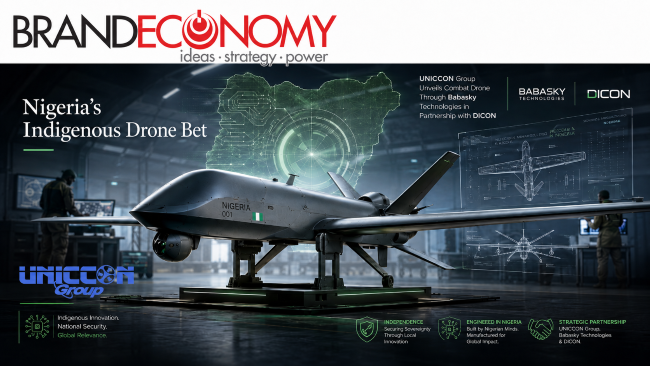 UNICCON Group says it has developed an indigenous loitering munition drone through its subsidiary, Babasky Technologies, in partnership with the Defence Industries Corporation of Nigeria. The platform, unveiled in Jaji, Kaduna State, is being positioned as a milestone in Nigeria’s defence-technology journey and a signal that local engineering capacity may yet play a larger role in national security, manufacturing and Africa’s emerging defence-industrial economy.
A New Claim in Nigeria’s Defence-Tech Story
Nigeria’s search for homegrown security technology has received a fresh boost with UNICCON Group’s announcement of an indigenous loitering munition drone, developed through its subsidiary, Babasky Technologies.




The company said the drone system, known as the UNIKAM Series, was developed in partnership with the Defence Industries Corporation of Nigeria, the country’s state-backed defence manufacturing institution.
The announcement was made in Abuja by UNICCON Group Chairman, Prof. Chuks Ekwueme, who said the platform was unveiled at a secured facility in Jaji, Kaduna State.
For Nigeria, the significance of the project goes beyond one product. It sits within a larger national question: can the country reduce dependence on imported defence systems by building credible local technology for its own security realities?
That question has become more urgent as Nigeria and several African countries continue to confront terrorism, banditry, insurgency, organised crime, border threats and hard-to-police terrain.
Local Engineering, Local Security Realities
According to Ekwueme, the UNIKAM Series was designed and developed in Nigeria by indigenous engineers. He described it as a major step in Nigeria’s technological and defence advancement, adding that the system was created to support responses to Africa’s evolving security challenges.
The company said the platform integrates artificial intelligence and autonomous detection capabilities. It also said its components and related systems were locally sourced and produced by Nigerian engineers.
That claim, if independently validated and scaled, would be important.
Nigeria has long suffered from the twin burden of security pressure and procurement dependence. Imported military hardware can be expensive, slow to acquire, difficult to maintain and vulnerable to supply-chain delays or foreign policy restrictions. Indigenous defence production, on the other hand, can support faster adaptation, local maintenance, job creation, technical skills and industrial learning.
This is why defence technology should not be viewed only through the security lens. It is also an industrial policy issue.
DICON and the Defence-Industrial Push
The involvement of DICON gives the project added institutional significance.
DICON has historically been central to Nigeria’s defence manufacturing ambition. Its partnership with private technology firms such as UNICCON suggests a model in which government defence institutions and indigenous innovators work together to develop systems suited to local operational needs.
Ekwueme said the partnership between UNICCON Group and DICON has lasted more than two years and has produced innovations across drone systems and electronic warfare technologies.
At the Jaji demonstration, the company said other advanced defence solutions were also showcased, including electronic countermeasure systems.
For Nigeria, this partnership model is strategically important. The state has the security mandate; private technology firms often bring speed, experimentation and engineering agility. Where both sides align properly, local innovation can move from prototypes to operational capability.
The Technology Ambition
UNICCON is presenting the UNIKAM Series as part of a wider African technology ambition.
The company said military experts who assessed the system praised its operational strength and technological resilience. It also argued that the innovation could reduce foreign procurement dependence and open export opportunities across Africa.
That export ambition is not far-fetched in theory. Many African countries face similar security and surveillance challenges, including vast terrain, porous borders and asymmetric threats. A reliable, locally adaptable, cost-competitive African defence-technology product could find demand.
But export credibility will depend on certification, regulatory compliance, operational testing, production consistency, ethical deployment rules, after-sales support and quality assurance.
In defence technology, announcements are only the beginning. Reliability is everything.
From Prototype to Industry
The real test for UNICCON and DICON will be scale.
Many countries announce indigenous defence innovations. Fewer build a sustainable industrial base around them. To move from demonstration to market relevance, Nigeria must answer several questions.
Can the platform be produced consistently at scale? Are supply chains truly local and resilient? What standards and testing regimes will govern performance? Can local technicians maintain the system? Will production create skilled jobs? How will export controls and responsible-use frameworks be handled? Can the project attract long-term financing without becoming dependent on one-off government patronage?
These questions matter because defence manufacturing is not a publicity exercise. It requires industrial discipline, precision engineering, quality control, cybersecurity, component reliability and strong governance.
If Nigeria gets this right, the benefits could stretch beyond one drone system. It could deepen the local ecosystem for robotics, sensors, embedded systems, AI, aerospace components, materials engineering and secure communications.
That is the bigger prize.
Government’s Signal
In his remarks, the Director-General of DICON, Maj.-Gen. Babatunde Alaya, commended UNICCON for the initiative and reaffirmed the Federal Government’s commitment to strengthening indigenous defence technology and regional collaboration.
That policy backing is essential. But government support must be matched with clear procurement standards, transparent evaluation, local-content development, export regulation and sustained funding for defence research and development.
The danger is that promising innovations may remain isolated projects if they are not tied to a broader defence-industrial strategy.
Nigeria needs more than prototypes. It needs an ecosystem.
BRANDECONOMY Insight
UNICCON’s announcement is significant because it points to a larger shift Nigeria must make: from consuming security technology to producing it.
For too long, Nigeria’s defence procurement model has depended heavily on foreign suppliers. That dependence is costly, strategically limiting and often poorly aligned with local operating realities. Indigenous defence technology can help change the equation, but only if it is built on real engineering competence, not ceremonial unveiling.
The UNIKAM Series, developed through Babasky Technologies in partnership with DICON, should therefore be treated as both a technological milestone and an industrial test.
The opportunity is clear. Nigeria can use defence technology to strengthen national security, build local manufacturing capacity, deepen AI and robotics expertise, create skilled jobs and position itself within Africa’s emerging security-technology market.
But the risks are equally clear. Defence-tech development requires strong governance, responsible deployment, rigorous testing, clear legal controls and credible quality assurance. Without these, innovation can become either unsafe, politicised or commercially weak.
The smartest path is to build a full defence-industrial pipeline: research, prototype development, testing, certification, production, maintenance, export control and ethical-use frameworks.
If UNICCON and DICON can move beyond demonstration into repeatable production and operational reliability, Nigeria may have a serious opportunity to build a new technology frontier.
In the 21st century, national security will not be defended only by boots on the ground. It will also be shaped by code, sensors, robotics, data, manufacturing and the ability to innovate under pressure.
Nigeria cannot afford to remain only a buyer.
It must become a builder.