#OccupyINEC: Atiku, Obi, Kwankwaso, Amaechi lead Protest
Battle over 2027 Elections

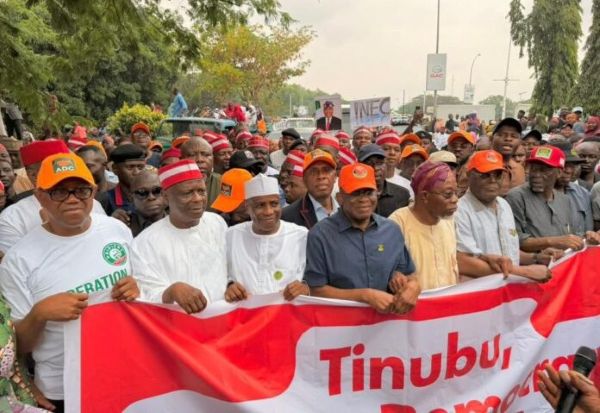 Nigeria’s electoral system—already under intense scrutiny ahead of the 2027 cycle—has entered another moment of institutional tension. In Abuja, a coalition of opposition leaders and civil society actors staged a coordinated protest against the Independent National Electoral Commission, accusing the electoral umpire of overreach in its handling of an internal leadership dispute within the African Democratic Congress.
At the centre of the confrontation is INEC’s decision to derecognise factions of the party’s leadership pending judicial resolution—effectively freezing its operational legitimacy at a critical pre-election juncture.




A Protest Framed as Democratic Defence
Leading figures—including Atiku Abubakar, Peter Obi and Rabiu Kwankwaso—joined the demonstration under the banner of “Save Democracy in Nigeria,” converging on Abuja’s Maitama axis.
The symbolism was deliberate. Placards warning against a drift toward a one-party state, alongside chants invoking democratic preservation, framed the protest not merely as partisan resistance but as a broader institutional critique.
Yet beneath the rhetoric lies a specific grievance: that INEC’s interpretation of an appellate court ruling has effectively constrained the ADC’s ability to organise, communicate and prepare for future elections.
Law, Procedure—and Institutional Boundaries
INEC’s position, by contrast, is rooted in procedural caution. Citing ongoing litigation stemming from Appeal No. CA/ABJ/145/2026, the commission maintains that its actions are guided by the need to preserve the status quo pending final judicial determination.
This raises a critical legal question: where does regulatory compliance end and institutional interference begin?
In Nigeria’s electoral jurisprudence, political parties retain autonomy over internal affairs—subject, however, to judicial oversight. INEC’s role is administrative, not adjudicative. The ADC and its allies argue that the commission has blurred that boundary; INEC insists it is merely respecting it.
The courts, ultimately, will arbitrate.
Electoral Stakes: Beyond the Immediate Dispute
The implications extend well beyond the ADC. If unresolved, the leadership dispute—and INEC’s stance—could affect the party’s eligibility to field candidates in future elections.
That prospect has elevated the dispute from an internal matter to a systemic concern, particularly among opposition actors wary of institutional asymmetry ahead of 2027.
The presence of figures such as David Mark, Rotimi Amaechi and Rauf Aregbesola underscores the breadth of that concern.
Political Economy of Protest
From a broader perspective, the protest reflects a familiar dynamic in emerging democracies: institutional trust deficits manifesting in public mobilisation.
As electoral cycles approach, the cost of perceived bias rises—affecting investor sentiment, governance stability and policy continuity.
Nigeria’s democracy, while resilient, remains sensitive to such signals. The credibility of its electoral institutions is not merely a political asset; it is an economic one.
Between Reform and Resistance
For INEC, the challenge is to maintain procedural integrity without appearing partisan. For opposition actors, the task is to convert protest into constructive legal engagement.
Between these positions lies the fragile equilibrium upon which Nigeria’s democratic trajectory depends.
BRANDECONOMY Insight
- Institutional Credibility Is Economic Capital
Perceptions of electoral fairness directly influence investor confidence, sovereign risk assessments and long-term capital inflows. - Legal Clarity Will Define Political Stability
The courts’ interpretation of party autonomy versus regulatory oversight will shape not just this dispute, but future electoral conduct. - Opposition Cohesion Signals Strategic Realignment
The convergence of multiple political heavyweights suggests early coalition-building ahead of 2027—a development with significant electoral implications. - Protest as Democratic Pressure Valve
Peaceful demonstrations remain a critical mechanism for institutional accountability—but their impact depends on legal follow-through. - Risk of Systemic Exclusion Narrative
If opposition parties perceive structural disadvantage, it could fuel narratives of democratic erosion—raising both domestic and international concerns.