
NPA Intensifies Truck Control to Ease Lagos Port Congestion, Improve Cargo Evacuation

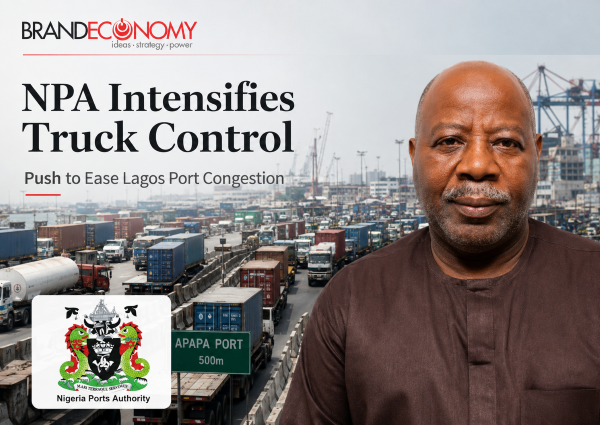 The Nigerian Ports Authority says it is tightening truck movement into Lagos ports through scheduled batch releases, daily road clearance and stronger enforcement. The move is more than a traffic-control exercise; it is a test of Nigeria’s ability to turn its busiest maritime gateway into a faster, more predictable and investor-friendly trade corridor.
The Nigerian Ports Authority, NPA, has intensified measures to eliminate truck gridlock and improve cargo evacuation at the Lagos Port Complex, with a renewed focus on scheduled truck releases, stricter enforcement and better coordination with private logistics platforms.



The General Manager, Lagos Port Complex, Mr Debo Lawal, disclosed this in Lagos, saying the NPA management under the Managing Director, Dr Abubakar Dantsoho, is determined to end indiscriminate truck parking around Apapa and Tin Can port corridors.
Lawal said the Authority is working with Truck Transit Parks Ltd., TTP, to regulate truck movement into terminals through a phased release system rather than allowing all approved trucks to enter the port corridor at once.
“If a terminal requires 100 trucks, they will not all be released at once. They will come in batches to reduce pressure on the port access roads,” he said.
The Core Problem
Lagos ports are Nigeria’s most important maritime gateway, but they have long carried the burden of congestion, weak traffic discipline, uneven truck scheduling and inefficient cargo evacuation.
Apapa and Tin Can are not just port locations. They are national supply-chain arteries. When they slow down, the cost is felt by importers, exporters, manufacturers, freight forwarders, shipping companies, transporters, consumers and government revenue agencies.
Reuters has reported that Nigeria’s port inefficiencies significantly raise import costs, with Lagos logistics costs far higher than comparable routes in South Africa and Ghana, according to SBM Intelligence.
That is why the latest NPA truck-control effort matters.
A port cannot be globally competitive if its access roads function like holding bays.
Scheduled Truck Releases
Lawal said the new approach is designed to align truck inflow with actual terminal demand.
This means that trucks will move into the port in controlled batches, reducing the pressure that comes when too many trucks converge on the same roads, bridges and terminal gates at the same time.
The logic is simple: port traffic must become demand-led, not chaos-led.
If implemented properly, scheduled release can improve road discipline, reduce illegal parking, ease terminal queues, reduce cargo dwell time and make the movement of goods more predictable.
But the system must be backed by real-time data, enforcement, compliance by truckers and discipline by terminals.
Clearing the Corridors
Lawal disclosed that a joint task force has been clearing Apapa and Tin Can port access roads since June 26, 2026, operating until about 8 p.m. daily to prevent indiscriminate parking.
He added that another clearance exercise would soon be carried out to sustain the gains and prevent a return to the prolonged gridlock that previously defined the port environment.
This is necessary, but it also raises an uncomfortable question: what went wrong after earlier improvements?
In 2024, port access roads were reported to have been fully cleared. Yet by 2026, the NPA is again intensifying enforcement.
That suggests the problem is not only clearing trucks. It is sustaining systems.
A one-off clearance can restore order temporarily. But without consistent enforcement, functional truck parks, reliable electronic call-up, terminal discipline, road maintenance and sanctions for violations, the old gridlock can return.
Truckers Must Comply
Lawal said truck operators also have a responsibility to support the initiative.
According to him, some drivers still park along access roads after loading or offloading cargo, instead of leaving the port environment immediately.
He said NPA engages truckers and their leadership daily, but enforcement will continue alongside sensitisation.
That balance is important.
Truckers are not merely offenders; they are participants in the logistics chain. But where sensitisation fails, enforcement must work. A few non-compliant operators can undermine an entire port-access system.
The rule must be clear: once a truck has completed its port operation, it must exit the corridor.
The Infrastructure Push
Beyond traffic control, Lawal disclosed that the Federal Government, through NPA, has begun payment of the five per cent counterpart funding for the $726 million port rehabilitation project.
He said preliminary activities, including borehole drilling and site investigations, had been completed, with contractors expected to mobilise before the end of July.
A technical stakeholders’ meeting was held on July 7, while a broader stakeholders’ review was scheduled for July 13 to assess progress and address gaps.
The rehabilitation project is significant because traffic management cannot succeed without strong port infrastructure.
Old quay walls, weak pavement, inadequate berthing capacity, inefficient terminal layouts and poor access design can all slow cargo movement. Lagos ports need not only discipline outside the gates, but efficiency inside the terminals.
Digital Reform
Lawal also said the National Single Window project is about 80 per cent completed, with a dedicated office already established near the port to improve inter-agency coordination.
The platform is expected to integrate banks, the Nigeria Customs Service, shipping companies and other government agencies to improve efficiency, reduce human interference, plug revenue leakages and enhance revenue collection.
This aligns with Nigeria’s wider digital trade reform. Reuters reported in March that Nigeria was launching the first phase of the National Single Window to streamline imports and exports, reduce bureaucratic delays and improve trade facilitation.
For the port system, digitisation is not cosmetic. It is operational medicine.
When documents move faster, cargo moves faster. When agencies share data, duplication falls. When payments and approvals are integrated, discretion reduces. When human interference declines, transparency improves.
Why Congestion Keeps Returning
The recurring Apapa gridlock points to several structural weaknesses.
First, Lagos ports still rely heavily on road-based cargo evacuation. Rail and barge options exist, but road haulage remains dominant.
Second, truck holding infrastructure is often insufficient or poorly used.
Third, some operators treat access roads as free parking space.
Fourth, terminal demand signals are not always matched with truck movement in real time.
Fifth, multiple agencies and stakeholders influence port operations, sometimes creating coordination gaps.
Sixth, enforcement tends to weaken once public pressure reduces.
This is why the NPA’s latest intervention must move beyond clearance, beyonf mere truck control to governance.
Market Implications
Efficient port access can reduce the cost of doing business in Nigeria.
For importers, it means lower demurrage, reduced storage costs, fewer delays and more predictable inventory planning.
For exporters, especially non-oil exporters, it can improve shipping timelines and strengthen buyer confidence.
For manufacturers, it can reduce raw-material supply disruption.
For consumers, lower logistics friction can ease price pressure over time.
For government, faster cargo evacuation and effective truck control can improve revenue collection and reduce leakages.
In a region where global shipping firms are positioning for long-term opportunities, port efficiency is a competitive issue. Reuters reported in March that MSC secured a 45-year Lagos port concession with Nigerdock as part of a broader $1 billion investment in Nigeria’s logistics and infrastructure sector, underscoring continued private-sector interest despite congestion challenges.
Brand Implications
For NPA, the brand promise is efficiency.
The Authority’s reputation will increasingly depend not on announcements, but on whether Apapa and Tin Can users experience faster access, cleaner corridors, predictable truck movement and reduced documentation friction.
For Nigeria, ports are part of the national investment brand.
A country that wants to lead African trade cannot allow its prime maritime gateways to be defined by disorder, delays and avoidable costs.
For logistics firms, truck operators and terminal managers, compliance is also a brand issue. Businesses that respect scheduling, use truck parks properly and support transparent systems will become more trusted partners.
Investor Relevance
Investors should watch Lagos port reform closely because it affects multiple sectors.
Opportunities may emerge in:
- truck parks and fleet management
- port technology and tracking systems
- cargo evacuation platforms
- rail and barge logistics
- warehousing and inland dry ports
- customs and trade-compliance technology
- equipment leasing
- marine services
- cold-chain logistics
- export processing and industrial zones
But investors will want evidence that reforms are durable.
They will watch whether scheduled truck releases work, whether the National Single Window reduces delays, whether rehabilitation projects move on schedule and whether enforcement survives political and commercial pressure.
What Must Change
The next phase should be guided by measurable outcomes.
NPA and stakeholders should track:
- average truck waiting time
- truck control efficiency
- cargo dwell time
- number of illegal parking incidents
- terminal gate turnaround time
- call-up compliance rates
- number of trucks released by batch
- road-clearance enforcement outcomes
- documentation processing time
- inter-agency response time
- rail and barge evacuation volumes
Without data, reform becomes perception.
With data, reform becomes management.
BRANDECONOMY Insight
The NPA’s truck-control reset is a welcome intervention. But Lagos port congestion has survived too many emergency measures to be solved by road clearance alone.
The issue is systemic.
Nigeria must treat port access as economic infrastructure, not traffic nuisance. Trucks must be scheduled. Truck Control must be effiient. Terminals must be disciplined. Agencies must be integrated. Roads must be protected. Digital systems must work. Enforcement must be sustained.
The question is not whether Apapa can be cleared for a week.
It is whether Nigeria can build a port-operating culture that prevents the gridlock from returning.
In maritime trade, time is money. At Lagos ports, time has too often become waste.