FG Suspends WAEC, NECO N50k Fee Review: Why Affordability Must Shape Nigeria’s Exam Policy

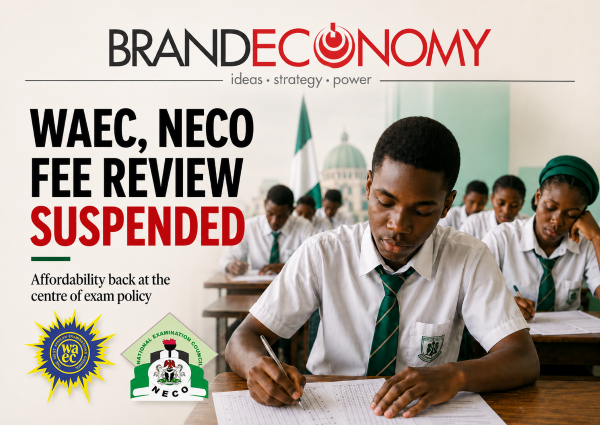 The Federal Government’s decision to suspend the proposed review of registration fees for the 2027 WAEC and NECO senior school examinations is more than an administrative pause. It is a recognition that examination fees sit at the sensitive junction of household hardship, education access, human-capital development and national competitiveness.
The Federal Ministry of Education announced the suspension in Abuja through a statement issued by its Director of Press and Public Relations, Folasade Boriowo. According to the Ministry, its earlier June 18, 2026 letter conveying the proposed fee adjustment has been withdrawn to allow for a more comprehensive review and wider consultations before a final decision is taken.



The proposal had triggered public concern after reports that registration fees for the West African Senior School Certificate Examination, WASSCE, conducted by WAEC, and the Senior School Certificate Examination, SSCE, conducted by NECO, could rise to a uniform ₦50,000 per candidate from 2027. The reported adjustment would have moved NECO’s internal SSCE fee from ₦30,000 to ₦50,000, while WAEC’s fee would have increased from ₦27,000 to the same ₦50,000 level.
A Policy Pause
Boriowo said the proposed review was informed by prevailing economic realities and the rising cost of conducting credible national examinations.
She cited higher expenses linked to logistics, security, printing of examination materials, technology deployment, quality assurance and other essential services.
But the Ministry also acknowledged public concern and constructive feedback. It said the Minister of Education, Dr Tunji Alausa, had directed that the proposal be placed on hold in line with the government’s commitment to inclusive, transparent and evidence-based policymaking.
“The proposed review of examination registration fees will not take effect, as earlier communicated, pending the conclusion of the consultation process,” Boriowo said.
That is the key policy reset. Government is not saying examination bodies no longer face cost pressures. It is saying a decision that affects millions of students, parents and schools must not be taken without broader engagement.
Why Parents Reacted
The backlash came quickly because WAEC and NECO are not luxury examinations. They are gateway assessments.
For many Nigerian students, these certificates determine access to universities, polytechnics, colleges of education, vocational pathways, jobs and future opportunity. A student may spend years in school, complete senior secondary education and still be blocked from the next stage if final examination fees become unaffordable.
That is why the National Parent Teacher Association of Nigeria, NAPTAN, described the proposed increase as too steep. Its Board of Trustees Chairman, Chief Deolu Ogunbanjo, argued that any adjustment should have been gradual, possibly around 25 per cent, rather than what he described as a sharp jump of more than 75 per cent.
His concern captured the mood of many households: parents are already paying school fees, uniforms, books, transport, feeding, levies and other education-related costs. In a period of high living costs, another major increase could push some families beyond the edge.
Cost Recovery vs Access
The Ministry’s argument should not be dismissed. National examinations are expensive to conduct.
WAEC and NECO must pay for question setting, printing, distribution, supervision, invigilation, marking, result processing, technology platforms, anti-malpractice systems, security and quality assurance. If these institutions are underfunded, examination credibility can suffer.
Nigeria cannot afford weak public examinations. Certificates must remain trusted by universities, employers, professional bodies and international institutions.
But credibility cannot be protected by shifting too much cost to already stretched households. If the price of examination integrity becomes exclusion, the policy fails the development test.
The right balance is clear: Nigeria must fund credible examinations without making final-year certification a privilege for families with deeper pockets.
The Equity Question
The proposed fee increase also raises concerns about inequality across states and income groups.
Some state governments pay WAEC fees for public-school candidates. Others subsidise examination costs. In many places, parents pay directly. The report notes that in Lagos State, for instance, the government pays WAEC SSCE fees for candidates, while parents who can afford it may pay for NECO.
A steep increase could therefore hit students differently depending on where they live and whether their state government can afford support.
That creates an equity problem. A child’s access to final certification should not depend solely on the fiscal strength or political priorities of a state government.
Wider Consultation
The Ministry has said it will now consult examination bodies, state ministries of education, school proprietors and administrators, parents’ associations, organised labour and other stakeholders.
That consultation must be serious, transparent and data-driven.
Stakeholders need answers to practical questions: What is the actual cost of conducting WAEC and NECO examinations per candidate? What portion should parents reasonably bear? How much should government subsidise? Should poor students receive targeted waivers? Can fee increases be phased? Can examination bodies reduce costs through technology and better procurement? How can states avoid owing examination bodies?
Without clear answers, any future fee review may face the same public resistance.
Market Implications
The issue has implications beyond schools.
Private schools will need to plan around parent affordability. Public schools may face pressure from parents unable to meet registration costs. Examination bodies must protect service quality while improving efficiency. State governments may need to budget more realistically for examination support.
The wider education economy is also affected. Publishers, lesson centres, edtech platforms, tutorial providers and school-finance services all depend on students being able to complete certification pathways.
When final examinations become unaffordable, the whole education value chain weakens.
Brand Implications
For the Federal Ministry of Education, the suspension of the WAEC NECO fee review is a chance to rebuild trust. It shows that government can listen when public feedback is strong.
For WAEC and NECO, the brand challenge is to explain their cost pressures without appearing insensitive to parents. They must show efficiency, transparency and reform discipline.
For the Tinubu administration, the larger brand issue is education affordability. A government cannot speak convincingly about youth empowerment, skills, innovation and economic growth if secondary-school certification becomes financially unreachable for ordinary families.
Investor Relevance
Investors should pay attention because education access shapes the future labour force.
If millions of young Nigerians cannot complete secondary certification due to the WAEC NECO fee review, the country loses productivity, employability and future consumer power. Education is not only a social service. It is economic infrastructure.
Impact investors, financial institutions and corporate organisations can help through examination-support funds, affordable education finance, school-management technology, learning platforms and targeted scholarship programmes.
But such interventions must expand access, not deepen household debt.
BRANDECONOMY Insight
The Federal Government was right to suspend the proposed WAEC and NECO fee review.
But the pause should not become avoidance.
Nigeria must still answer the difficult question of how to fund credible examinations in a tough economy. WAEC and NECO need resources. Students need access. Parents need fairness. Government needs legitimacy.
The best solution will balance cost recovery with compassion, examination integrity with inclusion, and fiscal reality with human-capital ambition.
In Nigeria, examination fees are not just prices.They are destiny points.