
NLNG, NCDMB Commit $9 Million to Turn Nigerian Research into Industrial Solutions

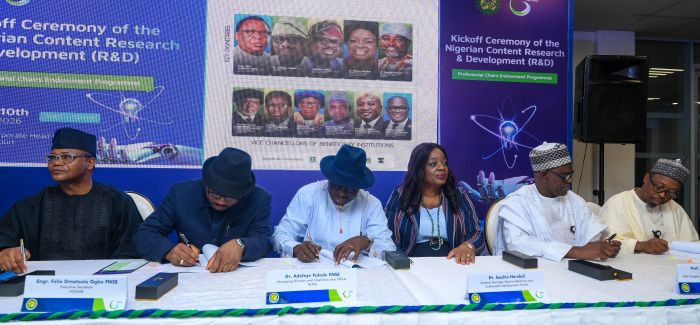 In a strategic joint initiative, Nigeria LNG Limited (NLNG) together with the Nigerian Content Development and Monitoring Board (NCDMB) has unveiled a $9 million professorial chair endowment program. Designed to fund six Nigerian academic institutions at $1.5 million each, the initiative addresses pressing energy sector challenges, ranging from gas processing pollution mitigation to satellite monitoring of critical infrastructure.
Managed under the NCDMB Planning, Research and Statistics Directorate, the Nigerian Content Research and Development (NC-R&D) Professorial Chair Endowment Programme mandates clear commercialization roadmaps alongside technical research milestones. While the pledge represents a significant financial commitment, actual technology adoption by energy operators and execution on the ground remain the critical steps ahead.




Under the Nigerian Content Research and Development (NC-R&D) Professorial Chair Endowment Programme, each university is to receive US$1.5 million to establish a specialised professorial chair focused on agreed industry research priorities. The initiative is being implemented in partnership with the NCDMB, under the supervision of its Planning, Research and Statistics Directorate.
The Nigerian Content Research and Development (NC-R&D) Professorial Chair Endowment Programme, overseen by NCDMB’s Planning, Research and Statistics Directorate, sets research targets and calls for each university to plan how its findings could reach the market. The announcement establishes a funding commitment. It does not establish that all funds have been disbursed, the chairs filled or any technologies adopted by industry.
With each of the six selected universities slated for a $1.5 million grant, the ultimate measure of success lies in transitioning laboratory breakthroughs to operational plants and commercial procurement contracts.
Six universities, six industrial research mandates
| University | Research focus |
| University of Ibadan, Oyo State | Natural gas processing, pollution control and environmental management |
| Rivers State University, Rivers State | Digital engineering, intelligent energy systems, automation and asset integrity |
| Modibbo Adama University, Yola, Adamawa State | Energy transition and the environment |
| Aliko Dangote University of Science and Technology, Kano State | Sustainable energy innovation and climate-resilient food systems |
| University of Nigeria, Nsukka, Enugu State | Green energy production and geoenvironmental engineering |
| University of Abuja (Yakubu Gowon University), Abuja, FCT | Geoscience and satellite intelligence for resilient gas infrastructure |
The institutions are expected to jointly host an information management hub to share findings and support exchanges. NLNG’s Research and Innovation Centre for Computer and Electrical Engineering (RICCEE) at Rivers State University is the proposed coordinating point for collaboration. Adeleye Falade, NLNG’s managing director and chief executive, said implementation discussions with the university were under way and acknowledged the role of its vice-chancellor, Professor Isaac Zeb-Obipi. Falade also reported indications of interest from Google, Cisco and MTN, but announced no signed partnerships or funding commitments from the companies.
Why industrial research needs industrial customers
In his keynote, Reshaping Nigeria’s Future Through Innovation, Research and Capacity Development, Falade made the case for sustained collaboration among government, industry and academia. He pointed to practical priorities: operating efficiency, emissions management, safety, infrastructure maintenance and more sustainable production. He also proposed exchanges, sabbaticals, field testing and jointly designed postgraduate curricula to connect academic work with the realities of running industrial assets.
Felix Omatsola Ogbe, NCDMB’s executive secretary, said the endowments complement the board’s investment in specialist R&D Centres of Excellence across six universities. He called for clear objectives, measurable results, careful use of funds and sustained engagement with industry. The aim, he said, is to move beyond publication as the principal measure of research success and develop solutions that improve industrial performance.
For a Nigerian engineering firm, a promising lab result is only a starting point. A tool that spots early signs of equipment failure, for example, still has to work with an operator’s existing systems, meet safety and cybersecurity requirements, and save enough in avoided downtime to justify procurement. Operators can improve the odds of adoption by getting involved before a prototype is built: defining the problem, providing controlled access to field data and agreeing on what a successful trial would look like.
The funding also covers minor civil works and upgrades to research spaces. Proposed arrangements would allow industry professionals in technical and non-technical disciplines to bring practical expertise into master’s and doctoral programmes. For early-career researchers, access to experienced practitioners and operating environments could be as valuable as new equipment. Falade urged the universities to attract additional grants, commercialise intellectual property and support technology transfer without lowering quality or safety standards.
The market and investor case
The strongest near-term opportunity may be in services that can be tested against a measurable operating cost: condition monitoring, emissions measurement, industrial automation and geospatial risk analysis. A Nigerian supplier that validates a tool on one operating asset has a stronger case when selling to another customer. A supplier with a prototype but no field record still faces a costly qualification process.
For investors, the endowments are research funding, not evidence of an investable pipeline. The signals worth watching are named pilot customers, clear ownership and licensing terms, independently verified performance, and a credible route from trial to paid deployment. A university licence to an established engineering company may get a useful technology into the market faster than creating a start-up around it. The right route depends on who can certify, support and sell the solution after the research grant ends.
What the commitment to research means for the NLNG brand
NLNG places the programme under its NextGen Nigerian Content Strategy. The strategy sets out to Sustain earlier commitments in alignment with NCDMB, Enable the business by making Nigerian content a more integral part of its operations, and Accelerate the growth of Nigerian industrial capability.
The endowments give that strategy a test beyond the value of the cheque. NLNG’s credibility as a technology-development partner will depend in part on whether its operating teams open suitable sites to researchers and its procurement teams give validated solutions a fair route to adoption.
BRANDECONOMY Insight
The hardest handover comes after the prototype. Universities can prove a concept, but operators have to trust it on a live asset and someone has to pay for its upkeep. The partners should agree early on who owns the intellectual property, who provides test sites, who validates results and who can buy a solution that meets the brief.
An annual scorecard should separate money committed from money disbursed and track chairs filled, field trials completed, technologies licensed, paid deployments and verified operating gains. That would show whether the US$9 million financed research alone or built industrial capability that survives the funding cycle.