

Lagos Warns Against ‘Ata Esha’ as Consumer Safety Concerns Grow Over Spoilt Tomatoes
Inspect Before Purchase

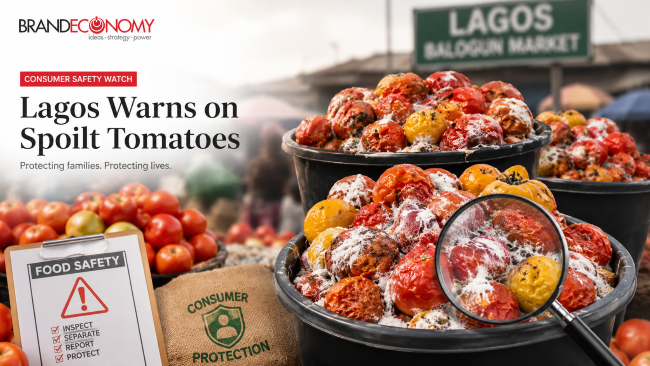 The Lagos State Consumer Protection Agency has cautioned residents against buying or consuming visibly spoilt, mouldy or fungus-infested tomatoes, commonly referred to in local markets as “Ata Esha,” warning that such produce may expose consumers to serious health risks.
The warning, issued in a statement attributed to the agency’s General Manager, Afolabi Solebo, draws attention to a practice that has become familiar in many urban food markets: the sale of deteriorated tomatoes at lower prices to consumers seeking to stretch increasingly pressured household budgets. LASCOPA’s intervention places a sharper public-health lens on that bargain, insisting that food affordability must never be confused with food safety.




The agency urged residents to avoid tomatoes showing white, green or black fungal growth, noting that visibly contaminated produce should not be purchased for cooking, processing or resale. That caution is consistent with international food-safety guidance: the USDA advises that mouldy soft fruits and vegetables, including tomatoes, should be discarded because contamination may extend beneath the surface and not be limited to the visible patch.
Why Spoilt Tomatoes Are More Than a Cosmetic Problem
The danger with mouldy tomatoes is that spoilage may represent more than an unpleasant smell, unattractive texture or loss of freshness. Some moulds can produce mycotoxins, naturally occurring toxins associated with a range of adverse health outcomes. The World Health Organisation notes that mycotoxins in food may contribute to acute poisoning and longer-term effects, including immune impairment and cancer risks, depending on the toxin, level of exposure and duration.
The U.S. Food and Drug Administration similarly warns that aflatoxins, one of the best-known families of mycotoxins, may increase the risk of liver cancer and can also affect the kidneys and immune system when exposure is significant or repeated.
LASCOPA’s warning therefore speaks to a broader food-safety principle: when perishable produce has become visibly mouldy, the risk cannot be dismissed as mere over-ripeness. In a city where tomatoes are central to daily cooking, from stews to sauces and soups, the distinction matters.
Cooking Is Not a Reliable Escape Route
The agency also cautioned that boiling, frying or otherwise cooking contaminated tomatoes should not be assumed to make them safe. While heat may destroy some visible mould organisms, public-health authorities remain cautious about foods already degraded by fungal contamination, particularly soft produce where contamination can spread beyond what the eye can see. The USDA’s practical consumer guidance is direct: mouldy soft fruits and vegetables should be thrown away rather than salvaged.
This warning is commercially and culturally significant. In many Nigerian kitchens, especially under economic pressure, consumers may be tempted to cut away visibly bad portions of tomatoes and cook the rest. LASCOPA’s position challenges that habit, arguing that a product sold cheaply because it is already spoilt is not necessarily a bargain; it may be an unsafe transfer of food risk from trader to household.
The Economics Behind Unsafe Food Choices
The alert arrives at a time when food prices remain a major source of pressure for many households. In such conditions, low-cost produce can become especially attractive, even where quality has deteriorated. LASCOPA’s statement confronts the uncomfortable reality that economic hardship can push consumers toward unsafe choices, while some traders may exploit that vulnerability by continuing to sell products that should be withdrawn from the food chain.
That is why the warning should not be read merely as advice to individual shoppers. It is also a call for stronger ethics in the informal food economy. Consumer protection is not fulfilled when buyers are simply told to “be careful”; it also requires that unsafe products are prevented from circulating freely in markets.
LASCOPA’s broader mandate includes protecting consumers against hazardous, substandard and unethical market practices, and the agency has recently positioned itself as an increasingly visible player in Lagos’ consumer-rights architecture.
Inspect Before Purchase, Report Unsafe Products
Solebo advised Lagos residents to inspect food items carefully before purchase, avoid visibly spoilt or mouldy products and ensure that contaminated food such as Ata Esha tomatoes is properly disposed of rather than passed on for resale or domestic use.
He also urged consumers to report unsafe, expired or spoilt products to relevant government agencies responsible for public health, environmental safety and consumer protection. That guidance aligns with the wider regulatory shift in Nigeria toward a more active consumer-rights culture, in which citizens are expected not only to avoid unsafe goods, but also to speak up against practices that place the public at risk. LASCOPA has publicly emphasised complaint resolution and consumer education as part of its institutional mission.
The agency further disclosed that monitoring and enforcement teams had been deployed to markets across Lagos to identify and sanction traders engaged in the sale of unsafe food products. While enforcement details may vary from market to market, the policy signal is important: food safety violations are being reframed as consumer-protection offences, not simply as routine imperfections of open-market commerce.
Consumer Rights Also Come with Consumer Responsibilities
In its broader message, LASCOPA reminded residents that consumers possess rights, but also responsibilities. These include seeking accurate information, rejecting harmful products, speaking out against unfair practices and making purchasing decisions that do not endanger personal or public health.
This framing deserves attention. Nigeria’s consumer-protection debate often focuses on telecoms, banking, aviation or digital services, but food markets are just as central to household welfare. Unsafe food is not only a public-health issue; it is also an issue of economic justice, because low-income consumers are frequently the most exposed to products sold below safety standards.
That is why the “Ata Esha” warning should resonate well beyond tomatoes. It speaks to the need for a healthier marketplace in which price, scarcity and desperation do not become excuses for distributing products that compromise public well-being.
BRANDECONOMY Insight
Food Safety Is Consumer Protection at Its Most Personal
LASCOPA’s warning against Ata Esha tomatoes (spoilt tomatoes) highlights a simple but often neglected truth: consumer protection begins with what people put on their tables.
Nigeria’s food economy is vast, informal and deeply sensitive to inflation. When prices rise, households search for cheaper substitutes. When margins tighten, traders may be tempted to push deteriorated produce into circulation rather than absorb losses. The result can be a dangerous market compromise in which economic strain quietly turns into public-health exposure.
That is why the Lagos alert matters. It moves the conversation beyond individual caution to a wider principle of market responsibility. No economy becomes healthier by normalising unsafe consumption in the name of affordability.
The state is right to emphasise inspection, reporting and enforcement. But the larger reform challenge remains: food markets need stronger surveillance, better consumer education and consistent consequences for those who sell obviously compromised products. At the same time, public-health messaging must be delivered in the language people understand — practical, local and unambiguous.
“Ata Esha” may look like a budget-friendly alternative. In truth, it represents a poor bargain when the potential cost is illness, avoidable treatment expenses and diminished public confidence in everyday food markets.
Healthy markets do not merely move goods. They protect people.