
Sanwo-Olu Positions Lagos as Africa’s Digital Infrastructure Capital with Kasi Cloud Launch

 From the commissioning of a hyperscale, AI-ready data centre in Lekki to the state’s expanding use of data for SDG delivery, Lagos is presenting technology not as a side project, but as the operating system of its next development phase.
 From the commissioning of a hyperscale, AI-ready data centre in Lekki to the state’s expanding use of data for SDG delivery, Lagos is presenting technology not as a side project, but as the operating system of its next development phase.
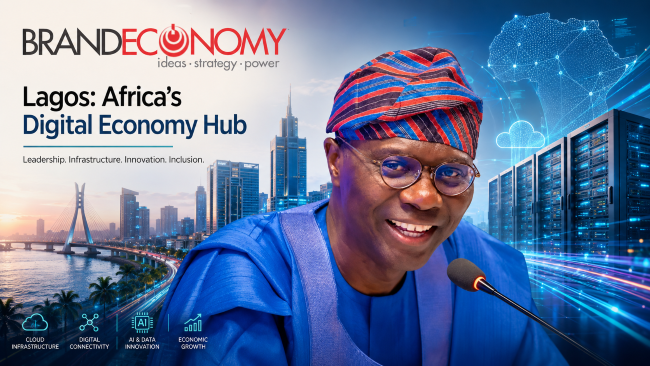
Lagos State is sharpening its claim as Africa’s emerging digital economy hub, with Governor Babajide Sanwo-Olu arguing that sustained investments in cloud infrastructure, fibre connectivity, energy reform and innovation ecosystems have positioned the state at the centre of Nigeria’s technology future.
Speaking at the commissioning of the Kasi Cloud Hyperscale Data Centre Campus in Lekki, Sanwo-Olu described the project as a major addition to Nigeria’s digital infrastructure and a strategic platform for the country’s participation in the coming era of cloud computing, artificial intelligence and sovereign data capacity. The facility is being developed as a hyperscale-ready, AI-capable campus intended to serve enterprises, financial institutions and public-sector users requiring in-country compute and storage infrastructure.



The governor said Lagos had deliberately built an environment where innovation capital, data demand and technology entrepreneurship can converge, insisting that enabling infrastructure is not a luxury but an economic imperative.
“If you are building cloud infrastructure, Lagos wants to work with you. If you are building AI infrastructure, Lagos wants to work with you. Enabling infrastructure is not charity; it is economic strategy,” he said.
His remarks came as the state also reaffirmed a second, closely related policy direction: the use of data-driven governance to accelerate progress on the Sustainable Development Goals and improve public-sector accountability. At the annual ministerial briefing in Alausa, the Special Adviser to the Governor on SDGs, Oreoluwa Finnih, said Lagos is strengthening data integration across Ministries, Departments and Agencies to improve coordination, track impact and guide evidence-based interventions in health, education and social development.
Taken together, the two developments reveal a broader Lagos strategy: build the infrastructure for the digital economy, and deploy data as a tool of governance.
Kasi Cloud and the Race for Sovereign Digital Infrastructure
The Kasi Cloud Lekki Campus represents one of the most ambitious private-sector investments yet in Nigeria’s digital backbone. The project is designed to scale to approximately 100 megawatts of critical IT capacity upon full development, with its first building, LOS1, engineered for cloud services, high-density workloads and AI-linked computing environments. The campus is strategically located near major subsea cable landing stations along the Lagos coast, strengthening its potential role in connectivity, low-latency services and data localisation.
For Nigeria, the significance is considerable. As more economic activity becomes data-intensive — from banking and fintech to public administration, e-commerce, health technology and AI applications — the availability of reliable local data-centre infrastructure becomes essential. It lowers dependence on offshore hosting, improves data sovereignty, supports faster digital services and strengthens national competitiveness in an increasingly cloud-driven global economy.
Sanwo-Olu said Lagos already accounts for a significant share of Nigeria’s installed data-centre capacity and remains the natural home for the next phase of digital infrastructure investment.
“Connectivity lands here. Enterprise demand lives here. Innovation grows here. Capital gathers here,” he said.
That argument is difficult to dismiss. Lagos combines population scale, financial-market depth, startup density, corporate headquarters, subsea cable access and growing infrastructure ambition in a way no other Nigerian state currently matches. The state’s technology ecosystem has produced globally recognised fintechs and a concentration of digital businesses that continue to shape Africa’s innovation economy.
The Policy Architecture Behind the Digital Push
Sanwo-Olu linked the state’s digital ambitions to what he called deliberate policy choices. Among the initiatives cited were the Lagos State Electricity Law, fibre-optic expansion, digital-skills programmes and innovation-funding efforts designed to attract investment and support higher-productivity sectors.
The electricity law is especially relevant. Digital infrastructure is power-hungry, and data centres require highly reliable energy systems. Lagos’ effort to build a more decentralised and investment-friendly electricity framework therefore has direct implications for technology infrastructure, cloud operations and future AI capacity. The state has presented the law as a foundation for more sustainable and dependable power supply, a point that fits neatly into the requirements of data-intensive industrial growth.
This is why the governor’s central claim — that infrastructure is economic strategy — resonates. Digital growth does not happen in abstraction. It relies on power, bandwidth, land-use planning, regulatory stability and investor confidence.
A National Infrastructure Moment
At the same event, Taiwo Oyedele, Minister of Finance and Coordinating Minister of the Economy, described the Kasi Cloud project as a defining moment in Nigeria’s economic modernisation and digital transformation journey. He said the facility would strengthen innovation, raise enterprise productivity and improve Nigeria’s standing in an increasingly AI-driven global economy.
That framing matters. Data centres are often discussed as real estate or telecoms infrastructure. In reality, they are becoming national productivity assets. They support the platforms through which businesses process payments, governments manage records, hospitals store data, manufacturers use automation and AI systems train on local workloads.
The more countries compete on digital efficiency, the more important such facilities become. Lagos is signalling that it does not want to be merely a consumer market for global technology. It wants to host the infrastructure on which digital value is built.
From Digital Economy to Data-Driven Government
While the Kasi Cloud commissioning captured attention on the infrastructure side, Lagos’ SDG briefing underscored that digital transformation is also being framed as a governance reform.
Oreoluwa Finnih said the state is integrating data systems across MDAs to improve decision-making, monitor programme outcomes and strengthen public accountability. She argued that data allows government to move “from intuition to impact,” particularly in interventions that affect vulnerable communities and long-term development targets.
The state also reported the successful coordination of its second Voluntary Local Review, bringing together communities, stakeholders and development partners to assess local progress on the Sustainable Development Goals. Lagos said the process helps align state development priorities with global best practice and deepens its role in localising the 2030 Agenda.
This is an important shift. Development policy is often weakened by poor measurement: programmes are launched, budgets are announced, but results remain difficult to track. A data-led public sector can identify gaps earlier, allocate resources more effectively and show citizens what is working — and what is not.
Technology as a Tool for Inclusion
Finnih also highlighted initiatives such as women’s financial inclusion programmes, SDG clubs in primary schools and social-impact cinema projects aimed at creating awareness and behavioural change around sustainable development. The state said these efforts are being aligned more closely across MDAs to support a unified implementation of the 2030 development agenda.
That intersection between digital governance and inclusion is crucial. Technology-led development will only gain legitimacy if it improves lived realities. Data infrastructure must translate into smarter social programmes. Digital economy growth must produce jobs, skills and access. Cloud capacity must eventually support a more responsive state and more competitive local enterprises.
Lagos appears to understand that the next generation of growth will not be measured only by the number of startups or servers in a data hall, but also by whether technology strengthens everyday governance.
The Bigger Lagos Proposition
The combined message from Lekki and Alausa is that Lagos is trying to build a full-stack development model:
- cloud and AI infrastructure for business growth;
- power and connectivity reforms to attract investors;
- innovation ecosystems to support entrepreneurs;
- data systems to improve governance;
- and evidence-based public programmes to make development measurable.
This is a more ambitious proposition than simply calling Lagos “Africa’s digital hub.” It is an effort to make the state an infrastructure-led technology economy and a data-informed public administration at the same time.
That ambition is not without challenges. Lagos still faces congestion, energy pressures, inequality, land constraints and the need for more inclusive participation in its innovation economy. But its strategic direction is increasingly clear.
The state is betting that the cities that win the next decade will be those that combine technology infrastructure with policy discipline and governance intelligence.
BRANDECONOMY Insight
Lagos Is Building More Than a Tech Hub — It Is Building a Digital Development State
The commissioning of the Kasi Cloud Hyperscale Data Centre Campus and Lagos’ renewed emphasis on data-driven SDG delivery should be read as two sides of the same development philosophy.
One side is market-facing: build the compute capacity, connectivity and policy stability required for cloud, AI, fintech and enterprise-scale digital services. The other is state-facing: use data to make government more coordinated, measurable and accountable.
That combination is powerful.
Lagos has long been Nigeria’s commercial nerve centre. It is now trying to evolve into the country’s digital infrastructure capital and, increasingly, a test bed for evidence-led governance. If successful, this could make the state not only a magnet for technology investment, but also a model for how African cities organise growth in the age of data.
The challenge, however, is execution at scale. Hyperscale data centres require dependable energy, local talent and policy consistency. Data-driven governance requires clean datasets, inter-agency cooperation, privacy safeguards and a culture that values evidence over bureaucracy.
The opportunity is equally clear. A Lagos that hosts sovereign cloud capacity, enables AI-era enterprise growth and governs through integrated data could strengthen its position as one of Africa’s most consequential urban economies.
The governor’s phrase is therefore apt: enabling infrastructure is economic strategy. The next test is whether Lagos can turn that strategy into durable, inclusive advantage.