

How Insecurity, Poverty Are Crushing Nigerian Workers – NLC, TUC
2026 May Day Review

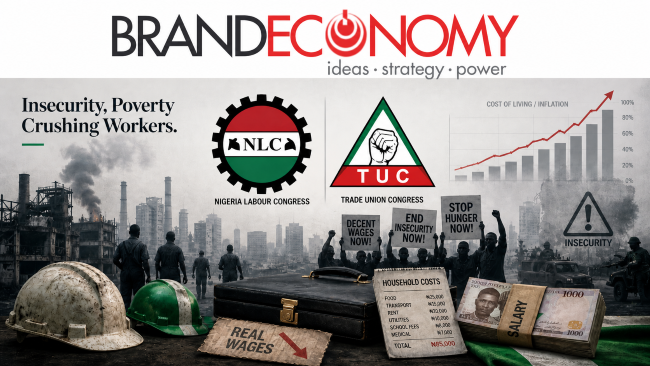 Nigeria’s organised labour has warned that insecurity and poverty are no longer merely social problems; they have become direct assaults on decent work, productivity and national development. At the 2026 May Day celebration in Abuja, the Nigeria Labour Congress and the Trade Union Congress placed workers’ welfare at the centre of the national conversation, arguing that no economy can create sustainable jobs where fear, hunger and institutional weakness define daily life for Nigerian workers.
.




Workers at the Edge of Survival
Nigerian workers marked the 2026 May Day celebration with a message that was both familiar and urgent: the economy cannot be rebuilt on the backs of a workforce crushed by insecurity, poverty and declining living standards.
At the Abuja event, themed “Insecurity, Poverty: Bane of Decent Work,” the Nigeria Labour Congress and the Trade Union Congress warned that the conditions under which many Nigerians now work have become increasingly hostile to productivity, dignity and sustainable development.
This was not the usual ceremonial labour rhetoric. It was a direct indictment of the economic and security environment in which workers are expected to serve, produce, teach, heal, transport, generate power, maintain infrastructure and keep government running.
Across sectors—healthcare, education, aviation, energy, public service, manufacturing, logistics, banking and the informal economy—workers continue to carry the country through difficult conditions. Yet for many, wages are being eroded by inflation, transport costs are rising, housing is becoming less affordable, food insecurity is deepening, and insecurity has made even movement to work a daily risk in many parts of the country.
This is the labour question Nigeria can no longer avoid: how does a country speak of productivity when its workers are fighting simply to survive?
Ajaero: Decent Work Cannot Thrive Under Fear
NLC President, Joe Ajaero, described workers as the backbone of Nigeria’s productive economy, stressing that they remain central to the functioning of critical sectors. But he warned that the twin pressures of insecurity and poverty are steadily destroying the conditions required for decent work.
According to him, this year’s May Day theme reflects the harsh reality confronting Nigerian workers. In his view, insecurity and poverty have become major obstacles to job creation, workers’ welfare, social protection and the enforcement of labour rights.
Ajaero’s message was simple: decent work cannot flourish where fear and deprivation dominate daily life of Nigerian workers.
That position aligns with the broader development logic behind decent work. Work is not decent simply because a person has a job. It is decent when the job is safe, fairly paid, productive, protected by rights, supported by social security and performed in an environment where workers can plan their lives with some measure of confidence.
Insecurity undermines all of this. It discourages investment, disrupts workplaces, displaces communities, weakens agriculture, increases transport risks, destroys small businesses and forces families into survival decisions. Poverty, on the other hand, weakens consumption, reduces worker morale, pushes children out of school, worsens health outcomes and traps households in cycles of dependency.
Together, insecurity and poverty do not merely reduce comfort. They reduce national capacity.
The Human Cost of Economic Distress
Ajaero also pointed to the worsening humanitarian picture, particularly the reality of internally displaced persons and vulnerable families across the country.
The significance of that concern goes beyond social sympathy. Displacement is an economic event. When communities are forced out of their homes, farms are abandoned, schools are disrupted, local markets shrink, informal jobs disappear and families lose productive assets. Children grow up in uncertainty. Women face additional burdens. Men lose work. Host communities come under pressure.
For labour, these conditions create a large pool of economically vulnerable citizens who cannot access stable employment or social protection. They also deepen poverty and widen inequality.
A country cannot build decent work while millions are trapped in insecurity, displacement and informal survival.
TUC: Insecurity Is Also an Investment Problem
TUC President, Festus Osifo, reinforced the economic dimension of the crisis. He warned that insecurity discourages foreign investment and limits growth opportunities.
This is a point policymakers should take seriously. Investors do not only study tax rates, market size and exchange rates. They also study safety, institutional predictability, judicial independence, infrastructure reliability and the social environment in which businesses operate.
Where insecurity is widespread, investors hesitate. Where poverty is deep, consumer demand weakens. Where institutions are not trusted, the cost of doing business rises. Where Nigerian workers are underpaid and anxious, productivity suffers.
Osifo also called for stronger institutional independence, particularly from the legislature and judiciary, arguing that transparency and accountability are essential to national progress.
This matters because labour issues are not resolved by wage negotiations alone. They are shaped by governance. A country with weak institutions will struggle to enforce labour laws, protect citizens, manage public finances, deliver infrastructure, prosecute corruption or design effective social protection.
Poverty Is a Productivity Crisis
Nigeria often treats poverty as a welfare issue. It is more than that. Poverty is a productivity crisis.
Poor workers spend more time and energy solving basic survival problems. They face poorer nutrition, weaker healthcare access, longer commutes, higher stress and limited capacity for skills development. Employers then face absenteeism, lower output, higher turnover and reduced morale.
Insecurity compounds the damage. When workers cannot move safely, factories cannot plan shifts confidently, farmers cannot access fields, traders cannot move goods, and public servants cannot operate effectively in affected communities.
The result is a national productivity trap: workers are expected to produce more under conditions that make productivity harder.
BRANDECONOMY Insight
The 2026 May Day message from organised labour should be understood as more than a wage complaint. It is a warning about the foundation of Nigeria’s economy.
Workers are the transmission belt between policy and real output. They turn hospitals into care centres, schools into learning institutions, airports into transport systems, power plants into electricity assets, ministries into public service, factories into production lines and markets into commerce.
If workers are insecure, underpaid, hungry, displaced or demoralised, the economy cannot perform at its best.
This is why insecurity and poverty must be treated as core economic issues. Security policy is labour policy. Food policy is wage policy. Transport policy is productivity policy. Housing policy is worker welfare policy. Institutional reform is investment policy.
The NLC and TUC are right to insist that decent work requires safety, stability and inclusive growth. But organised labour must also move from protest language to policy architecture. Nigeria needs a new compact built around living wages, social protection, skills development, workplace safety, job creation, productivity bargaining and stronger labour-market data.
Government, for its part, must understand that workers cannot be endlessly asked to sacrifice while the cost of living rises faster than income. The dignity of work is not protected by speeches. It is protected by purchasing power, secure communities, fair labour practices and accountable governance.
Nigeria’s greatest economic resource is not oil, gas, ports or minerals. It is its people. If workers are crushed, growth becomes hollow.
Strategic Takeaways
For government:
Security, poverty reduction and worker welfare must be treated as one integrated development agenda.
For employers:
Productivity cannot be separated from worker morale, income stability, workplace safety and fair treatment.
For labour unions:
Beyond agitation, organised labour must push practical reforms around living wages, skills, social protection and productivity.
For investors:
Labour stability and national security are essential indicators of long-term economic confidence.
For citizens:
Decent work is not only a labour slogan; it is the foundation of household dignity and national development.