
Felabration 2026: Mr. Logistics Turns “Embrace Humanity” Into a Pan-African Call to Conscience

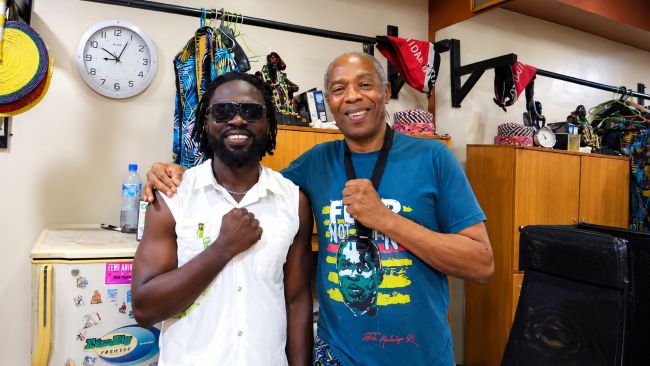
 Amid the pulsating horns, restless percussion and combustible energy that have come to define Felabration, Nigerian artist Mr. Logistics introduced a more contemplative register with a performance of “Embrace Humanity”—a socially conscious anthem built around African unity, historical memory and shared responsibility.
The rendition connected the struggles of an earlier generation of African liberation figures with the continent’s contemporary search for dignity, effective leadership and economic sovereignty.




Invoking the sacrifices and political legacies of Burkina Faso’s Thomas Sankara and Congo’s Patrice Lumumba, Mr. Logistics used the performance to remind his audience that Pan-Africanism is not simply an aesthetic, a slogan or a fashionable stage identity. At its most serious, it is a demand for solidarity across borders and a challenge to the institutions, leaders and citizens responsible for Africa’s future.
The song also referenced Captain Ibrahim Traoré, Burkina Faso’s current military leader, whose sovereignty-centred political language has attracted considerable support among sections of Africa’s young population.
 That reference gave the performance contemporary urgency, but also introduced complexity. Traoré remains a highly contested political figure: admired by supporters who see him as an emblem of resistance to foreign influence, but criticised over prolonged military rule, restrictions on independent expression and the delayed restoration of democratic government.
By bringing those names into the Felabration arena, Mr. Logistics was not merely entertaining. He was entering one of Africa’s most emotionally charged conversations: what liberation should mean in the 21st century and who has the legitimacy to define it.
Felabration asks: “Who Are You?”
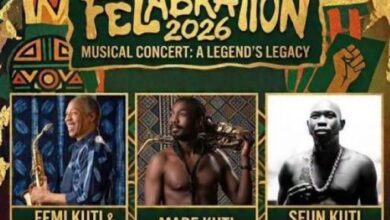
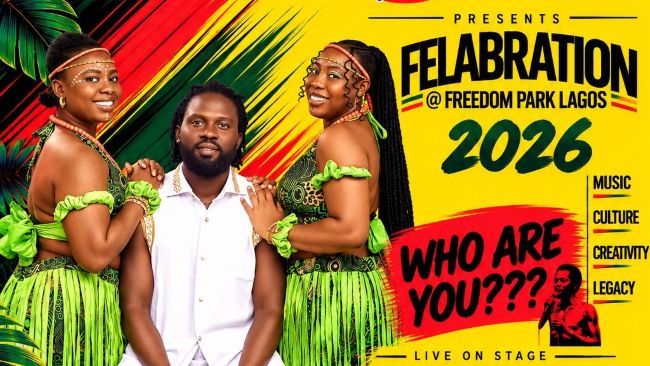
Felabration 2026 ran in Lagos from October 12 to 18 under the theme, “Who Are You?”
The question was particularly appropriate for a festival created to preserve the legacy of Fela Anikulapo-Kuti—an artist who repeatedly asked Africans to interrogate their identity, reject mental subjugation and confront political hypocrisy.
The week-long festival featured members of the Kuti musical dynasty, including Femi Kuti and The Positive Force, Made Kuti, and Seun Kuti with Egypt 80. Its wider line-up combined established names, emerging performers and musicians working across Afrobeat, Afropop, Apala and other Nigerian traditions. von.gov.ng
Conceived by Yeni Anikulapo-Kuti in 1998, Felabration has grown from a memorial gathering into a multidimensional cultural platform incorporating live music, public debate, visual art, fashion, dance and social commentary.
Its principal home, the New Afrika Shrine in Ikeja, remains one of Lagos’ most recognisable cultural spaces. The festival has also become an established tourism property supported by the Lagos State Government and major consumer brands. felabration.net
Felabration is therefore more than an annual concert series. It is a form of cultural infrastructure—one that connects Fela’s music with Nigeria’s creative economy, urban tourism and global influence.
Against that background, Mr. Logistics’ performance fitted naturally within the festival’s deeper purpose.
“Who Are You?” was not merely a branding device. It invited artists and audiences to examine the relationship between identity and responsibility. “Embrace Humanity” responded by widening the question: beyond ethnicity, nationality, ideology and political loyalty, what do Africans owe one another?
Mr. Logistics and the conscious-music lane
Mr. Logistics is the frontman of the Lagos-based Logistics Band, an ensemble operating since 2018 and known for blending Afro-cultural sounds with Afro-Calypso rhythms and socially engaged lyrics.
The group has built its identity around performance-driven music that addresses themes including poverty, gender equality, drug abuse and social responsibility. It has also developed familiarity with the Felabration platform through earlier appearances, including performances associated with the 2024 and 2025 editions. musicinafrica.net
Its catalogue and live repertoire include titles such as “Let the Poor Breathe,” “Time and Season,” “Eko: The Land of Hustle,” “Para” and “Over Do.” Those songs situate the band within a conscious-performance tradition that values commentary alongside danceability.
That positioning offers a clear point of differentiation.
Nigeria’s music industry is producing globally successful pop stars at extraordinary speed, but the commercial pressure to create short-form viral hits can sometimes narrow the thematic ambition of popular music. Mr. Logistics appears to be pursuing another route: using stagecraft, African rhythmic traditions and civic messaging to build a recognisable intellectual and cultural identity.
“Embrace Humanity” strengthens that proposition. Its message is inclusive enough to travel across borders while remaining rooted in Africa’s unresolved questions of leadership, justice, community and sovereignty.
From memory to modern aspiration
The performance reportedly referenced Thomas Sankara and Patrice Lumumba with restraint rather than theatrical hero worship.
Sankara’s legacy is associated with public integrity, self-reliance, women’s emancipation and opposition to external domination. Lumumba remains one of the defining symbols of African independence and of the geopolitical forces that frustrated the continent’s early post-colonial ambitions.
Their names carry emotional weight because they represent unfinished African possibilities.
The artistic challenge is ensuring that historical symbolism does not become a substitute for contemporary scrutiny. African audiences should be able to celebrate courage and sovereignty while still asking hard questions about democracy, human rights, economic performance and public accountability.
This is particularly important when contemporary figures are placed within the lineage of historic liberation heroes.
Captain Ibrahim Traoré has built a powerful political brand around sovereignty, popular mobilisation and resistance to established foreign relationships. He currently leads Burkina Faso under an extended military transition. presidencedufaso.bf
His popularity among sections of Africa’s digital generation illustrates the depth of dissatisfaction with conventional political leadership. But admiration should not suspend critical judgment. Reports of restrictions on journalists, civil society and independent public discourse complicate the revolutionary image promoted around his government. Human Rights Watch
In that sense, the strongest interpretation of “Embrace Humanity” is not as an endorsement of any government. It is a call for leadership that puts human dignity above faction, propaganda and power.
Music as African soft power
The performance also demonstrated music’s unusual capacity to compress history, politics and emotion into a form that can travel beyond formal institutions.
Fela understood that power instinctively. His songs were not policy documents, yet they influenced how generations understood corruption, militarism, inequality and colonial psychology.
Felabration keeps that tradition alive by allowing mainstream entertainment to coexist with political memory. A celebratory festival can still ask difficult questions. A danceable song can still function as civic education.
This has commercial significance.
Global demand for African music is no longer confined to recorded tracks. Audiences increasingly consume African identity through live festivals, fashion, documentary content, tourism, merchandise and digital communities.
Felabration occupies a valuable position within that ecosystem because it owns more than an event format. It possesses heritage, location, narrative and generational continuity.
For Lagos, the festival creates demand across hospitality, transport, food, security, media production and tourism. For artists, it offers access to culturally attentive audiences. For sponsors, it provides association with one of Africa’s most recognisable musical legacies.
Market implications
Mr. Logistics’ appearance demonstrates the importance of Felabration as a discovery and repositioning platform.
The Nigerian music market rewards visibility, but visibility must be converted into durable assets. To maximise the performance, Mr. Logistics and the Logistics Band should develop professionally recorded live material, strong streaming metadata, short-form video editions, media interviews and documentary content explaining the philosophy behind “Embrace Humanity.”
The opportunity is to turn a festival moment into a catalogue asset.
The song could also travel through university engagements, African cultural festivals, social-impact campaigns and collaborations with artists from other African countries. Its humanitarian theme creates potential partnerships with development institutions, youth organisations and brands seeking credible platforms around inclusion and social cohesion.
The risk is that the message becomes too broad or overly dependent on political names. The strongest socially conscious music combines moral clarity with memorable composition, emotional storytelling and a distinct point of view.
Brand implications
Felabration remains one of Nigeria’s strongest heritage-event brands because it has resisted becoming merely another music concert.
Its brand power comes from tension: celebration and protest, commercial sponsorship and anti-establishment memory, nostalgia and youth culture.
Sponsors must respect that identity. Excessive commercialisation could weaken the festival’s authenticity, while thoughtful partnerships can expand its reach without diluting Fela’s legacy.
Mr. Logistics faces a similar brand challenge. His conscious-music positioning can distinguish him in a crowded entertainment market, but consistency will be critical. Audiences must encounter the same purpose across his songs, visuals, interviews, collaborations and live performances.
“Embrace Humanity” can become more than a track. Properly developed, it could become the organising idea behind a distinctive artist brand.
Investor relevance
Felabration illustrates why Nigeria’s creative economy should be evaluated as an investable network rather than a collection of celebrity performers.
Opportunities exist in:
- Live-event production and venue infrastructure.
- Streaming and performance rights.
- Music publishing and catalogue acquisition.
- Cultural tourism and travel packages.
- Merchandising and licensed intellectual property.
- Artist development, distribution and export.
- Branded documentary and digital content.
The investment weakness remains fragmentation. Performances frequently generate excitement without producing reliable audience data, rights documentation, content libraries or structured post-event monetisation.
Felabration’s long-term value will increase if its performances, debates, archives and visual culture are systematically digitised and commercially managed.
BRANDECONOMY Insight
Mr. Logistics’ performance mattered because it returned Felabration to its most valuable territory: music as entertainment with intellectual consequence.
Fela’s legacy cannot be preserved only through costume, rhythm and nostalgia. It must remain a living argument about power, African identity and the dignity of ordinary people.
“Embrace Humanity” entered that argument by linking historical memory with contemporary aspiration. Its invocation of Sankara and Lumumba recalled Africa’s unfinished liberation project; its reference to Traoré reflected the hunger for new models of leadership.
But revolutionary branding must never replace rigorous accountability. Africa does not need new personality cults dressed in Pan-African language. It needs institutions that protect citizens, create opportunity and permit dissent.
That is why the most important phrase in Mr. Logistics’ performance was not the name of any leader. It was the song’s central instruction: embrace humanity.
For the artist, that message offers a defensible brand platform. For Felabration, it reaffirms the festival’s relevance. For Africa, it presents a standard against which every ideology and leader should be judged.