

 The latest testimony against Emefiele maps an alleged web of forex payments, luxury assets and intermediaries according to the EFCC. The harder question is why a nationally consequential case still appears to be circling without a final resolution.
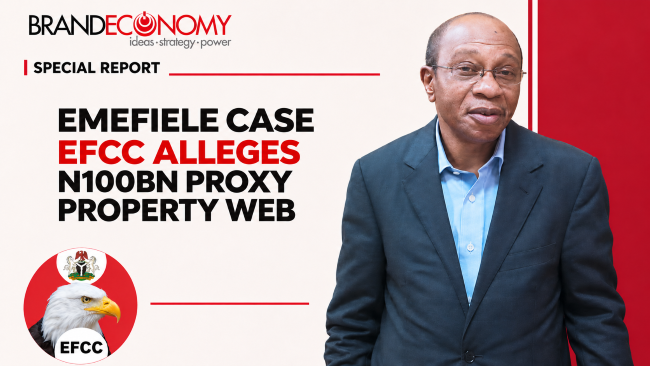 The latest testimony against Emefiele maps an alleged web of forex payments, luxury assets and intermediaries according to the EFCC. The harder question is why a nationally consequential case still appears to be circling without a final resolution.
BRANDECONOMY Editorial Intelligence Desk
The Testimony Before the Court
New allegations have been placed before the Lagos State Special Offences Court in Ikeja , but the public question is not only what investigators say they found. It is why, almost four years after controversies around Godwin Emefiele surfaced, Nigerians are watching a case moving in circles without final judicial closure.




Testifying before Justice Rahman Oshodi, Economic and Financial Crimes Commission (EFCC) investigator Alvan Gurumnaan alleged that the former Central Bank of Nigeria governor acquired multi-billion-naira assets through associates and proxies while in office. Emefiele is being tried on 19 counts bordering on alleged gratification, corrupt demands and abuse of office in transactions involving about $4.5 billion and N2.8 billion. His co-defendant, Henry Omoile, faces three counts for alleged unlawful acceptance of gifts. Both men have pleaded not guilty.
Led in evidence by the Federal Director of Public Prosecutions, Rotimi Oyedepo, SAN, Gurumnaan said the special operations team recorded Emefiele’s statements in the investigation. The witness claimed that access to foreign exchange had been structured in ways that forced businesses in need of dollars into arrangements before receiving allocations or contract payments.
He cited an alleged payment chain involving then-CBN staff member Monday Osazuwa, who investigators say received $17 million from a company and passed funds through Omoile to Emefiele. Gurumnaan referred to Source Computer, alleging that its managing director was required to provide money before the company’s contract fees were released. These allegations remain to be tested under cross-examination; they are not a finding of guilt.
The Alleged Emefiele Property Network
The property map was extensive. Gurumnaan alleged that investigators traced twin duplexes in Lekki Phase 1, two mansions on Queen’s Drive in Ikoyi, a factory in Agbor, Delta State, and a block of eight flats on Adekunle Lawal Street, Ikoyi. He said the Ikoyi flats had belonged to the Nigerian Security Printing and Minting Company, on whose board Emefiele served as chairman, and alleged that the property was sold to him.
The investigator also listed a warehouse in Ogun State containing containers said to be worth hundreds of billions of naira, an 11-storey project with about 94 luxury flats, and an estate of roughly 750 houses in Abuja’s Lokogoma District. He further alleged that more than $2 million in cash was recovered from the office of lawyer Ifeanyi Omeke, whom he described as secretary to several companies and an admitted front. Gurumnaan said forfeiture proceedings involving assets allegedly connected to Emefiele had produced judgments covering property estimated above N100 billion.
Emefiele’s lead counsel, Olalekan Ojo, SAN, and Omoile’s counsel, Kazeem Gbadamosi, objected that parts of the testimony were irrelevant to the charges. Justice Oshodi overruled the objection, holding that the defence remained free to challenge the account through cross-examination. The witness also said Emefiele had been given an opportunity during questioning to address some findings but did not respond to several of them.
A Case Still Seeking an Ending
The chronology now matters as much as the spectacle. Emefiele was suspended and arrested in June 2023; the present Ikeja case began with a 26-count charge filed in April 2024 and later proceeded on 19 counts. Since then, the record has included jurisdictional objections, arguments over the admissibility of statements, conflicting court dates, adjournments and parallel proceedings in Abuja and Lagos. Each step may be justified. Together, they create the impression of an accountability system travelling a distance without reaching a destination.
That delay carries an economic cost. At issue is not merely the personal conduct of a former public official, but the integrity of the mechanism through which scarce foreign exchange was allocated to businesses. If access depended on influence or unofficial payments, compliant companies would have been penalised, competition distorted and consumer prices increased. If the allegations cannot be proved, the accused deserve timely vindication. Either way, prolonged uncertainty weakens confidence in the courts, the EFCC and the policy architecture surrounding Nigeria’s most important financial regulator.
Market Brand and Investor Implications
The CBN has since introduced a more market-driven foreign-exchange framework, an electronic matching system and a formal FX Code intended to strengthen transparency and ethical conduct. Those reforms matter, but institutional reputation is not rebuilt by new platforms alone. Investors also ask whether past abuses are investigated competently, whether evidence survives scrutiny and whether judgments arrive within a credible period.
For the CBN brand, the strategic task is to separate the institution from the alleged conduct of any individual while demonstrating that controls have changed. For the EFCC, the brand test is different: dramatic asset inventories must become courtroom-proof evidence, not permanent headlines. For Nigeria, the investor signal will come from due process, consistency and closure, because capital prices institutional reliability long before it prices official reassurance.
BRANDECONOMY Insight
The size of an allegation is not the same as the quality of accountability. Nigeria will not strengthen trust by keeping politically significant cases alive indefinitely through testimony, objections and adjournments. The state must prove its case with admissible evidence; the defence must have a full opportunity to answer it; and the court must reach a decision within a timetable. As proceedings resume on November 13, the country needs more than another lap around familiar claims. It needs a verdict path that is visible, fair and finite.
Legal note: All claims attributed to the EFCC investigator remain allegations before the court. Godwin Emefiele and Henry Omoile have pleaded not guilty, and no inference of guilt should be drawn until the judicial process is concluded.