

Court Orders Accelerated Trial in Alleged Coup Case, Remands Suspects in DSS Custody
The alleged coup case is not just a criminal proceeding

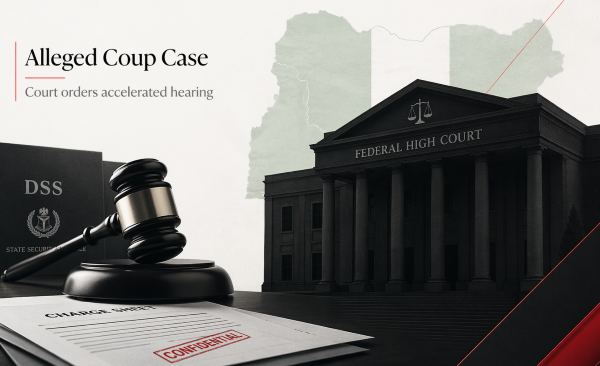 Nigeria’s political and security establishment has been thrust into fresh legal scrutiny following a Federal High Court order remanding six alleged coup suspects in the custody of the Department of State Services (DSS), while directing an accelerated hearing of the case. The ruling signals that what began as a dramatic security allegation is now entering a more consequential phase: judicial examination.
Justice Joyce Abdulmalik, sitting in Abuja, ordered that the defendants remain in DSS custody pending trial, while also directing that their lawyers and family members be granted access within a reasonable time. The matter was adjourned to April 27 for the commencement of trial and the hearing of the defendants’ bail applications.




At issue is a 13-count charge filed by the Federal Government through the Attorney-General of the Federation and Minister of Justice, Lateef Fagbemi, SAN. The charges range from alleged treason and terrorism-related offences to failure to disclose security intelligence and money laundering linked to terrorism financing.
From Security Allegation to Courtroom Process
The coup case now shifts from speculation and security briefings to the more disciplined arena of judicial procedure.
The six defendants—among them retired military officers, a serving police officer and other civilians—were arraigned before the court and pleaded not guilty to all counts. At the core of the prosecution’s case is the allegation that they conspired in 2025 to undermine the Nigerian state and levy war against it in a manner intended to overawe the President of the Federal Republic.
That is a grave allegation, and the court’s insistence on an accelerated hearing reflects the seriousness of both the charges and the broader public interest surrounding them.
Why the Court’s Orders Matter
The court’s orders were notable for two reasons.
First, by remanding the suspects in DSS custody, the judge effectively accepted the prosecution’s argument that the defendants should remain under secure detention pending further proceedings.
Second, by directing that defence lawyers and family members be given access to the accused, the court sought to preserve a basic procedural balance. In politically charged and security-sensitive cases, the integrity of the process can be as important as the substance of the accusations.
The issue of access had clearly become a point of concern. Some defence lawyers complained that they had only recently been able to see their clients after long periods of restricted contact, while others said access had improved once the defendants were transferred into DSS custody. The Attorney-General assured the court that lawful access would not be denied.
A Trial With Political Overtones
Although the named defendants pleaded to the charge, the case carries broader political overtones because former Minister of State for Petroleum Resources, Timipre Sylva, was reportedly listed in the charge as being at large, though not physically before the court in the same manner as the six defendants.
That detail alone ensures the case will attract heightened political attention, not merely legal curiosity.
Yet the judiciary’s early posture appears clear: whatever the wider political implications, the matter will be treated as a criminal trial requiring speed, order and procedural discipline.
The Broader State Question
coup cases of this nature are never just about the accused persons. They touch the deeper anxieties of the Nigerian state—questions of internal stability, institutional loyalty, democratic durability and elite contestation.
Nigeria has lived long enough with the memory of coups, military interventions and state insecurity for such allegations to resonate beyond the courtroom. Even when unproven, they expose the nervous system of governance: the fears of destabilisation, the fragility of trust within institutions and the enduring premium placed on security.
That is why the decision to accelerate the hearing matters. Prolonged ambiguity in such a case would only feed speculation, deepen political tension and weaken public confidence in both justice and state stability.
Justice Must Be Fast — and Seen to Be Fair
For now, the legal principle remains straightforward: the defendants have denied the charges, and the burden lies squarely on the prosecution to prove its case in court.
In security-related trials, the temptation is often to lean heavily on the gravity of the allegation itself. But the strength of the judicial process lies in resisting that temptation. If the Nigerian state wants this case to reinforce confidence in democratic order, it must ensure that the proceedings are not only swift, but visibly fair.
That is the narrow but important space in which the court has now placed the matter.
BRANDECONOMY Insight
The alleged coup case is not just a criminal proceeding; it is a stress test of institutional credibility.
- Accelerated hearings reduce political speculation
In cases involving treason and terrorism, delayed proceedings often create more instability than clarity. The court’s decision to fast-track the matter is therefore as much about governance as it is about justice. - Due process is critical in national security trials
Access to lawyers and family, proper arraignment and timely bail hearings are not procedural luxuries. They are essential to preserving public confidence in the fairness of the state. - Political names heighten market and governance sensitivity
Whenever prominent public figures are linked to security allegations, the implications go beyond law. Investors, political actors and institutions begin to read such cases as signals of wider elite tension. - Stability depends on the credibility of institutions
Nigeria’s democratic strength will not be measured by the existence of allegations, but by how competently and fairly its courts, prosecutors and security agencies handle them. - The state must avoid turning accusation into conviction
In a politically sensitive coup case, the legitimacy of the outcome will depend on evidence, transparency and judicial independence—not public emotion or executive pressure.