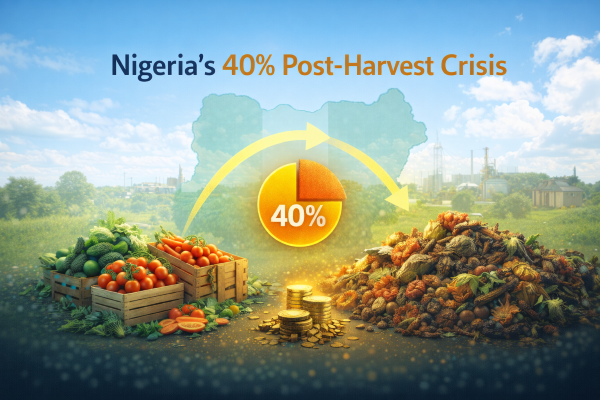
 Nigeria’s food inflation challenge is often framed around production deficits, insecurity in farming regions, and rising logistics costs. Yet a deeper structural failure sits quietly within the value chain: post-harvest losses approaching 40% in fruits and vegetables.
In an economy battling high food prices, import dependency, rural underemployment, and declining purchasing power, losing nearly half of perishable output after harvest is not merely an agricultural inefficiency—it is a macroeconomic distortion.




At a time when the federal government is prioritising food security, agro-industrialisation, and non-oil export expansion, post-harvest inefficiency has become one of Nigeria’s most expensive blind spots.
Context: Nigeria’s Production Paradox
Nigeria ranks among Africa’s largest producers of tomatoes, pepper, mangoes, citrus, plantain and several vegetable crops. Yet paradoxically:
- Retail prices remain volatile and elevated.
- Urban markets routinely display deteriorating produce.
- Agro-processors complain of inconsistent quality supply.
- Export competitiveness remains weak.
The underlying contradiction is simple: production is not the problem—preservation is.
Post-harvest loss refers to the decline in quantity and quality of agricultural produce between harvest and final consumption. In Nigeria’s case, this loss is exacerbated by:
- Poor rural road networks
- Weak cold-chain infrastructure
- Primitive packaging systems
- Informal market handling practices
- Electricity constraints
- Weak enforcement of storage and quality standards
In economic terms, this represents a structural value leakage across the agricultural ecosystem.
Core Analysis: The Structural Drivers of Loss
1. Infrastructure Deficits
Perishable crops move across long distances under harsh conditions:
- Overloaded trucks
- Exposure to heat
- Compression damage
- Vibration stress on bad roads
By the time produce reaches urban markets, a significant portion has already deteriorated.
This is not a marginal problem—it is systemic.
2. Cold Chain Failure
Globally, cold storage systems reduce post-harvest losses dramatically. However:
- Nigeria’s unreliable electricity grid limits scalability.
- Smallholder farmers lack access to affordable refrigeration.
- Rural aggregation centres remain underdeveloped.
The absence of a functioning cold chain has effectively capped Nigeria’s horticultural value.
3. Market Handling and Informality
In major markets, produce is often:
- Displayed in heaps under direct sunlight
- Stored overnight without temperature control
- Prioritised for sale based on age rather than freshness
The practice of selling deteriorating stock before introducing fresh inventory compounds waste.
4. Chemical Preservation Risks
Some traders resort to chemical preservatives and pesticides to artificially extend shelf life. While economically expedient, such practices introduce:
- Health risks
- Environmental concerns
- Export compliance violations
As global food standards tighten, unsafe preservation practices threaten Nigeria’s agro-export ambitions.
The Macroeconomic Cost
The implications extend far beyond farmers.
🔹 Food Inflation
When 40% of perishable output is lost:
- Effective supply shrinks
- Prices rise
- Consumers absorb the inefficiency
Food inflation becomes structurally embedded.
🔹 MSME Pressure
Agro-processors, market traders, transporters, and cold-storage operators face:
- Reduced margins
- Working capital strain
- Higher spoilage risk
Small businesses operating on thin profit margins suffer disproportionately.
🔹 GDP Leakage
Agriculture contributes significantly to Nigeria’s non-oil GDP. Losing up to 40% of output in key segments translates to:
- Billions in unrealised revenue
- Lower tax potential
- Weakened rural income growth
This is not just a farming issue—it is a national productivity challenge.
Implications for Policy and Markets
1. Food Security Strategy Must Shift
Increasing production without fixing preservation simply multiplies waste.
Nigeria’s agricultural policy must pivot from:
Production-centric growth → Value-chain efficiency optimisation
2. Investment Opportunity in Cold Chain Infrastructure
Private investors should see post-harvest reform as:
- A logistics opportunity
- A climate-smart investment play
- A rural industrialisation catalyst
Cold storage hubs, modular evaporative cooling systems, and rural aggregation centres represent scalable infrastructure gaps.
3. Digital Traceability and Market Reform
Technology can play a transformative role:
- Digital inventory management
- Real-time aggregation platforms
- Direct farmer-to-retailer channels
- Blockchain-based produce tracking
Such reforms reduce middle-layer inefficiencies and improve transparency.
4. Alternative Storage Innovation
Given Nigeria’s electricity constraints, scalable alternatives include:
- Solar-powered cold rooms
- Evaporative cooling chambers
- Natural antimicrobial preservation technologies
- Community-level micro-storage units
These models are particularly suitable for smallholder farmers and women-led enterprises.
Forward Outlook: Three Scenarios
Scenario 1: Status Quo
Losses remain at 40%, food inflation persists, and agro-industrial growth underperforms.
Scenario 2: Partial Reform
Incremental cold chain investment reduces losses to 25–30%, moderating inflation but leaving structural inefficiencies intact.
Scenario 3: Coordinated Value-Chain Overhaul
Integrated reforms reduce losses below 15%, unlock export potential, stabilise food prices, and significantly boost rural incomes.
The third scenario is not aspirational—it is achievable with coordinated infrastructure, regulatory and private-sector participation.
BRANDECONOMY Insight
Nigeria’s post-harvest crisis is a hidden tax on consumers, farmers and investors alike.
Every tomato that rots before reaching market represents:
- Lost farmer income
- Inflated retail pricing
- Wasted transportation cost
- Eroded GDP contribution
Reducing post-harvest losses may yield faster economic returns than expanding farmland.
If Nigeria truly seeks to diversify away from oil, the most immediate “new oil” opportunity may lie not in increasing output—but in preserving what it already produces.