

Nigeria’s Counterfeit Trade: Who Pays Beyond NAFDAC’s ₦22.73bn Destruction Figure?

 Behind the value of products destroyed lies a larger challenge for public health, honest manufacturers and investor confidence. Nigeria needs a market in which authenticity can be checked and failures and counterfeit trade can be traced.
The cost of an unsafe product can begin with a purchase that appears entirely ordinary. A household buys medicine. A retailer accepts a discounted consignment. A distributor trusts a supplier’s paperwork. When the product fails, the loss can travel well beyond the money paid at the counter.




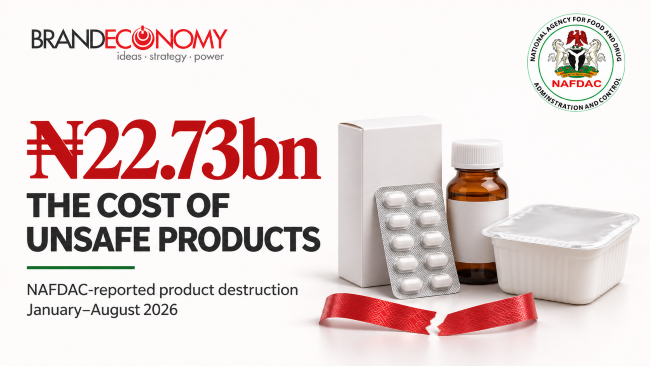
That is the economic significance of the National Agency for Food and Drug Administration and Control’s disclosure that it destroyed unwholesome products valued at approximately ₦22.73 billion in 22 exercises between January and August 2026.
The figure formed part of the regulatory update presented under Director-General Prof. Mojisola Adeyeye at the International Pharmaceutical Regulators Programme Management Committee meeting in Prague, Czech Republic, on November 18–19. In a statement reported by the News Agency of Nigeria on November 22, NAFDAC’s resident media consultant, Olusayo Akintola, outlined the agency’s enforcement and regulatory progress.
The eight-month scorecard also recorded 213 raids, 821 product seizures, 179 premises closures and 52 arrests. These are agency-reported enforcement outputs. They establish neither the number of people harmed nor the guilt of everyone arrested.
For Nigeria, the larger question is whether enforcement is making unsafe trading harder, legitimate production more competitive and consumer confidence easier to earn.
What the ₦22.73 billion figure actually measures
The figure is an attributed valuation of products destroyed during a defined period. It is not a measurement of Nigeria’s entire counterfeit economy, an annual consumer-loss estimate or a verified calculation of forgone government revenue. The public summaries do not provide a complete valuation methodology or a representative survey of goods circulating in the market.
The categories also matter. Counterfeit and falsified products involve deception, but a destruction exercise can include expired, defective, unregistered or otherwise non-compliant goods. NAFDAC’s own enforcement framework covers these different categories and includes arrangements under which companies submit products for supervised destruction. It would therefore be inaccurate to assume every item destroyed came from a criminal counterfeiting operation.
For medicines, the World Health Organization distinguishes substandard products, which fail required quality specifications, from falsified products, whose identity, composition or source is deliberately misrepresented. An authentic medicine damaged by poor storage and a deliberately fabricated medicine require different investigations, even when both expose patients to risk.
Precision protects the public without unfairly discrediting compliant businesses. It also helps regulators target the failure that actually occurred.
Households pay through health costs and lost time
WHO warns that poor-quality and falsified medicines can cause treatment failure, poisoning and worsening illness. Some can contribute to antimicrobial resistance. These are established risks associated with the category; the ₦22.73 billion disclosure does not quantify how many such outcomes occurred in Nigeria.
The financial mechanism is nevertheless clear. A treatment that fails can require another consultation, additional tests, replacement medicine and time away from work. A self-employed parent may lose both earnings and savings. A small employer can lose productive hours when staff or their dependants remain ill.
Affordability complicates prevention. When genuine products are difficult to obtain or too expensive, households face pressure to accept unfamiliar sellers and unusually cheap alternatives. Consumer education must therefore be accompanied by reliable access to affordable, quality-assured products. Responsibility cannot rest solely with the person standing at the shop counter.
Counterfeiting distorts competition for honest manufacturers
A compliant manufacturer pays for testing, quality assurance, trained staff, approved packaging and controlled distribution. A dishonest competitor can evade parts of that cost while borrowing the legitimate brand’s reputation. The result is a market in which the apparent bargain conceals costs transferred to patients, consumers and genuine businesses.
Manufacturers can lose sales to imitation products, then spend more defending their names and investigating complaints about goods they did not make. Where consumers cannot distinguish the imitation from the original, distrust can spread across an entire product category.
This creates difficult choices for smaller producers. Money that could fund equipment, staff or market expansion may instead be spent on authentication and channel monitoring. Larger companies may also become more cautious about appointing distributors or entering markets where product provenance is difficult to establish.
These are economic transmission channels, not losses measured by NAFDAC’s destruction total. Quantifying them would require separate evidence on sales displacement, compliance expenditure, consumer harm and business performance.
Retailers are a critical control point
A retailer’s reputation depends partly on the suppliers it admits into the business. A polished shopfront cannot compensate for undocumented stock, unknown intermediaries or purchases made entirely on price.
Retailers should retain supplier identities, invoices and batch information, inspect deliveries and review how products are stored. Suspected goods should be separated from sale while the concern is reported and investigated. Returning questionable stock into an undocumented trading chain risks moving the problem to another customer.
Manufacturers should make authorised distributors easy to identify and provide a practical route for retailers to verify unusual consignments. Online marketplaces should similarly be able to establish seller identity, preserve transaction records and remove suspect listings while credible complaints are assessed.
The commercial reward is a defensible promise: customers can ask where a product came from and receive an answer supported by records.
Technology must verify more than an attractive label
NAFDAC already operates a Mobile Authentication Service using one-time scratch codes and SMS for covered medicines. Its Greenbook database supports checks on registered products. In June 2026, the agency also launched an improved Med Safety App for reporting suspected substandard or falsified medical products and adverse reactions, including photographs and product details.
These tools serve different purposes. A registration search checks whether a product is authorised. A pack-level code can support authentication within the scheme that issued it. A safety report gives the regulator information to investigate. None should be marketed as a universal guarantee that every product bearing a familiar number or symbol is genuine and properly stored.
NAFDAC has previously documented a falsified injection carrying a registration number assigned to a different medicine. The lesson is practical: compare the returned product details with the pack rather than accepting the presence of a number as proof.
For businesses investing in traceability, the demanding questions concern execution. Does the system detect repeated codes? Can it identify the supplier and affected batch? Does it work where connectivity is weak? Can a complaint trigger a timely withdrawal? Technology creates value when someone acts on the evidence it produces.
Brand Nigeria needs credible assurance at home
For investors, product authenticity is an operating consideration. A manufacturer assessing a factory, a lender financing distribution or a retailer expanding its network must consider the cost of controlling supply, resolving complaints and protecting reputation.
Where records are weak, buyers may demand more testing, tighter contracts and greater oversight. Those precautions can raise transaction costs and slow expansion. Conversely, consistent regulation and dependable product records can make investment easier to assess.
For Nigerian exporters, quality assurance must travel with the goods. Traceable batches, credible laboratories and responsive recall procedures provide more persuasive evidence than patriotic branding alone. Imported origin is no substitute for these controls either.
Brand Nigeria benefits when genuine businesses can demonstrate quality and institutions can explain how failures are corrected. Treating every Nigerian product as suspect would punish the manufacturers whose standards the country should be protecting.
Measure enforcement by what changes after the raid
Removing unsafe stock is necessary. Sustained deterrence requires an account of what follows: laboratory findings, case outcomes, supply-chain investigations, corrective action and checks on repeat offending.
A stronger public scorecard would separate product categories, state the basis of valuation and distinguish seizures, administrative sanctions, prosecutions and convictions. Arrests must never be presented as convictions. Businesses that voluntarily withdraw defective stock should also be distinguishable from operators found to have deliberately falsified products.
Regulators should track complaint response times, the proportion of affected stock recovered and whether similar violations recur. Destruction should itself follow documented procedures that protect people and the environment.
More goods destroyed can reflect more effective detection, a larger underlying problem or both. A falling destruction total can equally reflect better compliance or weaker detection. Neither direction, taken alone, proves success.
BRANDECONOMY Insight
Nigeria’s counterfeit trade exploits an information gap: sellers know more about the product’s origin than buyers can easily discover. Legitimate businesses collectively lose when they leave that gap open.
Product integrity should therefore sit within brand strategy, procurement and board oversight. A premium advertising campaign can create demand, but the promise depends on what reaches the customer through a real distribution network.
The strongest manufacturers will make verification simple, support retailers who reject suspicious stock and publish clear instructions when packaging changes or safety concerns arise. Their customer-service teams should treat authenticity complaints as intelligence rather than an inconvenience.
The investment opportunity extends to testing, secure packaging, responsible distribution and traceability. Commercial claims in these areas should be judged by independently demonstrable performance, including detection accuracy and response times.
The ₦22.73 billion figure captures products removed from circulation. The more consequential prize is a market where consumers can buy confidently and honest businesses can compete without financing a permanent defence against deception.
Simple actions consumers can take now
Buy from identifiable, authorised sources and keep the receipt. Check the seal, batch number, manufacturer details and date markings. Use the approved authentication service where the product carries one, and compare registration details with the actual product.
Treat unusually low prices, inconsistent labelling and a seller’s refusal to provide a receipt as reasons to pause and verify. Packaging checks can reveal warning signs, but consumers cannot reliably establish safety by appearance, smell or taste. Do not taste a suspicious product to test it.
Report concerns to the nearest NAFDAC office or call 0800-162-3322. Suspected substandard or falsified products can also be reported to [email protected]; medicine-quality concerns and adverse reactions can be submitted through the Med Safety App. Keep photographs, purchase details and any remaining product securely for investigation, away from children.
If a medicine appears suspicious, seek prompt advice from a pharmacist or clinician about a safe replacement. Seek urgent medical help for serious symptoms rather than waiting for a product complaint to be resolved.
Pause. Check. Verify. Report. Product trust improves when vigilance at the point of purchase is matched by accountability throughout the supply chain.