Consumers Raise Alarm Over Alleged Fuel Pump Manipulation
The Hidden Cost of Under-Dispensing

 As fuel prices bite harder, Nigerian motorists say some filling stations are compounding the pain through suspected under-dispensing — a consumer-protection failure that cuts directly into household income, transport costs and public trust in the downstream petroleum market.
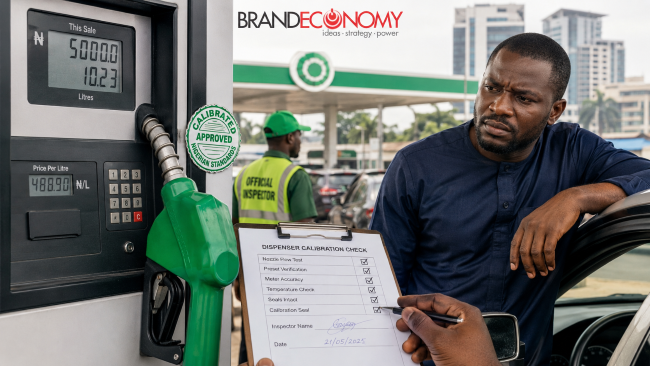 As fuel prices bite harder, Nigerian motorists say some filling stations are compounding the pain through suspected under-dispensing — a consumer-protection failure that cuts directly into household income, transport costs and
 Motorists in the Federal Capital Territory have called for stronger regulatory intervention following growing allegations that some fuel stations are manipulating their pumps to dispense less fuel than consumers pay for.
The motorists, who spoke across parts of Abuja including Dei-Dei, Central Area, Dutse, Nyanya, Mararaba and Kubwa, said suspected pump adjustment had left many consumers without value for money at a time when high fuel prices are already putting pressure on households, transport operators and small businesses.



Some said the situation had forced motorists to reduce trips or park their vehicles entirely because the cost of fuelling had become increasingly unbearable.
For many Nigerians, petrol is no longer merely a transport input. It is a household survival cost. It powers cars, buses, small businesses and generators. Any under-dispensing therefore amounts to a direct erosion of purchasing power in an economy already strained by inflation and weak disposable income.
Mrs Ladi Odika, one of the motorists, said some pump attendants deliberately distract customers while dispensing fuel.
According to her, attendants sometimes block the meter from clear view, engage motorists in conversation or try to sell additional items to create confusion.
“Some attendants will make compliments on motorists in order to cause confusion or distract them,” she said.
Odika said she had observed that fuel purchased from some stations did not reflect properly on her vehicle gauge, unlike purchases from major marketers such as MRS and NNPC retail outlets.
“The hike in fuel price is already causing hardship. When you buy fuel and still do not get value for your money, it becomes worse,” she said.
Another motorist, Mr Abdul Danladi, said he became suspicious of a filling station along Dutse after repeated experiences of poor fuel value. He said he now uses a 25-litre jerrycan to verify quantity before payment.
According to him, a station once claimed to have dispensed 25 litres, but the jerrycan was not full.
“I insisted that the jerrycan should be filled before paying. After arguments that attracted many people, the attendant complied and I paid,” he said.
Danladi urged regulators to intensify inspection of filling stations to ensure consumers receive the correct quantity of fuel.
Other motorists said they prefer major marketers because they believe their pumps are more reliable. In Kubwa, some commercial drivers reportedly avoid certain independent marketers and queue instead at stations considered more trustworthy.
Mrs Rejoice Achi said she patronises major marketers because she has more confidence in their meter accuracy.
Similarly, Mr Chidi Onu, a motorist in Dei-Dei, said many drivers believe major marketers operate better-calibrated pumps, while some independent stations are suspected of under-dispensing.
Lateef Ojerinde said he only buys from independent marketers when he is in a hurry and cannot wait in queues at major stations.
“Some filling stations like MRS and NNPC are still fair; when you buy, you see the difference. But some private ones are notorious, and if you complain, their attendants will insult you,” he said.
Consumer Protection and the Hidden Cost of Under-Dispensing
The allegations go beyond ordinary customer dissatisfaction. They raise important questions about consumer protection, regulatory enforcement and integrity in Nigeria’s deregulated downstream petroleum market.
Fuel under-dispensing is effectively a hidden price increase. A motorist may pay for ₦20,000 worth of petrol but receive far less in actual volume. The transaction appears complete at the pump, but the consumer has been shortchanged.
Dr Aliyu Ilias, a development expert and customer-experience management specialist, called on the Nigerian Midstream and Downstream Petroleum Regulatory Authority to intensify monitoring and enforcement at retail stations.
He said regulators should deploy stronger oversight tools, including “mystery shoppers” who would independently verify pump accuracy and service quality. He also recommended surprise inspections using calibrated measuring equipment.
“Imagine I want to buy fuel worth ₦20,000, but they gave me ₦15,000 worth of fuel. That would have taken a lot of purchasing power from me,” he said.
Ilias warned that such practices worsen the financial burden on ordinary Nigerians and undermine trust in the petroleum retail market.
He also called for collaboration among relevant energy-sector agencies to strengthen oversight and curb abuses.
“Anything you don’t monitor, you cannot manage,” he said.
IPMAN Condemns Sharp Practices
The Independent Petroleum Marketers Association of Nigeria also condemned sharp practices in the distribution and dispensing of petroleum products.
Its National Publicity Secretary, Chinedu Ukadike, said inaccurate dispensing, diversion and related misconduct could damage investor confidence and weaken trust in the downstream petroleum sector.
According to him, consumers deserve fair service, especially now that petroleum products are more expensive.
“It is not a very good practice considering the cost of petroleum products now, and consumers deserve optimal services both in the quality and quantity of fuel dispensed,” he said.
Ukadike said IPMAN would work with the Nigeria Union of Petroleum and Natural Gas Workers to improve sensitisation and professional training for pump attendants.
He said planned workshops would focus on ethical conduct, correct dispensing procedures and customer-service standards.
The IPMAN official noted that many communities already distinguish between stations seen as fair and those accused of sharp practices, warning that such reputational damage could hurt operators in the long run.
He reaffirmed the association’s commitment to professionalism, integrity and compliance with approved downstream petroleum standards.
NMDPRA Promises Investigation
Reacting to the allegations, George Ene-Ita, Director of Public Affairs at the NMDPRA, said the authority would investigate complaints relating to fuel quantity and quality irregularities at retail stations in Abuja.
He said the agency operates an on-field surveillance framework designed to detect anomalies in fuel dispensing and storage systems.
According to him, field teams routinely inspect underground tanks, pumps and meters to ensure consumers receive the correct quantity and quality of petroleum products.
“Normally, we implement an on-field surveillance framework designed to detect these anomalies. Our field teams are very thorough in these retail outlets and subject their underground tanks, pumps and meters to quality and quantity tests to ensure that the public is well served,” he said.
Ene-Ita, however, acknowledged that monitoring every station across the country remains difficult. He said public complaints, community reports and third-party information are therefore critical to enforcement.
He said the latest complaints had been forwarded to the Abuja/FCT regional office for operational assessment of the affected facilities.
He urged consumers to continue reporting suspected infractions, noting that citizen participation helps regulators identify stations violating operational standards.
BRANDECONOMY Insight
Fuel Under-Dispensing Is a Silent Tax on Struggling Consumers
The allegation of fuel pump manipulation should worry regulators because it strikes at the heart of consumer trust in a sensitive market.
Fuel is now one of the most important household and business cost drivers in Nigeria. It affects transport fares, food distribution, generator usage, logistics, school runs, market prices and small-business survival. When consumers pay high prices and still receive less than the quantity purchased, the loss is not trivial. It is a silent tax on already stretched Nigerians.
The problem also exposes a wider regulatory challenge in the downstream petroleum sector. Deregulation cannot succeed without strong consumer protection. A market-led fuel-pricing system requires transparent pricing, accurate measurement, product quality assurance and credible enforcement.
Consumers must not be left to fight pump attendants or rely on jerrycans to verify whether they are being cheated.
The NMDPRA’s pledge to investigate is welcome, but Nigeria needs more visible enforcement. Regulators should conduct routine and surprise calibration checks, publish sanctions, seal offending stations, mandate complaint hotlines and create a transparent reporting dashboard. Stations found guilty of persistent under-dispensing should face penalties strong enough to deter others.
IPMAN’s proposed training for pump attendants is also useful, but ethics cannot depend on training alone. It must be backed by inspection, technology and consequences.
At a time when fuel prices are already reshaping household budgets, consumers deserve at least one assurance: when they pay for a litre, they should receive a litre.