
Lagos Tourism Reset: Collaboration, Safety and Water Mobility Drive New Vision

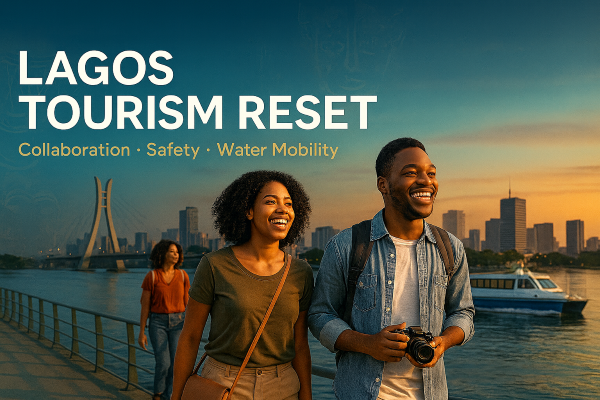
Nigeria’s cultural capital and Africa’s most commercially vibrant megacity—is stepping into a decisive new phase in its long-running quest to build a globally competitive tourism economy. At the Tourism Stakeholders Engagement Summit convened by the Lagos State Ministry of Tourism, Arts and Culture, top government officials, investors, creatives, tourism operators and regulators gathered to evaluate one central question:
How can Lagos convert its enormous cultural assets into a sustainable, investment-grade tourism industry?

The summit delivered clarity: through collaboration, structured safety systems, improved mobility infrastructure, and long-term strategic partnerships.
A Unified Approach to Unlocking Lagos’ Tourism Potential
Commissioner for Tourism, Arts and Culture, Toke Benson-Awoyinka, emphasised that Lagos’ unique advantage lies in its authentic cultural mosaic—its festivals, culinary diversity, arts, creative energy, nightlife, beaches and entertainment ecosystem.
But she made a critical point:
Tourism potential does not translate automatically into economic value. It requires collaboration, shared responsibility, and continuous engagement.
Her message signals a shift from episodic, season-driven tourism to a deliberate, year-round tourism economy built on:
- Private–public partnerships
- A stronger investment climate
- Top-tier service delivery
- Professional standards across hospitality and creative sub-sectors
- Digitally integrated visitor experiences
This style of coordinated ecosystem building mirrors best-practice models in cities like Dubai, Cape Town, Johannesburg and Barcelona—where collaboration fuels sustained growth.
Tourism as an Economic Engine, Not Just Entertainment
Lagos is pushing tourism to become a reliable contributor to job creation, SME competitiveness, urban renewal and state revenue. The state’s messaging hints at a future where tourism becomes:
- A strategic employer across entertainment, transportation, food, hospitality, and events
- A magnet for foreign direct investment (FDI) from hotel brands, event franchises and investors
- A driver of auxiliary industries—tech, mobility, real estate, retail, creative production
- A centre for global festivals, conferences and cultural showcases
The ambition is clear:
Tourism should evolve into a multi-billion-naira pillar of the Lagos economy.
Safety Becomes the Foundation of the New Tourism Framework
A city built on experiences must first be predictably safe.
At the summit, the Lagos State Safety Commission (LSSC), represented by DG Lanre Mojola, outlined a robust regulatory architecture built around the “Four Es of Safety”:
- Engineering – ensuring facilities meet modern structural and technical standards
- Education – training operators and sensitising communities
- Enforcement – compliance audits, inspections and certifications
- Evaluation – continuous system improvement and real-time oversight
From hotels and nightclubs to shortlets, beach resorts, bars, lounges and event venues, every hospitality establishment in Lagos must now be certified and registered with the LSSC.
With the festive season approaching—a peak period for concerts, nightlife, beaches and entertainment events—the state has activated a Crowd-Ready Safety Plan, including:
- Pre-event inspections and risk assessments
- Tourism Safety Marshals deployed in partnership with the tourism ministry
- Emergency preparedness checks
- Rules against drugs, firearms and underage attendance
- A citywide public-safety awareness campaign
The goal is very clear:
Make Lagos “the safest place to have fun” in West Africa.
Waterways as Lagos’ Next Big Tourism & Mobility Asset
An equally significant highlight came from Lagos Ferry Services (LagFerry) Managing Director, Ladi Balogun, who revealed that Lagos’ waterways are now central to the state’s tourism and transport transformation agenda.
Key developments reshaping Lagos mobility:
1. New Water Taxi Initiative
A pilot scheme connecting Ibeju-Lekki, Epe and Victoria Island will go live soon—designed to ease road congestion, enhance tourist access, and provide a water-based urban lifestyle.
2. Zero-Accident Record
Recent safety data shows Lagos waterways have recorded zero accidents, a result of investments in modern ferries, trained crew, improved regulation and monitoring.
3. Scaled Expansion Beyond Festive Seasons
LagFerry is signaling that water mobility will be a permanent backbone for tourism, business mobility, and inner-city transit.
Globally, successful coastal cities—from Istanbul to Sydney—have leveraged ferries as lifestyle infrastructure. Lagos is now moving in the same direction.
Stakeholder Panels: From Diagnosis to Solutions
The summit featured multiple panels where industry leaders dissected:
- Structural gaps in tourism service delivery
- Safety issues in entertainment and hospitality
- Transport bottlenecks affecting visitor experience
- Investment hurdles for SMEs
- Opportunities for festivals, experiential events and cultural showcases
- Digital adoption gaps in the creative and tourism value chain
The collective output was clear:
Lagos must build — not inherit — the tourism industry it desires.
BRANDECONOMY INSIGHT
Lagos is finally approaching tourism with the seriousness of a strategic economic sector, not a seasonal attraction. This shift mirrors global cities that understand one truth:
Tourism thrives where there is structure. Structure thrives where there is safety, mobility, investment confidence, and policy clarity.
From our analysis at BRANDECONOMY, several competitive advantages are emerging:
1. Tourism is aligning with transportation strategy.
A city where tourists can move freely—via ferries, buses, taxis and pedestrian-friendly corridors—is a city that grows its visitor economy.
2. Safety is no longer reactive—it is now embedded in policy.
The deployment of safety marshals and pre-event audits signals an institutional maturity that Lagos has long needed.
3. Private-sector creatives and operators now have a seat at the table.
Global tourism success stories are private-sector driven; Lagos is beginning to embrace this model.
4. Water mobility is Lagos’ strongest differentiator.
No other Nigerian city has this advantage at scale. If fully harnessed, the waterways could become Lagos’ signature tourism identity—just as canals define Amsterdam or ferries define Sydney.
5. The state is preparing for investment-grade tourism.
By focusing on standards, safety, data, stakeholder partnerships, and year-round programming, Lagos is gradually positioning its tourism ecosystem to attract serious capital.
The city’s “Tourism Reset” is not just an event—it is becoming a framework for economic transformation.