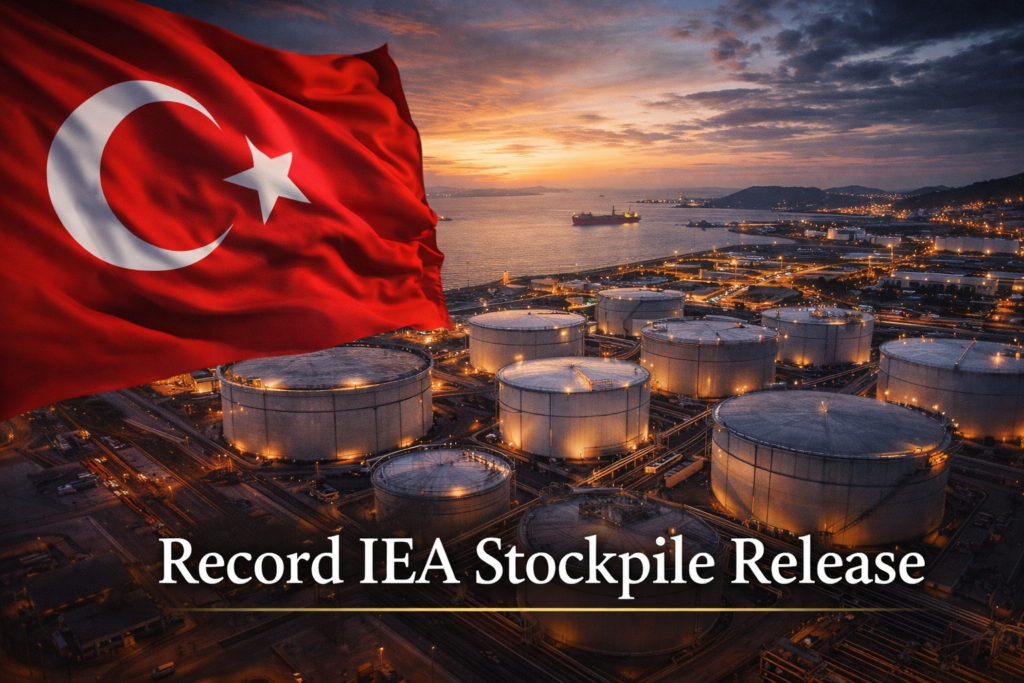
 Global energy markets are entering an extraordinary phase of coordinated crisis management as countries move to stabilise oil supply following escalating disruptions across the Middle East energy corridor. In a significant intervention, Türkiye has announced the release of 11.6 million barrels of crude oil from its strategic reserves, joining the largest coordinated stockpile release ever organised by the International Energy Agency (IEA).
The move forms part of a sweeping emergency response in which IEA member and partner countries are collectively releasing 400 million barrels of oil from national strategic reserves—a historic intervention designed to prevent severe supply shocks in global energy markets.




Why Governments Are Releasing Strategic Oil Reserves
Strategic petroleum reserves exist as emergency buffers designed to protect economies during major supply disruptions. They are rarely deployed at scale, and coordinated releases of this magnitude are extremely uncommon.
The latest intervention comes amid intensifying geopolitical tensions across the Middle East, where conflict has disrupted shipping routes and constrained crude flows through the Strait of Hormuz, the narrow maritime passage that handles roughly one-fifth of the world’s oil supply.
Energy markets have responded with sharp volatility, pushing governments to act quickly to prevent a destabilising surge in global oil prices.
Türkiye’s Energy and Natural Resources Minister, Alparslan Bayraktar, confirmed that the release would occur gradually over a 90-day period after approval from the country’s national oil stock committee.
The Largest Emergency Oil Release in History
The coordinated release recommended by the IEA marks the largest collective deployment of emergency oil reserves since the agency’s creation in 1974.
The IEA network includes 32 member countries and 13 association nations, representing approximately 75 percent of global energy demand.
According to Fatih Birol, the coordinated release is intended to stabilise energy markets while global supply chains adjust to ongoing geopolitical disruptions.
Strategic reserves across IEA member states collectively contain billions of barrels of oil stored in underground caverns, salt domes and massive storage terminals. These reserves serve as an economic shock absorber during crises ranging from wars to natural disasters.
Oil Supply Vulnerability in the Gulf
The immediate trigger for the emergency release is the deterioration of security conditions across the Gulf energy corridor.
Recent disruptions have affected crude shipments through the Strait of Hormuz, which links Gulf oil exporters with global markets across Asia, Europe and North America.
Any sustained reduction in oil flows through this chokepoint has the potential to significantly tighten global supply.
Energy analysts note that even short-term disruptions can drive price spikes because oil markets operate on finely balanced supply-demand dynamics.
Strategic Role of Türkiye in Energy Security
Türkiye occupies a critical position in the global energy system as both a major energy consumer and a strategic transit corridor linking Europe, Asia and the Middle East.
By participating in the coordinated reserve release, Ankara signals its commitment to broader energy market stability while reinforcing its role within global energy diplomacy.
The country also continues to invest heavily in diversifying its energy mix through natural gas pipelines, renewable energy projects and domestic energy exploration.
Implications for Global Energy Markets
The release of 400 million barrels of oil could provide short-term relief to markets by injecting additional supply and calming speculative price pressures.
However, the intervention also highlights the fragility of the global energy system in the face of geopolitical shocks.
Strategic stockpile releases can temporarily stabilise supply but cannot fully compensate for prolonged disruptions in major producing regions.
As a result, governments are increasingly prioritising energy diversification strategies to reduce reliance on volatile supply corridors.
BRANDECONOMY Insight
Strategic Oil Reserves Are the World’s Emergency Economic Shock Absorber
The coordinated stockpile release demonstrates the critical role of strategic petroleum reserves in stabilising global economic systems during geopolitical crises.
Three structural realities explain why these reserves are increasingly important:
- Energy Geopolitics Remains Central to the Global Economy
Despite the rise of renewable energy, crude oil continues to power transportation, logistics and industrial production worldwide. - Supply Chokepoints Create Systemic Risk
Key maritime routes like the Strait of Hormuz concentrate enormous volumes of energy supply within narrow geographic corridors. - Strategic Reserves Provide Policy Flexibility
Governments can deploy emergency reserves to dampen price shocks and prevent inflationary spirals triggered by energy shortages.
In an increasingly volatile geopolitical landscape, strategic oil reserves remain one of the most powerful tools available to governments seeking to stabilise global markets.