Tinubu Heads to U.K. on High-Stakes Royal Visit to Reframe Nigeria–Britain Economic Ties

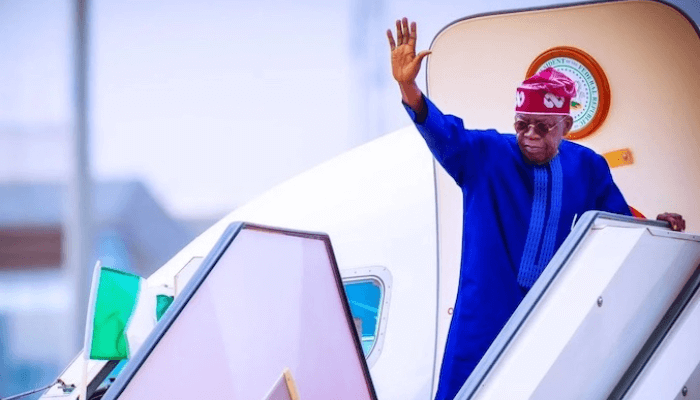 President Bola Ahmed Tinubu on Tuesday departed Abuja for a two-day state visit to the United Kingdom, in what signals a renewed diplomatic and economic push to recalibrate Nigeria’s strategic partnership with Britain.
The President left the Presidential Wing of the Nnamdi Azikiwe International Airport at approximately 10 a.m., accompanied by First Lady Oluremi Tinubu, following an official invitation from King Charles III.


Royal Diplomacy Meets Economic Strategy
At the heart of the visit is a carefully choreographed engagement at Windsor Castle, where the Nigerian leader will be hosted by King Charles III and Queen Camilla.
Beyond ceremonial optics, the visit is expected to yield concrete economic outcomes, including the signing of bilateral agreements and memoranda of understanding (MoUs) spanning:
- Trade and investment flows
- Energy transition partnerships
- Solid minerals development
- Security and intelligence cooperation
Senior government officials, including Senate President Godswill Akpabio, Chief of Staff Femi Gbajabiamila, and FCT Minister Nyesom Wike, were present at the airport to formally see off the President—underscoring the importance attached to the trip.
Repositioning Nigeria in a Post-Brexit Order
The visit comes at a pivotal moment as the United Kingdom continues to redefine its global economic relationships post-Brexit, with Africa—particularly Nigeria—emerging as a critical frontier for trade, capital flows, and geopolitical influence.
For Nigeria, the engagement represents an opportunity to reposition itself as a preferred investment destination, while also leveraging historic ties to unlock new financing and technology partnerships.
Cultural Diplomacy as Soft Power Lever
In a symbolic gesture reinforcing historical ties, the Royal Household will host the President and First Lady at a special Royal Collection exhibition, featuring artefacts linked to Nigeria.
This element of the visit reflects a broader strategy of cultural diplomacy, aimed at strengthening people-to-people relations alongside formal state engagements.
BRANDECONOMY Insight
Tinubu’s U.K. visit is not merely ceremonial—it is strategic economic diplomacy dressed in royal protocol.
1. Nigeria’s Investment Reset Narrative
Nigeria is actively seeking to rebuild investor confidence amid macroeconomic reforms, including FX liberalisation, subsidy removal, and fiscal restructuring.
A successful engagement with the U.K. could:
- Unlock institutional capital inflows
- Strengthen trade finance pipelines
- Accelerate public-private partnerships in infrastructure and energy
2. Energy Transition and Solid Minerals Play
With global capital shifting toward clean energy and critical minerals, Nigeria is positioning itself as a dual-play economy:
- Oil & gas as a transition backbone
- Solid minerals (lithium, cobalt, etc.) as future growth drivers
The U.K.’s expertise and capital could play a catalytic role in this repositioning.
3. Post-Brexit Britain’s Africa Strategy
For the U.K., Nigeria represents:
- Africa’s largest consumer market
- A gateway to West Africa
- A strategic partner in security and migration management
This President Tinubu visit aligns with Britain’s broader ambition to reassert influence in high-growth emerging markets.