
Nigeria, UAE Deepen Water and Irrigation Cooperation to Boost Food Security

 The renewed engagement between Abuja and Abu Dhabi is more than diplomatic courtesy. It speaks to Nigeria’s urgent need to modernise water infrastructure, expand irrigation, strengthen sanitation systems and unlock agriculture as a serious engine of jobs, exports and rural productivity.
 The renewed engagement between Abuja and Abu Dhabi is more than diplomatic courtesy. It speaks to Nigeria’s urgent need to modernise water infrastructure, expand irrigation, strengthen sanitation systems and unlock agriculture as a serious engine of jobs, exports and rural productivity.
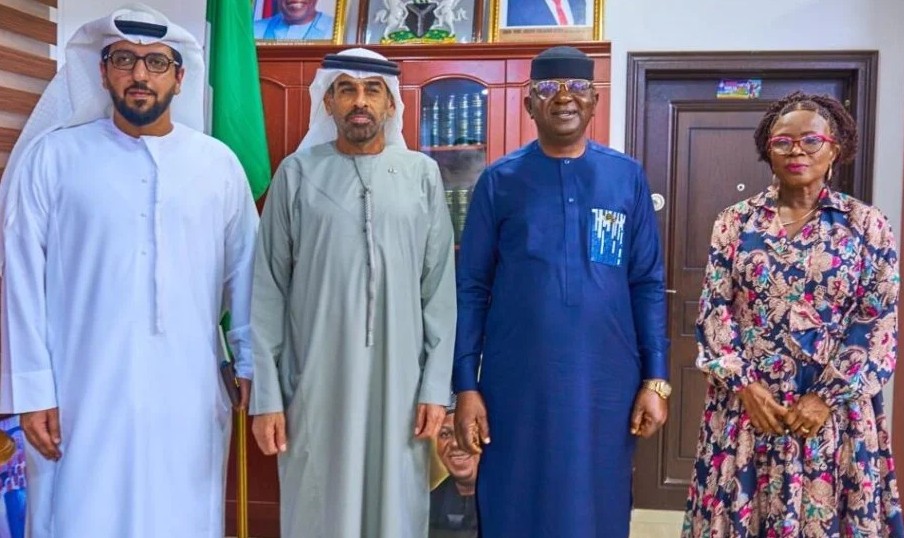
Nigeria and the United Arab Emirates have reaffirmed their commitment to stronger cooperation in water supply, sanitation and irrigated agriculture, in a move aimed at improving food security, sustainable development and economic resilience.
The Minister of Water Resources and Sanitation, Prof. Joseph Utsev, gave the assurance in Abuja when the UAE Ambassador to Nigeria, Salem AlShamsi, paid him a working visit.




Utsev said the administration of President Bola Tinubu had prioritised agriculture and water supply as strategic sectors for expanding access to safe water, strengthening food production and creating employment opportunities.
According to him, Nigeria remains committed to deepening collaboration with the UAE in water-resources development, sanitation systems and irrigation infrastructure. He said the ministry would work closely with the UAE to exchange technical expertise, explore investment opportunities and strengthen institutional cooperation.
The minister noted that such collaboration could improve sustainable water management and raise agricultural productivity at a time when Nigeria is under pressure to reduce food inflation, expand dry-season farming and make rural economies more productive.
SPIN Initiative and the Water-Energy-Food Link
Ambassador AlShamsi said the visit was intended to strengthen partnership with Nigeria on the Sustainable Power and Irrigation for Nigeria initiative and explore opportunities around ongoing water and energy projects.
The SPIN framework is significant because agriculture, water and energy are increasingly inseparable. Irrigation systems require power. Food production depends on water. Rural productivity depends on both. Without reliable water infrastructure and affordable energy, farming remains overly dependent on rainfall, leaving output vulnerable to drought, flooding, climate shocks and seasonal disruptions.
For Nigeria, the stakes are considerable. A country with vast arable land cannot achieve food security if irrigation remains limited, water systems are poorly maintained and farmers depend almost entirely on unpredictable weather patterns.
The UAE’s interest is also strategic. The Emirates has built experience in water management, desalination, irrigation technology and arid-zone agriculture. Nigeria, meanwhile, has land, population scale, food demand and agricultural potential. Properly structured, the partnership could produce a practical exchange of capital, technology, expertise and market access.
Water Diplomacy and Trade Relations
AlShamsi also invited the minister to attend a forthcoming Water Forum scheduled for December, to be jointly hosted by the UAE and Senegal.
The forum is expected to bring together global leaders, policymakers and development stakeholders to exchange ideas on improving access to water and sanitation, especially in underserved communities.
The ambassador commended President Tinubu for strengthening bilateral relations between Nigeria and the UAE, noting that improved cooperation had boosted trade between both countries.
He said the UAE had become Nigeria’s leading Arab trading partner, accounting for about 47 per cent of Nigeria’s trade with Arab nations.
That trade context matters. Water cooperation should not be viewed in isolation. It is part of a wider economic relationship involving trade, investment, logistics, aviation, finance, energy, food security and technology. If managed properly, water and irrigation could become a new pillar of Nigeria-UAE economic diplomacy.
Policy Implications: From Meetings to Measurable Projects
The policy test will be execution.
Nigeria does not lack policy conversations around agriculture, irrigation and water supply. What it has often lacked is implementation discipline, project continuity, financing clarity and maintenance culture.
For this partnership to matter, both countries must move from broad cooperation language to bankable projects. Priority areas should include irrigation schemes, rural water supply, sanitation systems, water-treatment facilities, climate-resilient dams, solar-powered irrigation, smart metering, data-driven water management and public-private partnerships.
The Federal Government must also align water policy with food-security strategy. Irrigation should not be treated as a ministry-specific project, but as a national productivity asset linked to agriculture, power, rural development, climate adaptation, nutrition and jobs.
Investor Relevance: Water Is Becoming Infrastructure Capital
For investors, water is no longer a soft development issue. It is infrastructure.
Irrigation systems, water treatment, sanitation services, wastewater reuse, solar pumping, agribusiness clusters and climate-smart farming all offer investable opportunities if supported by credible regulation and payment structures.
Development-finance institutions, private equity firms, infrastructure funds, agritech companies and equipment suppliers should pay attention to this Nigeria-UAE engagement. It could create openings in irrigation technology, water engineering, rural energy systems, project finance, farm clusters and food-processing value chains.
But investor confidence will depend on clarity: who finances, who operates, who maintains, who pays, who regulates and how returns are protected.
Brand Implications: Nigeria Must Rebrand Agriculture as Infrastructure-Led Enterprise
The partnership also has brand implications for Nigeria.
For too long, Nigerian agriculture has been presented largely as subsistence activity or political rhetoric. But modern agriculture is infrastructure-led enterprise. It requires water control, power, logistics, storage, processing, finance, insurance, technology and market access.
If Nigeria can build credible irrigation and water systems with partners such as the UAE, it can strengthen its image as an emerging agribusiness market rather than merely a food-import-dependent economy.
For the UAE, the partnership reinforces its positioning as a global convenor in water security, climate adaptation and infrastructure diplomacy.
For both countries, the opportunity is shared prosperity. Nigeria needs productivity; the UAE needs strategic partnerships in food, energy and water security. The relationship can work if it is practical, commercial and measurable.
BRANDECONOMY Insight
Nigeria’s Food-Security Future Will Be Won or Lost on Water
Nigeria’s renewed cooperation with the UAE on water resources and irrigation should be taken seriously because food security is ultimately a water question.
Rain-fed agriculture cannot carry a country of Nigeria’s size and ambition. It leaves farmers exposed to climate shocks, limits dry-season cultivation, depresses yields and keeps food prices vulnerable to seasonal scarcity.
If Nigeria wants to reduce food inflation sustainably, it must invest in irrigation, water storage, rural power, sanitation and climate-resilient agriculture. Monetary policy cannot irrigate farms. Import waivers cannot replace productive water systems. Emergency food interventions cannot substitute for structural agricultural infrastructure.
The UAE partnership offers an opportunity to bring technology, financing discipline and water-management expertise into Nigeria’s agricultural transformation agenda. But Nigeria must avoid the familiar trap of ceremonial diplomacy without project delivery.
The focus should now be clear: identify priority irrigation corridors, structure investable projects, involve state governments, mobilise private capital, integrate solar power, support smallholder farmers and build maintenance systems from day one.
Water is no longer just a social service. It is economic infrastructure. It is food security. It is public health. It is climate resilience. It is rural employment.
Nigeria’s agricultural future will not be determined only by the size of its land. It will be determined by how intelligently it manages water.