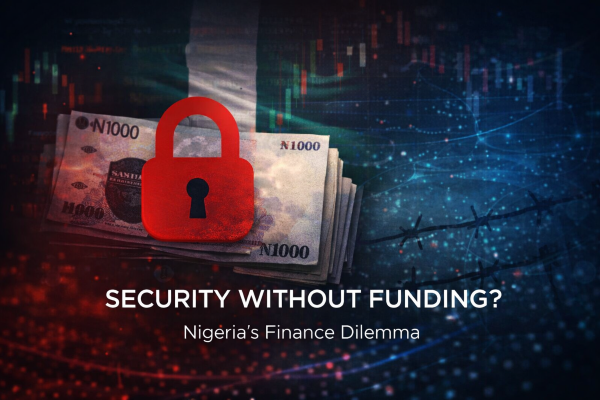
 At a time when Nigeria faces multi-dimensional security threats — terrorism, banditry, cyber warfare, arms proliferation, and cross-border criminality — a fundamental contradiction sits at the heart of national security policy: the country continues to finance its intelligence architecture through an “envelope budgeting” system widely criticised for being disconnected from operational realities.
This tension came sharply into focus during the Senate’s examination of allocations to the intelligence community for the 2026 fiscal year. What emerged was not merely a debate over numbers, but a structural fault line in Nigeria’s public finance architecture — one that could determine whether security reform succeeds or stalls.




In national security, timing is not administrative — it is existential.
Context: Envelope Budgeting and the Security Financing Model
Envelope budgeting refers to a system where spending ceilings are predetermined, often based on historical allocations rather than strategic needs assessments. In theory, it promotes fiscal discipline. In practice — especially within the security sector — it risks underfunding critical capabilities in an evolving threat landscape.
Nigeria’s security ecosystem — anchored by the Office of the National Security Adviser (ONSA) and its specialised centres including the National Counter Terrorism Centre, National Cyber Security Coordination Centre, and National Centre for Control of Small Arms and Light Weapons — operates in an environment of asymmetric warfare and technology-driven threats.
The challenge is straightforward:
Threats are dynamic.
Budgets are static.
This structural mismatch is now drawing legislative scrutiny.
Core Analysis: The Security Funding Dilemma
1. The Cost of Partial Releases
Senators expressed concern over the non-release or partial release of capital allocations in recent fiscal years. Capital expenditure in the security sector typically funds:
- Surveillance and reconnaissance systems
- Intelligence-gathering platforms
- Cyber defence architecture
- Tactical mobility equipment
- Arms control and monitoring systems
When capital releases are delayed or withheld, procurement cycles stall. Modernisation slows. Operational readiness weakens.
Security infrastructure cannot be built through intermittent funding.
2. Envelope Budgeting vs. Needs-Based Funding
Sen. Yahaya Abdullahi, Chairman of the Senate Committee on National Security and Intelligence, described the envelope system as inappropriate for agencies confronting escalating threats.
The central issue is not simply the amount allocated — it is the methodology.
Needs-based budgeting in security environments requires:
- Threat modelling
- Capability gap analysis
- Risk-adjusted funding projections
- Scenario planning
Envelope budgeting rarely accommodates these variables.
For a country declared to be under a “national emergency on security,” the budgeting architecture must reflect urgency, not routine.
3. Irregular Overhead Releases and Operational Constraints
Beyond capital funding, irregular overhead releases compound the problem. Overhead financing supports:
- Intelligence logistics
- Personnel mobility
- Field operations
- Inter-agency coordination
- Emergency deployments
Irregularity in these flows creates operational unpredictability — the antithesis of effective intelligence work.
4. The Supplementary Budget Option
The Permanent Secretary, Special Services at ONSA, Mohammed Sanusi, called for supplementary funding to close operational gaps.
This signals a deeper fiscal reality:
Annual appropriations may no longer be sufficient for Nigeria’s evolving security architecture.
Supplementary mechanisms may become structural rather than exceptional.
The Fiscal–Security Trade-Off
Nigeria’s 2026 budget faces competing pressures:
- Debt servicing obligations
- Infrastructure financing
- Social spending
- Energy transition commitments
Security funding now competes within a tight fiscal envelope — even as threats expand.
The paradox is clear:
Without security, economic growth stalls.
Without growth, security funding shrinks.
This circular dependency requires strategic recalibration.
Implications for Business, Markets and Policy
1. Investor Confidence
Capital markets price political and security risk aggressively. Underfunded security institutions elevate:
- Sovereign risk premiums
- Insurance costs
- Logistics costs
- Foreign direct investment hesitation
Security is not a line item. It is a macroeconomic variable.
2. Defence Procurement and Local Content
If properly structured, security capital expenditure can stimulate domestic manufacturing, cybersecurity firms, defence technology startups, and logistics infrastructure — aligning with Nigeria’s broader industrialisation goals.
However, delayed capital releases undermine this multiplier effect.
3. Governance Credibility
A declared security emergency without commensurate funding architecture weakens policy credibility. Markets observe not rhetoric, but execution.
Forward Outlook: Three Possible Scenarios
Scenario 1: Structural Reform of Security Budgeting
Nigeria transitions from envelope budgeting to strategic, needs-driven multi-year security planning.
Impact: Strong institutional resilience and improved operational capability.
Scenario 2: Incremental Adjustments
Supplementary budgets fill gaps without structural reform.
Impact: Tactical stability, strategic fragility.
Scenario 3: Status Quo Persistence
Irregular releases and envelope ceilings continue.
Impact: Operational erosion and rising economic cost of insecurity.
Strategic Conclusion
Nigeria stands at a fiscal inflection point.
Security is no longer a conventional line item within the national budget. It is the foundation upon which economic reform, industrial expansion, digital growth and capital inflows depend.
A modern state cannot confront 21st-century threats with 20th-century budgeting models.
The Senate’s intervention signals a recognition that funding architecture must evolve alongside threat architecture.
The question now is whether reform will be tactical — or transformational.