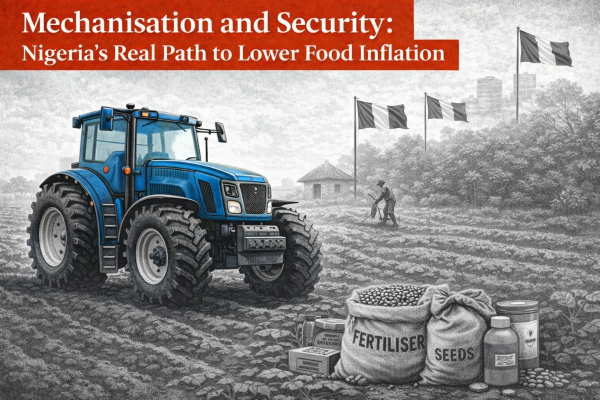
Nigeria’s battle with food inflation is not a mystery of economics; it is a problem of execution. The fastest route to higher food output, lower prices, and sustainable inflation control lies in two decisive interventions: large-scale farm mechanisation and secured agrarian communities.
This is the core argument emerging from policy economists and agribusiness leaders assessing Nigeria’s food economy as the country navigates post-reform stabilisation.




Why Mechanisation Is Nigeria’s Fastest Food Multiplier
According to Institute of Professional Economists and Policy Management, expanding Nigeria’s food supply does not begin with new farmland—it starts with mechanising what already exists.
Deploying tractors and shared mechanised equipment to farming settlements would immediately:
- Expand cultivated acreage
- Reduce planting and harvesting cycles
- Improve yields per hectare
- Lower unit production costs
In an economy where food inflation has been a dominant driver of household hardship, mechanisation represents the shortest path to supply-side relief.
Nigeria’s current farming structure remains overwhelmingly manual. As a result, output growth lags population growth, making food prices structurally inflationary. Mechanisation changes that equation quickly—without waiting years for land reforms or new settlement schemes.
Security: The Silent Constraint on Food Supply
Even the best tractors are useless if farmers cannot access their fields.
Across Nigeria’s agrarian belts, insecurity continues to disrupt:
- Harvesting
- Storage
- Processing
- Farm-to-market logistics
The consequence is predictable: food rots on farms, supply tightens in urban markets, and prices spike.
While food prices have eased in some hinterland markets, insecurity still discourages scale farming and long-term investment. Food inflation is as much a security problem as it is an agricultural one.
Grassroots Farming Is Rising—But It Can’t Carry the System Alone
A notable shift is underway at the grassroots level. As imported food prices surge under currency pressure, Nigerians are turning inward—literally.
Urban and peri-urban households are increasingly adopting:
- Sack-bag farming
- Home-garden cultivation
- Small-scale tuber and vegetable production
One hectare can accommodate thousands of sack-bags, harvested multiple times a year. This trend reflects adaptive resilience, but it is not a substitute for industrial-scale food production.
Grassroots farming cushions demand; mechanised agriculture feeds the nation.
Currency Stability Is Helping—But Supply Must Catch Up
Improved foreign-exchange stability has restored a degree of confidence:
- Capital inflows are improving
- Dollar hoarding is easing
- Local sourcing is accelerating
But currency stability alone cannot permanently tame food inflation if domestic supply remains constrained. Without structural increases in output, price relief will be temporary.
Input Costs: The New Threat to Farming Sustainability
Private-sector participation in agriculture is rising, yet farmers now face a different squeeze: volatile and arbitrarily priced inputs.
Rising costs of:
- Fertilisers
- Agro-chemicals
- Seeds
- Energy and transport
are eroding margins and discouraging expansion. This creates a paradox: more farmers, but fewer scalable farms.
Coordination Failure Is Costing Nigeria Billions
Nigeria’s agricultural problem is no longer production alone—it is coordination.
Effective food-inflation control requires tighter alignment between:
- Agriculture
- Trade and Investment
- Infrastructure
- Export and standards agencies
Without cold storage, processing equipment, and export-ready standards, post-harvest losses continue to drain value from the system.
Inflation Is Easing—but the Base Effect Is Not the Solution
Recent data from National Bureau of Statistics show easing inflation pressures, particularly in food.
However, much of the sharp year-on-year decline reflects statistical rebasing, not a fundamental food-supply breakthrough. Month-on-month price pressures remain present, underscoring the need for real structural fixes.
The Strategic Bottom Line
Nigeria does not need food miracles. It needs:
- Tractors where farmers are
- Security where food is grown
- Cheaper inputs where production scales
- Storage, processing, and logistics where value is lost
Food inflation will not be beaten by policy statements or rebased statistics. It will be beaten in the fields, with machines, safety, and coordination.