Nigeria’s deposit insurance safety net has been formally activated as the Nigeria Deposit Insurance Corporation (NDIC) commenced insurance payments to depositors of two failed primary mortgage banks—Aso Savings and Loans Plc and Union Homes Savings and Loans Plc—following the revocation of their operating licences by the Central Bank of Nigeria (CBN).
The development provides immediate relief to thousands of depositors while reinforcing confidence in Nigeria’s banking resolution framework at a time of heightened regulatory tightening across the financial system.




How Depositors Will Be Paid
NDIC confirmed that depositors of the defunct banks are entitled to insurance payments of up to ₦2 million per depositor, in line with the statutory coverage for primary mortgage banks.
To ensure speed and transparency, the Corporation is deploying the Bank Verification Number (BVN) system as a unique identifier to trace depositors’ alternate bank accounts, into which insured sums will be credited automatically once verification is completed.
Depositors with balances above the ₦2 million insurance limit will receive the insured portion immediately, while the uninsured balances will be settled as liquidation dividends as assets are realised and debts recovered.
Liquidation and Recovery Process Underway
Following the licence revocation, NDIC was formally appointed liquidator of the two failed banks under Section 12(2) of the Banks and Other Financial Institutions Act (BOFIA) 2020.
As part of the liquidation process, the Corporation has commenced:
- Verification of depositors and creditors,
- Sale of the banks’ assets, and
- Recovery of outstanding loans owed to the defunct institutions.
NDIC has also called on debtors of the failed banks to promptly settle their obligations, stressing that loan recoveries are critical to accelerating payment of uninsured deposits and other liquidation dividends.
Claims Verification: Digital-First, With Physical Support
Depositors and creditors are required to submit their claims through NDIC’s online claims portal, completing digital verification forms with all required information.
For stakeholders who prefer physical verification, NDIC officials are available at designated branches of the closed banks within the approved verification period. Claimants are required to present proof of account ownership, valid identification, BVN details and alternate bank account information to facilitate prompt payment.
Order of Payment: Who Gets Paid and When
NDIC restated the legally prescribed hierarchy for liquidation payments:
- Depositors – fully settled first, starting with insured deposits.
- Creditors – paid after depositors are fully settled.
- Staff of the defunct banks – paid from asset realisation proceeds.
- Shareholders – paid last, subject to surplus asset recovery.
This structure reflects the core principle of Nigeria’s deposit insurance regime: protecting depositors above all other stakeholders.
Regulatory Context: Strengthening Nigeria’s Mortgage Banking Space
The revocation of the banks’ licences, according to the CBN, forms part of a broader effort to reposition the mortgage banking sub-sector, strengthen compliance and restore confidence in housing finance institutions.
For the wider banking industry, the episode underscores the growing resolve of regulators to enforce prudential standards, discipline weak institutions and protect depositors, even where intervention becomes unavoidable.
What This Means for Depositors and the System
For depositors, the immediate message is reassurance: Nigeria’s deposit insurance framework works. For the financial system, the action reinforces a tougher regulatory posture aimed at long-term stability rather than short-term forbearance.
As NDIC advances the liquidation process, the pace of asset recovery and debt settlement will determine how quickly uninsured depositors, creditors and other stakeholders are made whole.
BRANDECONOMY Insight
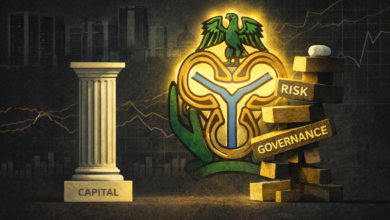
NDIC’s swift activation of insurance payments following the failure of two mortgage banks is a quiet stress test of Nigeria’s financial safety architecture—and it passed. More significantly, the episode exposes the structural fragility of the mortgage sub-sector, where weak governance and undercapitalisation continue to undermine housing finance ambitions. While depositors are protected, the deeper lesson is clear: banking stability cannot be insured into existence. Sustainable reform will depend on tougher supervision, better risk culture and the political will to let weak institutions fail—without fear or favour.