NCC–CBN Refund Rule Ends Airtime, Data Losses — A Major Win for Digital Consumers

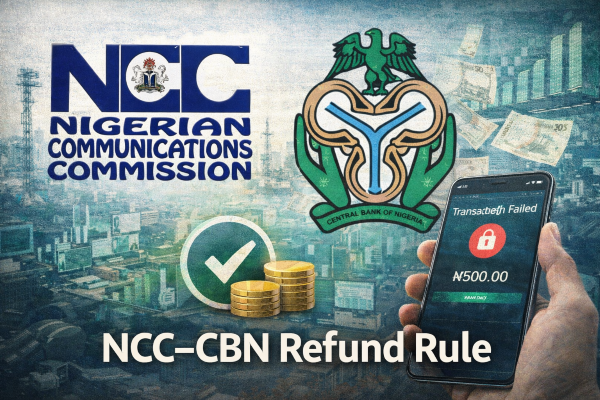
Nigeria’s telecommunications and financial regulators are moving decisively to close one of the most persistent trust gaps in the country’s digital economy: failed airtime and data transactions that debit consumers without delivering value.
In a landmark regulatory convergence, the Nigerian Communications Commission (NCC) and the Central Bank of Nigeria (CBN) have jointly developed a unified refund framework designed to guarantee near-instant restitution for unsuccessful airtime and data purchases—regardless of whether the failure occurs within banking systems or telecom networks.




The NCC’s Head of Public Affairs, Nnenna Ukoha revealed this in a statement on Thursday in Abuja.
Ukoha said that said that these failed transactions happen during network downtimes, system glitches, or human input errors.
She said that the framework was the outcome of several months of engagements involving the NCC, the CBN, Mobile Network Operators (MNOs), Value Added Service (VAS) providers, Deposit Money Banks (DMBs), and other relevant stakeholders.
“These engagements were prompted by a rising incidence of failed airtime and data purchases, where subscribers were debited without receiving value and experienced delays in resolution.
“The framework represents a unified position by both the telecommunications and financial sectors on addressing such complaints.
“It identifies and tackles the root causes of failed airtime and data transactions, including instances where bank accounts are debited without successful delivery of services,” she said
For Nigeria’s fast-expanding digital consumer base, the move represents more than a policy adjustment. It marks a structural shift toward consumer-centric digital governance, tighter accountability across platforms, and restored confidence in everyday digital payments.
Ukoha said: “We are grateful to all stakeholders, particularly the CBN and its leadership for their tireless commitment to resolving this issue and arriving at this framework,”
She also thanked the stakeholders for ensuring that consumers of telecommunications services receive full value for their purchases.
“So far, pending the approval of management of both regulators on the framework, MNOs and banks have collectively made refunds of over N10 billion to customers for failed transactions.”
She said that implementation of the framework was expected to commence on March 1, once the two regulators make final approvals, and technical integration by all MNOs, VAS providers and DMBs is concluded.
Why Failed Airtime Transactions Became a Systemic Risk
Over the past few years, failed airtime and data purchases have quietly become one of Nigeria’s most widespread consumer pain points—fuelled by:
- Network downtimes and congestion
- Bank–telco system mismatches
- Human input errors
- Ported-number routing failures
- Delayed dispute resolution across institutions
Subscribers were often debited without receiving service, then forced into prolonged complaint loops involving banks, mobile network operators (MNOs), or value-added service (VAS) providers—sometimes with no clear resolution path.
From a policy standpoint, this failure exposed a regulatory blind spot at the intersection of telecoms and financial services—two sectors increasingly fused by digital payments.
What the New NCC–CBN Framework Changes
The newly developed framework—shaped by months of cross-sector consultations involving regulators, MNOs, banks, and service providers—introduces clear, enforceable consumer protections.
Key provisions include:
1. 30-Second Refund Rule
Where a transaction fails—whether at the bank or telecom layer—the consumer is entitled to an automatic refund within 30 seconds.
Only transactions classified as pending may extend resolution timelines, and even then, refunds must be completed within 24 hours.
2. Mandatory Transaction Alerts
Consumers must receive SMS notifications confirming the success or failure of every airtime or data transaction—closing the information gap that often fuels disputes.
3. Clear Accountability Across Platforms
The framework defines who bears responsibility at every stage of the transaction chain—ending the long-standing “blame game” between banks and telecom operators.
4. Coverage of Common Consumer Errors
The policy explicitly addresses:
- Erroneous recharges to ported lines
- Purchases made to incorrect phone numbers
- Incorrect data or airtime bundles
This ensures refunds are not limited to system failures alone but also cover common real-world consumer mistakes.
A Central Monitoring Dashboard: Real-Time Oversight
Perhaps the most strategic innovation is the introduction of a Central Monitoring Dashboard, jointly hosted by the NCC and the CBN.
This platform will:
- Track failed transactions in real time
- Identify the responsible institution
- Monitor refund timelines
- Flag Service Level Agreement (SLA) breaches instantly
For regulators, this shifts enforcement from reactive complaint handling to proactive supervision, strengthening transparency across Nigeria’s digital payments ecosystem.
The Economic Signal: Trust Is Infrastructure
From a BRANDECONOMY perspective, the framework is not merely a consumer-rights intervention—it is economic infrastructure.
In a country pushing aggressively toward:
- Cashless payments
- Digital financial inclusion
- E-commerce growth
- Telecom-driven innovation
Trust becomes as critical as bandwidth or liquidity.
Already, regulators confirm that over ₦10 billion has been refunded to consumers by banks and telecom operators during preliminary reconciliation exercises—underscoring both the scale of the problem and the immediate impact of coordinated oversight.
What This Means for Telecoms, Banks, and Investors
- Telecom operators face tighter compliance expectations but gain restored consumer confidence.
- Banks benefit from clearer operational boundaries and reduced dispute friction.
- Consumers gain speed, clarity, and fairness.
- Investors see a maturing regulatory environment capable of managing complex digital ecosystems.
Implementation is expected to commence March 1, following final regulatory approvals and technical integration by all participating institutions.
BRANDECONOMY Insight
This NCC–CBN refund framework signals a quiet but profound shift in Nigeria’s digital economy: regulators are no longer operating in silos. As payments, telecoms, and digital services converge, policy coordination is becoming the new standard—not the exception.
For consumers, it restores confidence.
For businesses, it clarifies rules of engagement.
For the economy, it reinforces trust—the currency that underpins all digital growth.