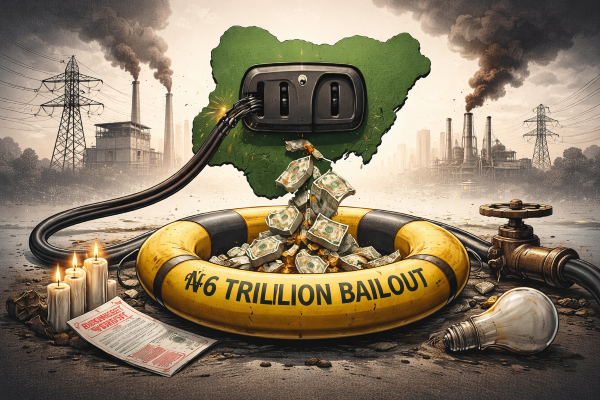
 Nigeria’s long-running electricity crisis has entered a new phase of contestation, as organised labour pushes back against yet another proposed financial intervention. The Nigeria Labour Congress has rejected a planned ₦6 trillion ₦6trn Power Sector Bailout for power generation companies, arguing that repeated injections of public funds have failed to deliver the one outcome that matters most—reliable electricity.
At stake is not just a policy decision, but a deeper question about the architecture of Nigeria’s power sector: Can a system built on structural inefficiencies be fixed with capital alone?


Why This Matters Now
Electricity sits at the core of Nigeria’s economic competitiveness. From manufacturing floors to digital startups, from small traders to heavy industry, power reliability determines productivity, cost structures, and ultimately, growth.
Yet, more than a decade after privatisation, the sector continues to struggle with:
- Chronic generation shortfalls
- Transmission bottlenecks
- Distribution inefficiencies
- Tariff tensions between cost recovery and affordability
The proposed ₦6trn Power Sector Bailout—one of the largest in recent history—was intended to stabilise generation companies weighed down by liquidity constraints. But labour leaders see it differently: not as a solution, but as a repetition of a flawed playbook.
The Core Argument: Funding vs. Structure
NLC President Joe Ajaero framed the issue bluntly: financial interventions have consistently failed to translate into improved service delivery.
The criticism rests on three structural concerns:
1. Liquidity Without Efficiency
Previous bailouts have addressed short-term cash flow problems but left operational inefficiencies untouched. Generation companies receive funds, yet consumers continue to experience outages.
2. Tariff Burden on Consumers
Despite public funding support, electricity tariffs have trended upward, effectively transferring inefficiencies to households and businesses already grappling with inflation.
3. Fragmented Energy Governance
Nigeria’s energy ecosystem remains split across multiple ministries and agencies, complicating coordination—particularly in gas supply, which underpins thermal power generation.
A Radical Proposal: Towards a Unified Energy Framework
Perhaps the most consequential element of labour’s intervention is its call to merge the Ministries of Power and Petroleum into a single Ministry of Energy.
The logic is compelling:
- Gas supply constraints are a major limiter of power generation
- Policy misalignment between sectors creates bottlenecks
- Integrated planning could optimise resource allocation
Such a move would align Nigeria with global best practice, where energy policy is treated as a single, interconnected system rather than siloed domains.
Electricity as a Public Good vs. Market Commodity
Beyond institutional reform lies a philosophical divide.
Labour insists that electricity should be treated as a social service and fundamental right, not merely a profit-driven commodity. This raises difficult but necessary questions:
- Should electricity pricing prioritise cost recovery or social welfare?
- Can private-sector-led models deliver universal access?
- What is the appropriate balance between public subsidy and market discipline?
These questions are not unique to Nigeria—but they are more urgent in an economy where energy poverty remains widespread.
Implications for Business, Markets and Policy
For Businesses
Unreliable grid power continues to impose a “self-generation tax” on firms, forcing reliance on diesel and alternative energy sources—significantly raising operating costs.
For Investors
Policy uncertainty around tariffs, subsidies, and sector reforms may dampen long-term investment appetite unless a clear, credible roadmap emerges.
For Government
The rejection of the bailout signals growing resistance to fiscal interventions that lack visible impact. It also raises pressure for deeper, system-wide reforms rather than incremental fixes.
Forward Outlook: Reform or Recurrence?
Nigeria’s power sector stands at a crossroads, with three possible trajectories:
- Incremental Fix (Status Quo)
Continued bailouts and partial reforms, with limited improvement in supply reliability. - Structural Reset (Reform Path)
Integration of energy governance, improved gas-to-power coordination, and targeted investments in transmission and distribution. - Systemic Strain (Downside Risk)
Rising costs, declining investor confidence, and worsening service delivery—triggering broader economic drag.
The difference between these paths will depend on one critical factor: political will to confront entrenched inefficiencies.
BRANDECONOMY Insight
Nigeria’s Power Crisis Is a Design Problem, Not Just a Funding Problem
The NLC’s position on the ₦6trn Power Sector Bailout underscores a fundamental truth:
Capital cannot fix a system whose incentives are misaligned.
For Nigeria to unlock reliable electricity, reform must move beyond funding to address:
- Governance fragmentation → through unified energy policy
- Market distortions → via transparent tariff frameworks
- Infrastructure gaps → especially in transmission and gas supply
- Accountability deficits → ensuring performance-linked interventions
In economic terms, electricity is not just a utility—it is a multiplier sector. Every inefficiency here reverberates across manufacturing, agriculture, services, and household welfare.
Without structural reform, each bailout risks becoming another cycle in an expensive loop of underperformance.