 Nigeria is quietly repositioning maritime security from a defensive necessity to a growth-enabling national asset. The decision by the Nigerian Maritime Administration and Safety Agency (NIMASA) to consider expanding the Deep Blue Project signals a strategic pivot: consolidate hard-won security gains in the Gulf of Guinea and convert them into durable trade, investment, and blue-economy dividends.
This is not a routine security upgrade. It is an economic strategy with regional and global implications.



Why This Matters Now
Maritime insecurity once imposed a punitive “risk tax” on Nigeria’s trade—raising insurance premiums, deterring port calls, and eroding investor confidence. The Deep Blue Project helped reverse that narrative. Expansion now matters because security gains depreciate without reinvestment, while trade volumes, vessel sophistication, and transnational threats continue to evolve.
As Nigeria seeks to scale its blue economy—ports, shipping, offshore energy, fisheries, and marine services—predictable maritime security becomes a prerequisite for capital formation. Deep Blue’s next phase is about locking in that predictability.
 Context: From Crisis Response to System Architecture
 Context: From Crisis Response to System Architecture
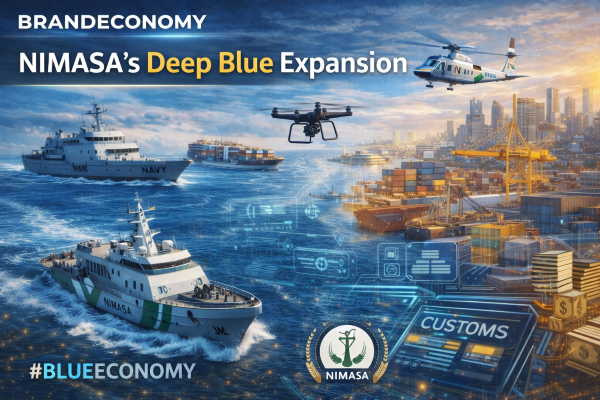
Deep Blue emerged as a multi-layered maritime security architecture—air, sea, land, and cyber—integrating surveillance, interdiction, and coordination. Its success repositioned Nigeria within the Gulf of Guinea and earned commendation from the International Maritime Organization (IMO), a rare endorsement for a civilian-led model operating at scale.
Under the leadership of Dayo Mobereola, NIMASA’s review focuses on sustainability and scalability—how to keep the system effective, interoperable, and cost-efficient as threats adapt and traffic intensifies.
Core Analysis: What Expansion Really Means
1. Security as Trade Infrastructure
Deep Blue’s expansion reframes security as infrastructure—akin to ports and channels—reducing transaction costs across shipping, insurance, and logistics. Fewer incidents translate directly into lower premiums and faster cargo flows.
2. Civil–Military Synergy That Works
Operational success has hinged on seamless collaboration with the Nigerian Navy. The engagement with Idi Abass underscores continuity: intelligence sharing, interdiction capacity, and command coordination remain central to scale.
3. A Replicable African Model
The IMO’s interest—and peer countries’ study tours—suggest Deep Blue has exportable value as a governance and capability model. Expansion strengthens Nigeria’s soft power in maritime administration across Africa.
4. Maintenance, Not Just Muscle
Next-phase priorities extend beyond assets to maintenance ecosystems: vessel repair, hydrographic surveys, charting, and wreck removal. These are essential to safety of navigation and readiness—especially as Nigeria hosts foreign naval and commercial vessels.
Implications for Business, Markets, and Policy
For shipping and insurers: Sustained security lowers risk pricing and stabilises routes—improving Nigeria’s competitiveness as a port-of-call and transhipment option.
For investors: Predictable maritime conditions de-risk offshore energy, ship repair, bunkering, and logistics investments.
For policymakers: Expansion aligns security spending with economic outcomes—supporting jobs, revenues, and regional trade leadership.
For institutions: Revisiting long-standing MoUs and formalising shared services (repairs, surveys, wreck removal) enhances value for money across agencies.
Forward Outlook: From Expansion to Endurance
The test is execution discipline. Expansion should prioritise:
- Technology refresh and lifecycle maintenance
- Inter-agency interoperability and data fusion
- Skills transfer and domestic service capacity
- Performance metrics tied to trade outcomes
If these elements are embedded, Deep Blue can evolve from a successful intervention into enduring national infrastructure—one that compounds returns as trade scales.
BRANDECONOMY INSIGHT
Deep Blue’s real achievement is not the suppression of piracy; it is the conversion of security into economic certainty. Markets reward certainty. Capital follows it. Countries that treat maritime security as infrastructure—not episodic enforcement—win trade share over time.
Nigeria’s opportunity now is to institutionalise what worked: civilian leadership with military synergy, technology with governance, and security with commerce. Expansion, done right, transforms Deep Blue from a project into a platform—one capable of underwriting Nigeria’s blue-economy ambitions for the next decade.