FG Expands Port Modernisation Nationwide as Oyetola Drives Nigeria’s Blue Economy Transformation
Procurement processes are now underway to modernise

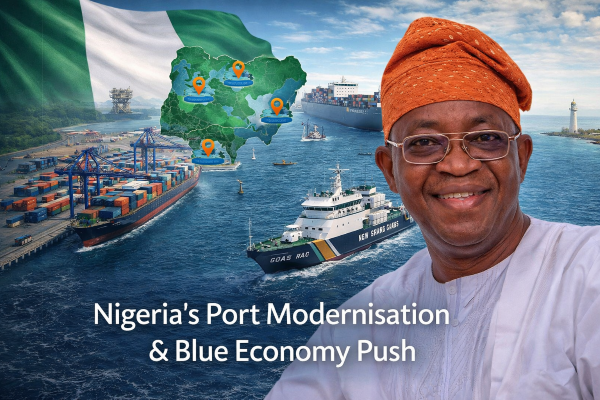 Nigeria’s maritime reform story is entering a decisive new phase—one that moves beyond Lagos and into a national port transformation agenda designed to unlock trade, deepen industrial logistics, and reposition the country within the global shipping architecture.
At a high-level stakeholders’ engagement and ministerial retreat in Lagos, Adegboyega Oyetola set out an ambitious blueprint: modernise ports nationwide, revive indigenous shipping capacity, and enforce a new regime of performance-driven governance across the marine and blue economy.


For decades, Nigeria’s port system has been overconcentrated in Lagos, with Apapa Port and Tin Can Island Port absorbing the bulk of cargo traffic—often at the cost of congestion, delays, and inefficiencies.
Oyetola’s intervention seeks to redraw that map with the port modernisation drive.
Procurement processes are now underway to modernise:
- Warri Port
- Port Harcourt Port
- Onne Port
- Calabar Port
Alongside upgrades in Lagos, the strategy is clear: decentralise capacity, rebalance cargo flows, and create a distributed logistics network.
This is not merely infrastructure renewal—it is a structural correction of Nigeria’s maritime geography.
Deep Seaports and New Economic Corridors
Beyond rehabilitation, the Federal Government is pushing into greenfield expansion.
New deep seaports have been approved in:
- Bayelsa
- Cross River
- Akwa Ibom
- Ondo
These projects are designed to:
- Handle larger vessels and reduce reliance on transshipment hubs
- Open up inland and coastal economic corridors
- Catalyse industrial clusters around port ecosystems
In effect, Nigeria is attempting what many emerging economies have struggled to achieve: align port infrastructure with long-term industrial policy.
Shipping Sovereignty: The Return of a National Carrier
A critical pillar of the strategy is the planned revival of a National Shipping Carrier—a move that speaks directly to Nigeria’s long-standing dependence on foreign shipping lines.
With interest secured from global operators such as AD Ports Group and DP World, the initiative signals a hybrid model:
- Public-private collaboration
- International technical expertise
- Local capacity development
The implications are profound:
- Retention of freight earnings within Nigeria
- Expansion of indigenous fleet capacity
- Creation of maritime jobs across the value chain
Complementing this is the long-awaited disbursement of the Cabotage Vessel Financing Fund (CVFF), aimed at unlocking capital for local shipowners.
Accountability as Policy: Performance Bonds and Institutional Reset
In a notable departure from business-as-usual governance, Oyetola introduced performance bonds for heads of maritime agencies—binding commitments tied to measurable outcomes.
Agencies including the Nigerian Ports Authority, Nigerian Maritime Administration and Safety Agency, and Nigerian Shippers’ Council are now subject to:
- Data-driven performance monitoring
- Measurable delivery benchmarks
- Enhanced transparency obligations
This reflects a broader shift toward results-based public sector management—long advocated but rarely enforced at scale.
Revenue Surge Signals Early Gains
The reform momentum is already translating into fiscal outcomes.
According to the Minister, revenues generated by agencies under the Ministry rose from ₦700.79 billion in 2023 to ₦1.83 trillion by 2025—a 160% increase.
This surge has been driven by:
- Digitalisation of port and maritime processes
- Stronger regulatory enforcement
- Improved revenue assurance systems
- Leakages reduction
For investors, this signals something deeper: institutional discipline is beginning to align with economic performance.
The Bigger Picture: Blue Economy as Growth Engine
Nigeria’s marine and blue economy—long underleveraged—is now being repositioned as a core pillar of national growth strategy.
The sector’s potential spans:
- Shipping and logistics
- Fisheries and aquaculture
- Offshore energy and marine services
- Coastal tourism and infrastructure
By integrating ports, shipping, and policy reform, the government is attempting to unlock a multi-trillion-naira economic frontier.
BRANDECONOMY Insight
1. Nigeria Is Building a Multi-Port Economy
The shift from Lagos dominance to a distributed port system could significantly reduce logistics costs and improve trade efficiency—if execution matches ambition.
2. Deep Seaports Are Strategic, Not Cosmetic
These port modernisation projects are less about prestige and more about capturing value from global shipping routes and intra-African trade flows.
3. National Carrier Revival Is an Economic Imperative
Without indigenous shipping capacity, Nigeria will continue to export value through freight payments. The new carrier could reverse this leakage.
4. Governance Reform May Be the Real Game-Changer
Performance bonds and accountability frameworks could deliver more impact than infrastructure spending—if rigorously enforced.
5. Blue Economy Is Nigeria’s Next Oil
With global trade shifting and maritime logistics expanding, Nigeria’s coastline could become a strategic economic advantage comparable to hydrocarbons.
The Bottom Line
Nigeria’s port modernisation programme is evolving into something far more consequential than a routine infrastructure upgrade.
It is a systemic reset—one that seeks to:
- Rewire logistics and trade flows
- Build indigenous shipping capacity
- Institutionalise accountability
- Unlock the blue economy as a growth frontier
If successfully executed, this strategy could reposition Nigeria not just as a regional maritime hub—but as a continental gateway for trade, investment and industrial expansion.