Port Modernisation: Customs Unveils Scanners and Real-Time Electronic Cargo Tracking in Apapa Port to Boost Trade Efficiency

A New Era for Nigeria’s Maritime Operations
In a bold stride toward full port automation and trade transparency, the Nigeria Customs Service (NCS) has launched the Electronic Cargo Tracking System (ECTS) and integrated high-capacity container scanners at the Apapa Port Complex, signalling a historic leap in Nigeria’s maritime modernisation agenda.
The dual launch positions Apapa — Nigeria’s busiest port — as the testbed for Customs’ sweeping digital reforms under Comptroller-General Bashir Adewale Adeniyi, aligning with the government’s broader drive for efficiency, national security, and global trade competitiveness.




Cargo Tracking Reimagined: Electronic Seals and Real-Time Oversight
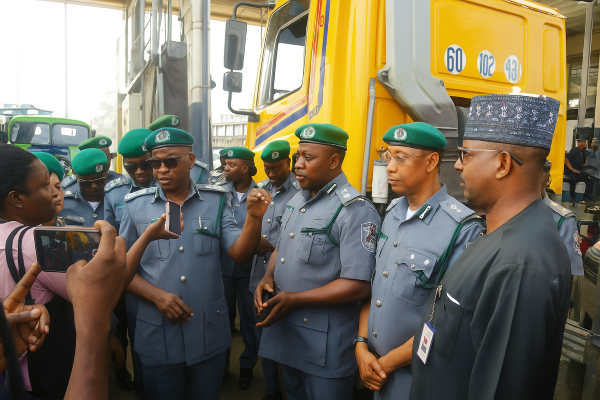
Announcing the deployment, Comptroller Emmanuel Oshoba, Customs Area Controller of Apapa Command, described the Electronic Cargo Tracking System as a transformational leap for border management and logistics security.
The ECTS enables real-time monitoring of cargoes from their points of entry to their final inland destinations — a critical step in reducing diversion, theft, and cargo tampering during transit.
“The system employs electronic seals and handheld devices to track every container from departure to destination,” Oshoba explained. “It reduces human interference, strengthens accountability, and eliminates the need for physical escorts.”
The pilot phase, which commenced on November 5, began with a container bound for the Kano/Jigawa Command, marking the first live deployment of Customs’ national digital monitoring grid.
Each shipment is now digitally tagged and tracked across Nigeria’s logistics chain, providing Customs, security agencies, and traders with end-to-end visibility in real time.
Seamless Coordination and Enforcement
Under the Apapa pilot, the tracking team comprises officers from the Rapid Response Unit (Federal Operations Unit Zone A, Ikeja) and the Apapa Command Enforcement Unit.
Deputy Comptroller Christopher Fanyam, who leads the implementation, disclosed that all personnel had undergone extensive training on the new digital protocols, adding that standard operating procedures were now fully institutionalised.
“Containers will remain sealed until they reach their final destinations and are authorised for opening,” Fanyam stated. “Our officers are equipped to operate and monitor every device efficiently — ensuring that the technology achieves its intended results.”
The ECTS aligns Nigeria with international best practices already in place in countries such as Kenya, South Africa, and Morocco, where electronic tracking has drastically reduced transit fraud and revenue leakages.
Apapa Scanners Revolutionise Port Inspection Efficiency
Complementing the ECTS rollout is the long-awaited integration of high-capacity scanners at Apapa Port, capable of processing 200 containers per hour — a major boost for Customs’ modernisation and time-release performance.
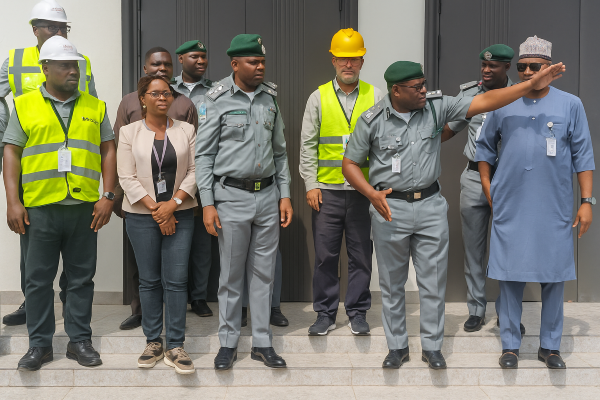
During a final test run at APM Terminals, Comptroller Oshoba confirmed that the scanners had passed all technical and operational validations, paving the way for full deployment.
“We are now ready for paperless, automated inspection,” Oshoba said. “Every scanned image will be electronically matched with the declaration data — analysed and released without physical documentation or manual interference.”
This transition marks a pivotal shift from manual cargo clearance to a fully digital, data-driven inspection process that allows instant transmission of results to Abuja’s central analysis centre via a secure cloud platform.
The system’s architecture — designed by Nuctech Company Ltd. — ensures seamless national integration and guarantees that operations continue uninterrupted even during network downtimes through local redundancy.
Security and Transparency at the Core
The new scanners are not just about speed; they are a cornerstone of national security.
Each machine’s advanced imaging and detection capabilities can identify concealed weapons, narcotics, and contraband goods — even hidden within dense cargo loads.
“With these scanners, illicit items can no longer slip through. Even a hidden pistol is visible. This technology strengthens both national security and trade facilitation,” Oshoba asserted.
Deputy Comptroller Umar Madugu, Head of the Scanning Unit, confirmed that the system is equipped with internal cameras and fault-tolerant mechanisms to ensure image accuracy and operational resilience.
The scanners, when fully operational, are projected to process up to 200 containers daily, reducing port congestion, cutting clearance times, and saving billions in demurrage and inefficiencies.
From Manual to Automated: A Trade Modernisation Milestone
The Apapa deployment integrates directly with ASYCUDA (Automated System for Customs Data), creating a unified workflow that links declaration, inspection, and release in one digital ecosystem.
This integration, Oshoba explained, eliminates paperwork, minimises physical contact, and strengthens transparency.
Data is transmitted instantly to Customs’ central image analysis workstation in Abuja, allowing analysts to verify, recommend, and release shipments without delay or manipulation.
The initiative is part of the Nigeria Customs Modernisation Project (B’Odogwu) — a multi-billion-naira reform partnership designed to fully digitise port operations, revenue collection, and trade facilitation.
Chinedu Bamidele, Stakeholder Engagement Lead for the project, emphasised the broader impact:
“Once operations go live, we expect true 24-hour cargo clearance. The biggest challenge now is resistance from those who benefit from delays.”
BRANDECONOMY ANALYSIS: Nigeria’s Ports at a Digital Crossroads
The combined rollout of the ECTS and high-capacity scanners marks a watershed moment for Nigeria’s maritime logistics, but its success will depend on institutional discipline and stakeholder alignment.
1. From Bottlenecks to Blockchain
The digitisation of port logistics could unlock efficiencies comparable to the Port of Singapore or Rotterdam, where electronic tracking and automation have reduced cargo dwell time to less than 24 hours. Nigeria’s ambition is similar — to cut bureaucracy and elevate port performance within the Gulf of Guinea corridor.
2. A Security Upgrade for Global Trade
Beyond trade facilitation, the ECTS enhances supply chain integrity — critical for restoring international confidence in Nigerian ports.
By ensuring end-to-end visibility, Customs can now protect legitimate commerce while isolating smuggling networks and revenue leakages.
3. Boosting Investor Confidence
Investors and shipping lines have long cited slow clearance times, corruption, and inconsistent processes as deterrents.
The new digital framework, if consistently implemented, could dramatically improve Nigeria’s Ease of Doing Business ranking and strengthen its appeal as a regional maritime hub.
4. Human Factor and Compliance Challenge
Automation will only deliver results if stakeholders comply. Freight agents, terminal operators, and clearing professionals must adapt to digital workflows. Resistance to change remains the single biggest obstacle to Customs’ reform momentum.
A Port Reborn: From Apapa to the World
The Apapa Command’s digital transformation is more than a pilot; it is a blueprint for the future of Nigerian trade.
With the successful deployment of ECTS and the integration of advanced scanners, Customs has set the stage for paperless, transparent, and intelligence-driven port operations.
The journey from analogue to automated is far from complete, but Apapa has shown that Nigeria’s ports can indeed function at world-class standards — once reform meets execution.