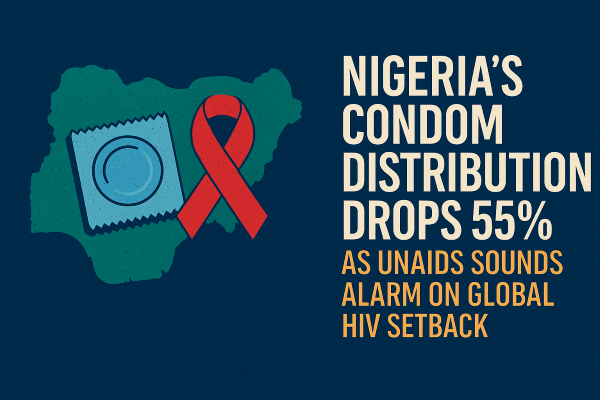
Nigeria has recorded a staggering 55% decline in condom distribution in the last year—one of the clearest indicators of a rapidly destabilising HIV-prevention landscape across Africa.
This revelation, contained in UNAIDS’ 2025 World AIDS Day report, Overcoming Disruption, Transforming the AIDS Response, signals that the global fight against HIV is facing its worst setback in decades.
With prevention services collapsing, testing disrupted, and funding evaporating, global health experts fear that the world may be sleepwalking into a new surge of infections—one that could erase years of gains made across Sub-Saharan Africa.




A Troubling Collapse in Prevention
According to UNAIDS, Nigeria’s 55% drop in condom distribution is symptomatic of a wider pattern of prevention system breakdown across dozens of countries.
Key components of HIV response infrastructure—testing, treatment initiation, community outreach—are failing simultaneously.
Across 13 countries:
- New treatment initiations have sharply declined,
- Testing and community-led interventions are disrupted, and
- Mother-to-child prevention programmes are losing critical personnel, including the 450,000 “mother mentors” who serve as vital connectors between HIV-positive women and care.
UNAIDS warns that without urgent intervention, 3.3 million additional HIV infections could occur between 2025 and 2030.
Funding Collapse: The Silent Killer
At the heart of this crisis is a dramatic fall in global health financing.
OECD projections show:
- 30–40% decline in external health assistance expected in 2025 (compared to 2023).
- The rapid withdrawal of donor support has left low- and middle-income countries dangerously exposed.
Community structures—women-led NGOs, rural outreach programmes, adolescent support networks—are crumbling:
- 60% of women-led organisations have suspended essential HIV services due to cash shortages.
- Prevention programmes dismantled by austerity measures are pushing millions of vulnerable people back into risk zones.
Young Women Remain the Most at Risk
Even before the crisis, adolescent girls and young women were disproportionately affected.
UNAIDS reports:
- 570 new infections every day among girls and women aged 15–24 in Sub-Saharan Africa.
With prevention efforts collapsing, their vulnerability is rising sharply. Schools, clinics, and community networks that once provided lifelines are shrinking or closing altogether.
A Wake-Up Call from UNAIDS
UNAIDS Executive Director Winnie Byanyima describes the situation as a “moment of truth” for world leaders.
“Behind every data point are people—babies missed for HIV screening, young women cut off from prevention support, and communities suddenly left without care. We cannot abandon them.”
Byanyima urges nations to:
- Reinforce funding commitments—especially for countries heavily reliant on external assistance,
- Invest in new technologies such as affordable long-acting HIV prevention,
- Protect human rights,
- Strengthen community-led responses, and
- Honour multilateral commitments made at the 2025 G20 Summit in South Africa.
BRANDECONOMY ANALYSIS: Nigeria at a Crossroads
The 55% dip in condom distribution is more than an alarming statistic—it is a warning flare for policymakers.
What this signals for Nigeria:
- A weakened prevention ecosystem,
- Higher long-term economic burden from rising infections,
- Strain on maternal health systems,
- Increased vulnerability for adolescents and young women,
- Heightened risk for key populations already facing stigma and limited access to care.
The path forward requires:
- Restored funding,
- Stronger community health networks,
- Scaled-up prevention technologies,
- Reinforced supply chains for condoms and HIV kits,
- Policy reforms to safeguard vulnerable groups,
- A national recommitment to HIV control.
If Nigeria and the global community fail to act urgently, the HIV resurgence could become one of the biggest public health reversals of the decade.