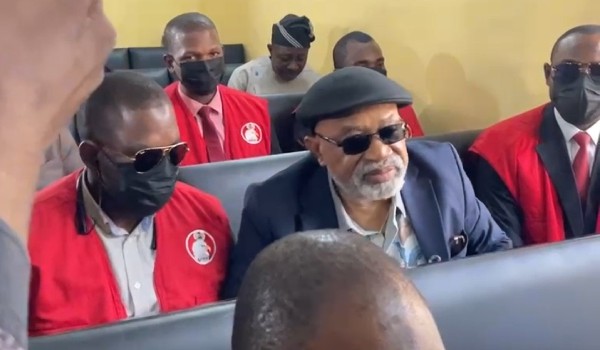
An Abuja High Court on Friday ordered the remand of former Minister of Labour and Employment, Chris Ngige, at the Kuje Correctional Centre, pending the hearing and determination of his bail application.
Ngige was arraigned by the Economic and Financial Crimes Commission (EFCC) on an eight-count charge bordering on fraud and receipt of gratification, involving an alleged ₦2.2 billion.




The former Anambra State governor, who served as Minister of Labour and Employment between 2015 and 2023, pleaded not guilty to all charges when they were read in court.
According to the EFCC, the alleged offences were committed during Ngige’s tenure as minister, particularly through the award of multiple contracts linked to the Nigeria Social Insurance Trust Fund (NSITF).
The anti-graft agency alleged that Ngige used his office to award several contracts to companies owned by associates. These include contracts worth over ₦366 million and ₦583 million awarded to Cezimo Nigeria Limited, as well as contracts exceeding ₦362 million awarded to Jeff & Xris Limited. Additional contract awards were allegedly made to Olde English Consolidated Limited and Shale Atlantic Intercontinental Services Limited, totalling over ₦800 million.
The EFCC further accused Ngige of receiving funds from contractors through an organisation linked to him, alleging payments of ₦38.6 million, ₦55 million, and ₦26 million from different companies. The offences, according to the prosecution, contravene provisions of the Corrupt Practices and Other Related Offences Act, 2000.
EFCC counsel, Sylvanus Tahir, SAN, urged the court to remand the defendant and fix a trial date. He opposed any oral bail application, noting that the defendant had not fulfilled earlier bail conditions, including the submission of his international passport.
Ngige’s counsel, Patrick Ikwueto, SAN, told the court that the defence was only informed of the arraignment a day earlier and therefore could not file a formal bail application. He sought conditional bail on health grounds and attempted an oral application for bail on self-recognition, arguing that Ngige’s international passport had been stolen and that the EFCC had been duly notified.
Justice Maryam Hassan, after listening to submissions from both parties, declined the oral bail request and ordered Ngige’s remand at the Kuje Correctional Centre. The court adjourned proceedings until Monday for the hearing and determination of the bail application.
BRANDECONOMY Insight
The remand of Chris Ngige, a former senior cabinet minister and former state governor over alleged multi-billion-naira contract fraud marks a defining moment in Nigeria’s long, uneven battle against elite corruption. Beyond the courtroom drama, this case sits at the intersection of governance credibility, institutional reform, and investor confidence—three pillars Nigeria urgently needs to stabilise.
First, the charges spotlight a persistent structural weakness in public procurement. The allegations—preferential contract awards, repeated use of the same private entities, and alleged kickbacks routed through affiliated organisations—mirror patterns that have plagued public institutions for decades. Whether ultimately proven or not, the case reinforces the urgency of end-to-end transparency in contract awards, particularly in social security and labour-related agencies meant to protect vulnerable workers.
Second, the court’s decision to remand the defendant pending bail determination underscores a subtle but important shift: status is no longer an automatic shield. In a country where high-profile suspects have often secured swift release, the optics of custodial remand—even temporarily—send a signal that judicial processes may be recalibrating toward procedural firmness rather than deference to political pedigree.
Third, this prosecution carries implications for Nigeria’s reform narrative under fiscal and governance scrutiny. As the government pushes tax reforms, subsidy rationalisation, and capital-market confidence, unresolved perceptions of selective justice could undermine public buy-in. Conversely, credible, rules-based prosecutions—handled without media sensationalism or political vendetta—could help restore faith in institutions.
Finally, there is a cautionary note. Due process must remain sacrosanct. Anti-corruption efforts gain legitimacy not from arrests alone, but from meticulous investigations, fair trials, and clear judicial outcomes. A collapse of high-profile cases on technical grounds would only reinforce cynicism.
In essence, this case is not just about one individual or ₦2.2 billion in alleged fraud. It is a stress test for Nigeria’s justice system, a mirror held up to procurement governance, and a signal to both citizens and investors about whether accountability is becoming systemic—or remains episodic.