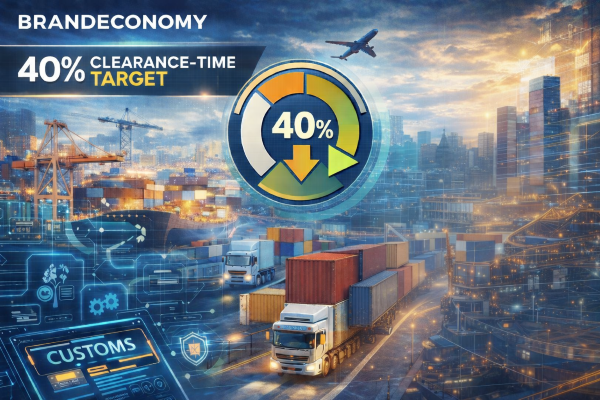
 Nigeria’s trade ecosystem is approaching a rare inflection point—one where data, leadership, and digital execution are converging to unlock real economic value. The endorsement by the Customs Consultative Committee (CCC) of the Nigeria Customs Service’s ambition to cut cargo clearance time by 40% is not an industry courtesy; it is a validation of a reform pathway with macroeconomic consequences.
At stake is nothing less than the efficiency of Nigeria’s ports, the competitiveness of its trade corridors, and trillions of naira currently lost to friction, delay, and uncertainty.




Why This Matters Now
Global trade competitiveness is increasingly measured in hours, not policy intentions. In an era of near-real-time logistics, extended clearance times translate directly into higher costs, lost investment, and weaker supply chains.
Nigeria’s ports have long been viewed as a structural bottleneck. The Time Release Study (TRS) unveiled by the Nigeria Customs Service (NCS) marks a shift from anecdotal diagnosis to evidence-based reform—quantifying where time is lost, why it is lost, and how it can be recovered.
The finding that coordinated digital integration across stakeholders could deliver up to a 40% reduction in clearance time, with potential savings estimated at ₦3 trillion in demurrage and related costs, reframes port reform as an economic stimulus lever.
Context: What TRS Really Represents
The TRS is not new globally, but its disciplined application is rare. Endorsed by the World Customs Organization, the TRS is a diagnostic instrument that measures the actual time goods spend from arrival to release, cutting through institutional defensiveness and subjective blame.
What distinguishes the current Nigerian effort is leadership intent. Under Bashir Adeniyi, the NCS has signalled that TRS will not be a one-off compliance exercise, but a continuous reform loop—measure, learn, reform, repeat.
Core Analysis: Why the 40% Target Is Credible
1. Data as Process Intelligence
As articulated by Eugene Nweke, Secretary of the CCC, the power of TRS lies in treating data as process intelligence, not institutional fault-finding. This distinction matters. It allows leadership to prioritise high-impact reforms while shielding decision-making from unsubstantiated criticism.
2. Digital Integration as the Multiplier
The TRS findings point clearly to fragmented digital systems and inter-agency disconnects as primary dwell-time drivers. Improved digital integration—rather than isolated automation—offers exponential gains by collapsing redundancies across Customs, terminal operators, shipping lines, and regulatory agencies.
3. Trade Facilitation Meets Revenue Assurance
Contrary to outdated assumptions, faster clearance does not weaken revenue. By improving predictability and reducing discretion, TRS-driven reforms strengthen voluntary compliance and expand the effective tax base—aligning trade facilitation with revenue assurance.
4. From Metrics to Management
The proposal to integrate TRS outputs into management scorecards and KPIs elevates reform from rhetoric to accountability. When clearance time becomes a monitored performance indicator, efficiency stops being optional.
Implications for Business, Markets, and Policy
For importers and exporters, a 40% reduction in clearance time directly improves cash flow, inventory turnover, and price competitiveness.
For investors, it reduces logistics risk premiums that often deter manufacturing and distribution hubs in Nigeria.
For government, it enhances non-oil revenue resilience without raising tariffs—by simply making the system work better.
For policymakers, the TRS provides defensible, verifiable evidence to guide port, trade, and infrastructure decisions—strengthening reporting to the Presidency, the Ministry of Finance, and international partners.
Forward Outlook: Execution Is the Real Test
The TRS itself is not the reform; institutional response is. Policy refinement, process simplification, automation optimisation, structured inter-agency coordination, and stakeholder compliance education are the bridge between measurement and impact.
Encouragingly, NCS has committed to institutionalising the TRS as a recurring diagnostic tool. If sustained, this could anchor Nigeria’s trade reforms in continuous learning rather than episodic intervention.
The alignment of TRS with the NCS’s broader reform architecture—including the B’Odogwu modernisation framework—suggests coherence rather than fragmentation.
BRANDECONOMY INSIGHT
The most important signal from Nigeria’s Time Release Study is not the 40% headline—it is the maturity of reform thinking. For decades, port inefficiency was debated as a moral failure; TRS reframes it as a systems problem solvable through data, coordination, and leadership.
What makes this moment different is intent. When measurement is institutionalised and leadership commits to acting on uncomfortable evidence, reform becomes inevitable. In trade economics, speed is credibility. Countries that move goods faster attract capital faster.
If Nigeria sustains this TRS-driven approach, port efficiency could quietly become one of its most effective industrial policies—unlocking value without new taxes, subsidies, or legislation.
Measurement creates clarity. Leadership turns clarity into money.