NAICOM Mandates NIN Linkage for All Insurance Policies in Nigeria

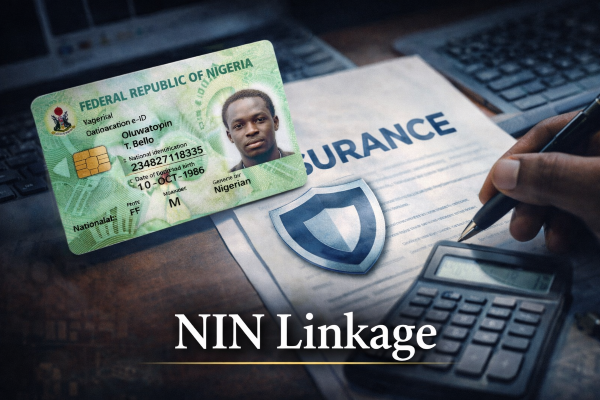 Nigeria’s insurance regulator, the National Insurance Commission (NAICOM), has made NIN Linkage mandatory by introducing a new identity verification rule requiring all insurance policies in the country to be linked to the National Identification Number (NIN).
The directive, which forms part of strengthened Know-Your-Customer (KYC) compliance standards in the insurance sector, takes effect from April 1, with a compliance deadline of April 30.



According to Olusegun Omosehin, the policy is designed to improve transparency in insurance transactions, eliminate identity fraud and strengthen regulatory oversight across the industry.
Identity Verification Becomes Mandatory
Under the new framework, every insurance policy issued in Nigeria—whether individual or corporate—must be directly linked to the policyholder’s National Identification Number.
The requirement will apply across all categories of insurance products, including:
- life insurance
- non-life insurance
- group life policies
- corporate insurance cover
For group life insurance schemes, employers will now be required to submit the NINs of all employees covered under the policy.
This measure is intended to eliminate discrepancies where organisations insure fewer employees than their actual workforce while attempting to file claims for individuals not listed in official records.
Closing Fraud Loopholes in Group Insurance
Regulators say the new system will close long-standing loopholes in the insurance ecosystem.
Historically, the absence of robust identity verification mechanisms has made it difficult for regulators to independently verify:
- the number of employees covered under corporate policies
- the authenticity of claims submitted by organisations
- the identity of policyholders in insurance databases
By integrating insurance records with Nigeria’s national identity database, regulators aim to create a more reliable verification framework.
This will enable authorities to quickly confirm whether a policyholder or beneficiary is genuinely captured under an insurance policy.
Digital Verification Platforms Under Development
NAICOM also revealed that it is building digital verification platforms that will allow other government agencies to confirm insurance compliance records.
Institutions expected to gain access to the verification system include:
- the National Pension Commission (PenCom)
- the Bureau of Public Procurement (BPP)
These agencies will be able to verify insurance certificates issued by companies and confirm the number of employees covered under mandatory policies.
The integration of databases across government institutions is expected to reduce fraudulent documentation and strengthen regulatory coordination.
Aligning With Global Compliance Standards
The directive also aligns Nigeria’s insurance industry with international compliance standards relating to:
- Anti-Money Laundering (AML) regulations
- Counter-Terrorism Financing (CTF) frameworks
- identity verification protocols for financial institutions
In recent years, banks, telecom operators and capital market institutions in Nigeria have implemented strict identity verification requirements tied to the NIN database.
The insurance industry has been among the last major financial services sectors to adopt similar compliance standards.
Strengthening Consumer Protection
Beyond fraud prevention, NAICOM says the initiative is also intended to improve consumer protection in the insurance market.
The regulator has introduced additional reforms aimed at:
- improving transparency in insurance documentation
- ensuring fair treatment of policyholders
- strengthening dispute resolution mechanisms
- accelerating claims settlement processes
These reforms form part of broader regulatory changes intended to rebuild public trust in Nigeria’s insurance industry.
BRANDECONOMY Insight
Identity Infrastructure Is Becoming the Backbone of Financial Regulation
The integration of insurance policies with Nigeria’s National Identification Number reflects a broader shift toward data-driven financial regulation.
Three structural forces are driving this NIN linkage transition:
- Digital Identity as a Regulatory Tool
National identity databases are becoming essential infrastructure for verifying financial transactions and reducing fraud. - Inter-Agency Data Integration
Regulators increasingly rely on shared digital platforms to coordinate compliance monitoring across sectors. - Consumer Trust and Market Expansion
Transparent identity verification systems improve confidence in financial services and encourage broader adoption of insurance products.
If implemented effectively, the NIN linkage requirement could significantly improve transparency within Nigeria’s insurance ecosystem and help support the industry’s long-term growth.