MSC Secures 45-Year Concession to Build Snake Island Container Terminal in Lagos
The project ends decades search for investors, boosts Nigeria’s blue economy

By Prince Adeyemi Shonibare
Nigeria’s maritime sector is set for a major transformation following a landmark agreement involving the world’s largest container shipping company, Mediterranean Shipping Company (MSC), which has secured a 45-year concession to build, manage and operate a modern container terminal at Snake Island Port in Lagos.



The project, to be developed in partnership with Nigerdock, marks one of the most significant private sector investments in Nigeria’s port infrastructure in recent decades and is expected to strengthen the country’s role as a major maritime gateway in West and Central Africa.
For Nigeria, the agreement brings to close decades of efforts to attract large-scale investors to develop Snake Island Port, a strategically located maritime asset in Lagos.
Long-standing concession history
Snake Island’s maritime facilities date back several decades. In 1992, the Federal Government granted a 99-year concession for the island’s port and industrial facilities to Nigerdock, a major maritime engineering and logistics company.
Nigerdock was later privatised and is currently operated by the Jagal Group owned by Nigerian industrialist Maher Jarmakani.
Over the years, the Island Container Terminal fell into disrepair, requiring major rehabilitation and modernization to meet modern global shipping standards.
The new partnership with MSC is expected to transform the port into a state-of-the-art container handling facility capable of attracting larger vessels and increasing Nigeria’s cargo throughput capacity.
The Buhari administration approved the project.
The investment framework for the Snake Island development was approved in May 2023 by the Federal Executive Council under then President Muhammadu Buhari.
The approval authorised total private investment of approximately $974.1 million for the project under a Public-Private Partnership structure, including the 45-year concession period.
At the same time, the Federal Government also approved two other major maritime infrastructure projects:
* Development of the Ondo Multipurpose Port in Ilaje, Ondo State, with $1.48 billion in private investment and a 50-year concession.
* Expansion and development of the Burutu Sea Port in Delta State, involving $1.2 billion in private investment and a 40-year concession.
These projects form part of Nigeria’s broader effort to develop its blue economy and expand maritime trade capacity.
Construction partners
Engineering and construction of the Snake Island container terminal will be handled by:
* ITB Nigeria Limited
* DEME Group
ITB Nigeria Limited is part of the Chagoury Group and owned by the Chagoury family, while DEME Group is a globally recognised Belgian marine engineering and dredging company with extensive experience in port construction.
MSC profile
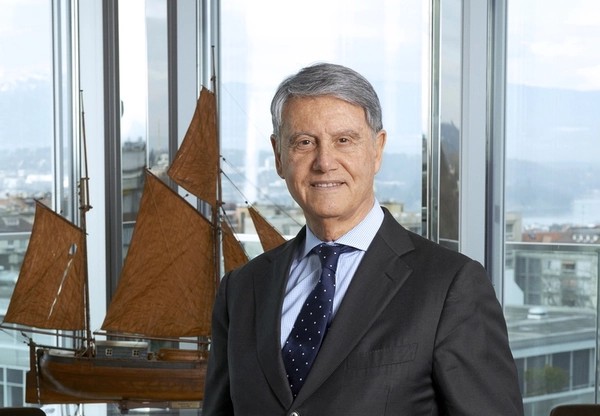
Founded in 1970 by Italian shipping entrepreneur Gianluigi Aponte and his wife Rafaela Aponte-Diamant, MSC has grown from a single cargo vessel into the largest container shipping company in the world.
Headquartered in Geneva, Switzerland, the company operates in more than 155 countries and serves over 500 ports worldwide, with a fleet of roughly 900 container ships and over 200,000 employees globally.
The MSC Group also operates major logistics and maritime businesses including inland logistics through Medlog, cruise tourism through MSC Cruises, and port terminal operations across several continents.
According to Forbes, the estimated net worth of MSC founder Gianluigi Aponte is about $43.9 billion as of February 2026, placing him among the world’s richest shipping magnates. The company remains privately owned by the Aponte family, with both founders holding equal ownership stakes.
Management comments
Speaking on the development, MSC Group President Diego Aponte said the company is committed to strengthening its operations in Nigeria and across Africa.
“We are proud to expand our presence in Nigeria through this important infrastructure project. The Snake Island terminal will enhance service delivery and improve port efficiency for our customers and partners in the region,”
Chief Executive Officer of Nigerdock, Maher Jarmakani, described the agreement as a major milestone for the Nigerian maritime sector.
“We are delighted to partner with MSC in developing a world-class container terminal that will enhance Nigeria’s logistics capabilities and support economic growth,” he said.
Economic impact
Industry analysts say the project could significantly strengthen Nigeria’s maritime economy by expanding cargo handling capacity, reducing congestion at Lagos ports and attracting additional international shipping traffic.
The development is also expected to create thousands of direct and indirect jobs across maritime operations, logistics, transport services and port-related commercial activities.
Infrastructure expansion
Beyond the port development, plans are also underway for Nigeria’s first underwater tunnel, linking Ahmadu Bello Way in Victoria Island through Snake Island and connecting the Lagos-Calabar Coastal Highway with the Sokoto-Badagry Superhighway corridor through Badagry.
The tunnel project is expected to significantly improve freight movement and road connectivity between Lagos ports and national transport networks.
Strategic milestone
With the entry of MSC into the Snake Island development, industry observers say Nigeria is taking a significant step toward modernizing its maritime infrastructure and positioning itself as a regional hub for global shipping and trade.
For a project that has waited for decades for major international investors, the Snake Island concession represents a turning point in Nigeria’s port development strategy and a strong signal of global confidence in the country’s maritime future.