Shock Crown: Morocco Awarded AFCON Title After CAF Overturns Senegal’s Final Win
CAF said Senegal, through the conduct of its team, infringed Article 82

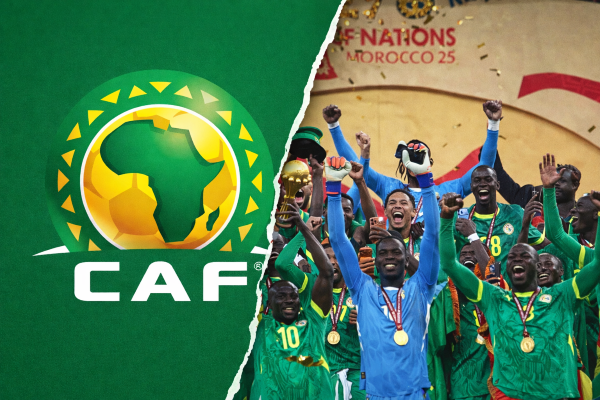
African football has been jolted by one of the most extraordinary title reversals in modern continental competition after CAF’s Appeal Board stripped Senegal of the 2025 Africa Cup of Nations crown and awarded the title to Morocco on a 3–0 forfeiture ruling. The decision overturns the result of the Rabat AFCON final and instantly transforms what had seemed a settled sporting outcome into a case study in tournament governance, regulatory enforcement and the cost of indiscipline at the highest level.
At the centre of the controversy was the chaotic AFCON final of 18 January 2026, when Senegal’s players left the field in protest after a stoppage-time penalty was awarded to Morocco following a VAR review. Play was halted for a lengthy period before Senegal eventually returned, Morocco missed the penalty, and Senegal later scored in extra time to secure what was then recorded as a 1–0 victory. That sequence of events had already triggered sanctions and fierce debate across the continent about officiating, gamesmanship and competitive integrity.




The decisive shift came on 17 March 2026, when CAF’s Appeal Board upheld Morocco’s appeal, set aside the earlier Disciplinary Board decision, and ruled that Senegal’s conduct fell within Articles 82 and 84 of the AFCON regulations. CAF said Senegal, through the conduct of its team, infringed Article 82, and that Article 84 therefore applied, meaning the final was forfeited and officially recorded as a 3–0 result in favour of the Fédération Royale Marocaine de Football.
That legal distinction matters. Article 82 treats a team that refuses to play or leaves the field before the end of regulation time without the referee’s authorisation as the loser, while Article 84 extends the consequence to forfeiture and elimination. In practical terms, CAF’s ruling sends an unmistakable message: once a team’s protest crosses from dissent into collective withdrawal, the disciplinary consequences can go beyond fines and suspensions to the rewriting of results themselves.
The ruling is all the more remarkable because CAF’s Disciplinary Board had initially stopped short of changing the result. In its January sanctions, CAF punished Senegalese and Moroccan players and officials for misconduct, fined both federations, and suspended Senegal coach Pape Bouna Thiaw, but did not award the trophy to Morocco. Morocco’s federation then escalated the matter through appeal, and the Appeal Board adopted a much harder interpretation of the regulations.
The Board’s decision also adjusted several Morocco-related sanctions from the original disciplinary process. CAF said Ismaël Saibari’s sanction was reduced to a two-match suspension, one of them suspended, while the earlier $100,000 fine against him was scrapped. The Board also reduced Morocco’s fine over the ball boys incident to $50,000, confirmed a $100,000 fine related to interference around the OFR/VAR review area, and reduced the laser-related fine to $10,000. In other words, Morocco won the trophy on appeal, but did not emerge from the final without regulatory blame of its own.
For Morocco, the outcome is historic. CAF’s ruling means the North Africans are now recognised as African champions for the second time, ending a half-century wait since their first title in 1976. For Senegal, the reversal is reputationally bruising because it turns what had been a celebrated tournament triumph into a disciplinary collapse, with long-tail consequences for coaching authority, federation governance and the team’s image as one of Africa’s model football projects.
From a football governance standpoint, this is bigger than Morocco and Senegal. CAF has effectively demonstrated that tournament administration is no longer confined to post-match fines and symbolic reprimands; it is willing, at least in this instance, to revisit the central sporting outcome itself. That raises the bar for conduct management in elite African football and increases the legal and operational importance of federation compliance teams, bench discipline and referee-protest protocols during high-stakes fixtures. This is an inference from the ruling and its broader implications rather than a quoted CAF position.
For sponsors, broadcasters and investors in African football, the episode is double-edged. On one hand, strict enforcement can strengthen credibility by showing that regulations have consequences. On the other, the spectacle of a continental title being reassigned two months after the final underlines the fragility of matchday governance and the commercial risks that flow from disorder in showcase events. In an era when African football is competing harder for global rights value, sponsorship growth and premium brand positioning, governance volatility is not a side story; it is part of the product. This is BRANDECONOMY’s assessment based on the official rulings and their commercial context.
The forward risk now lies in precedent. Federations across the continent will study this case closely because it sharpens the boundary between legitimate protest and punishable abandonment. Coaches and team managers will also have to rethink how they handle VAR flashpoints, especially in finals and knockout matches where a few minutes of emotional escalation can now carry title-level consequences. Whether this leads to more disciplined tournament behaviour or more frequent legal contestation after controversial matches will be one of the defining governance questions for CAF in the next cycle. This is forward-looking analysis grounded in the facts of the case.
BRANDECONOMY Insight
What happened in Rabat is not just a football scandal. It is a governance stress test for African sport. The surprise is not simply that Morocco have been crowned champions after losing on the pitch that night; it is that CAF ultimately decided regulatory order mattered more than the match’s resumed scoreline. That is a profound signal to African football’s ecosystem: elite tournaments are now shaped as much by rule enforcement, institutional process and behavioural control as by talent and tactics.
The wider lesson for African football business is equally sharp. If CAF wants AFCON to keep climbing as a premium global sports property, it must pair spectacle with predictable governance. Broadcasters can price drama. Sponsors can monetise passion. But investors struggle to price regulatory uncertainty when the ultimate product, the result itself, is vulnerable to reversal weeks later. The long-term winners will be federations that build not only strong squads, but strong compliance cultures.
At the opposite end of the spectrum, this AFCON Appeal Board decision can be seen as controversial and a killjoy by football fans who invest a lot of passion and resources into the game and would rather that winners are decided on the field of play rather than in boardrooms. Since there were different categories of match officials on the day of the AFCON final, fans may reason that their decision to allow the game to be concluded was final, and that any sanctions that should have been applied were limited to fines and suspensions.
Clearly, this promises to be a controversial turn in African, and indeed, world football…and may not be the last word.