Millions of Naira Traced to Accounts Linked to Abubakar Malami, Family — Witnesses Tell Court
"Millions of naira were transferred into and out of accounts..."

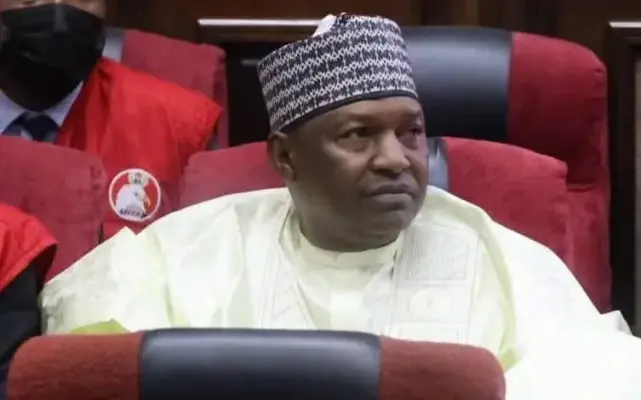 Fresh testimony at the Federal High Court in Abuja has shed light on financial transactions involving companies linked to former Attorney-General of the Federation, Abubakar Malami, his wife Hajia Asabe Malami, and their son Abdulaziz Malami.
Two prosecution witnesses on Monday told the court that millions of naira were transferred into and out of accounts associated with companies connected to the defendants.




The testimonies were presented before Justice Joyce Abdulmalik as the prosecution, led by Senior Advocate of Nigeria Jibrin Okutepa, continued to build its case.
The defendants are facing a 16-count charge of alleged money laundering involving about ₦8.7 billion, filed by the Economic and Financial Crimes Commission.
All the accused persons have pleaded not guilty to the charges.
Bank Compliance Officers Present Financial Records
The second prosecution witness, Simon Daniel Kwayil, a compliance officer with Union Bank of Nigeria, testified that his bank received a formal request from the EFCC in December 2025 seeking account statements and compliance documentation relating to an account belonging to Meethaq Hotels Limited.
According to the witness, the bank responded by forwarding the requested documents on December 23, 2025.
The documents were admitted into evidence and marked Exhibit B series, although the defence reserved its objection to their admissibility.
Kwayil told the court that Hajia Asabe Malami was the sole signatory to the Meethaq Hotels Limited account, based on the company’s board resolution.
He added that between February 2 and April 3, 2024, transfers totaling about ₦48 million were made from the account to Abubakar Malami and A.A. Malami & Co.
The witness further revealed that the account recorded over ₦99 million in inflows between December 5, 2022 and April 14, 2023.
However, during cross-examination by defence counsel Joseph Daudu (SAN), the witness stated that no funds deposited into the account came from any government agency, and he could not determine the purpose of the transactions.
Additional Financial Records Presented
A third prosecution witness, Olomotane Egoro, a compliance officer with Access Bank Plc, also testified regarding transactions involving companies linked to the defendants.
Egoro told the court that the EFCC requested documents relating to accounts belonging to Agro Allied Limited and Khadimiya for Justice and Development Initiative.
The bank submitted the documents in early 2026, and they were admitted into evidence as Exhibits C1 and C2 despite objections from the defence.
According to Egoro, Abdulaziz Malami was the sole signatory to the Agro Allied Limited account.
He also disclosed that the company obtained a ₦400 million loan from the bank in October 2020, which was later fully repaid in July 2022.
The witness further explained that parts of the loan were transferred to other companies, including New Horizon Ltd and Rayhaan Bustan.
In relation to Khadimiya for Justice and Development Initiative, Egoro said the account had three signatories — Abdulaziz Malami, Usman Abubakar and Farouk Abubakar.
He told the court that ₦77.9 million flowed into the account between October 2019 and March 2020, while total inflows reached approximately ₦1.857 billion between March 2020 and January 2025.
Under cross-examination, the witness maintained that he did not know the purpose of the transactions and confirmed that no payments into the accounts came from government agencies.
Trial Continues
Justice Abdulmalik subsequently adjourned the case until April 29 for continuation of trial proceedings.
The EFCC had earlier opened its case in March by calling its first witness, David Ajoma, a compliance officer with Sterling Bank Plc.
BRANDECONOMY Insight
The Malami case underscores three major dynamics shaping Nigeria’s anti-corruption and financial accountability landscape.
1. Banking Compliance Systems Are Becoming Central Evidence Tools
Modern corruption prosecutions increasingly rely on bank compliance officers and transaction trails rather than eyewitness testimony.
Financial institutions are now legally required to maintain detailed records of transactions, beneficial ownership and account activity, making them key sources of evidence in economic crime investigations.
2. Anti-Corruption Trials Are Becoming Data-Driven
The case reflects a growing reliance on documentary and forensic financial evidence, including account statements, transaction histories and corporate filings.
Such evidence often forms the backbone of prosecution cases in complex financial crime investigations.
3. Political Accountability and Institutional Credibility
High-profile cases involving former senior public officials inevitably attract intense scrutiny.
Beyond the EFCC investigations and the courtroom, the broader issue is how effectively Nigeria’s legal institutions handle complex financial investigations while maintaining due process and judicial independence.
For investors and international observers, the credibility of anti-corruption enforcement remains a critical factor shaping perceptions of governance and institutional stability in Africa’s largest economy.