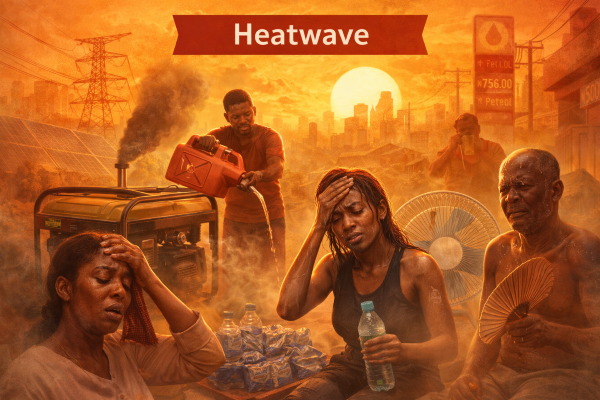
 Residents across several communities in Lagos have raised concerns over the combined impact of an intense heatwave, unstable electricity supply, and rising fuel prices, describing the situation as increasingly difficult for households and businesses.
Interviews with residents across the state indicate that soaring temperatures have made daily activities uncomfortable, while limited access to electricity has reduced the ability of many households to power fans, air-conditioners, and other cooling devices.




For many residents, the situation has forced greater reliance on petrol-powered generators, significantly increasing household expenses.
Residents Struggle to Cope with Extreme Heat
Miss Tomiwa Ajayi, a resident of Ijaye in Agege, said the heatwave had become particularly difficult to manage due to irregular electricity supply.
According to her, electricity in the area is typically available for only about eight hours daily, and often goes off during the daytime when temperatures are at their highest.
She explained that residents are increasingly relying on simple coping mechanisms such as opening windows, staying in shaded areas, and drinking large quantities of water.
Similarly, Idara Obong, who lives in Ogba, said the heat had become overwhelming and power supply remained inconsistent.
“The heatwaves are very high. Sometimes the best way to cope is to lie on the floor tiles in the afternoon to cool down,” she said, adding that residents rely heavily on hydration to prevent dehydration.
Bisola Adeyemo, a content creator living in Oke-Ira, Ogba, said the extreme weather was also affecting her skin and daily comfort.
“The heat is intense and it has affected my skin. I make sure I wear sunglasses when going out and apply sunburn cream,” she said, noting that she drinks several sachets of water daily and showers frequently to stay cool.
In Bucknor, trader Joel Ogwu described the heat as “biting the skin,” making outdoor activity difficult.
Mrs Ese Brume, a civil servant living in Lekki, said the absence of stable electricity had worsened the experience for many residents who rely on rechargeable fans and other alternatives to cope.
Rising Fuel Costs Add to the Burden
Residents also said the rising cost of petrol had made it difficult to run generators long enough to provide relief from the heat.
Samuel Igbokwe, a businessman living in Okota, said several communities had experienced severe electricity shortages in recent days.
According to him, some neighbourhoods had gone for days without power, forcing residents to endure hot nights without fans or air-conditioning.
He also noted that residents had previously protested poor electricity supply, arguing that some areas classified under premium electricity bands were not receiving the expected service levels.
In FESTAC, civil servant Gladys Okpara said poor public electricity supply had compounded the heatwave’s impact.
She explained that many residents could not afford the cost of petrol required to run generators for extended periods.
Okpara added that some households were resorting to loans to install solar energy systems, noting that installing solar panels capable of powering a two-bedroom apartment could cost up to ₦1.7 million.
Residents also reported increasing cases of heat rashes among both adults and children.
Yemisi Dada, an On-Air Personality living in Ikorodu, said the heat had become so severe that members of her household were bathing multiple times daily to cope.
She added that electricity supply often arrives at times when residents are away from home and disappears at night when cooling is most needed.
Security concerns, she said, also prevent residents from leaving windows open overnight.
Experts Link Heatwave to Climate Change and Urbanisation
Environmental experts say the current heatwave being experienced across Nigeria is linked to climate change, rapid urbanisation, and environmental degradation.
Philip Jakpor, Executive Director of the Renevlyn Development Initiative, said the situation reflects years of neglect of environmental warnings.
According to him, Nigeria’s dependence on fossil fuels and continued gas flaring contribute to rising global temperatures.
He also pointed to the disappearance of green spaces in cities.
“What we see today are government-approved constructions that have turned many urban areas into concrete environments where trees are removed faster than they are replaced,” he said.
Suleiman Arigbabu, Executive Director of the HEDA Resource Centre, said Lagos residents feel the heat more intensely because of high humidity levels.
He noted that while Lagos temperatures typically range between 27°C and 30°C, humidity levels between 70 and 80 per cent make conditions far more uncomfortable.
Arigbabu also cited rapid urban development and loss of vegetation as factors increasing heat retention in the city.
Medical experts have advised residents to stay hydrated, remain in ventilated areas, and avoid prolonged exposure to the sun, particularly between 11 a.m. and 3 p.m., when temperatures and ultraviolet radiation are highest.
BRANDECONOMY Insight
The heatwave currently affecting Lagos reveals a deeper structural issue within Nigeria’s urban economy: the intersection of climate stress, energy shortages, and urban planning deficits.
Three structural realities are emerging.
1. Lagos’ Energy Deficit Has Economic Consequences
Africa’s largest city and Nigeria’s commercial capital remains heavily dependent on private generators due to unreliable electricity supply.
This creates what economists describe as a “self-generation economy,” where households and businesses spend billions of naira annually on petrol and diesel just to maintain basic comfort and productivity.
During heatwaves, the cost becomes even higher.
2. Climate Change Is Amplifying Urban Vulnerability
Extreme heat events are becoming more frequent across West Africa.
Cities like Lagos are particularly vulnerable because rapid urbanisation has replaced natural cooling systems—trees, wetlands, and open land—with concrete infrastructure that traps heat.
This urban heat-island effect significantly increases temperature intensity.
3. Renewable Energy Is Emerging as a Household Survival Strategy
With petrol prices rising and grid electricity unreliable, many households are turning to solar power despite high upfront costs.
The growing demand for rooftop solar systems suggests that Nigeria’s energy transition may increasingly be driven from the bottom up by households and small businesses, rather than solely through large national power reforms.
For policymakers, the message is clear: climate resilience, electricity reform, and sustainable urban planning must become interlinked policy priorities.
Without these structural changes, heatwaves will continue to magnify existing economic and social vulnerabilities in Nigeria’s megacities.